How to prevent botnet attacks: prioritise network segmentation
Botnets bypass perimeter defences by using your own devices as launchpads, making internal network segmentation the only effective barrier against lateral movement.

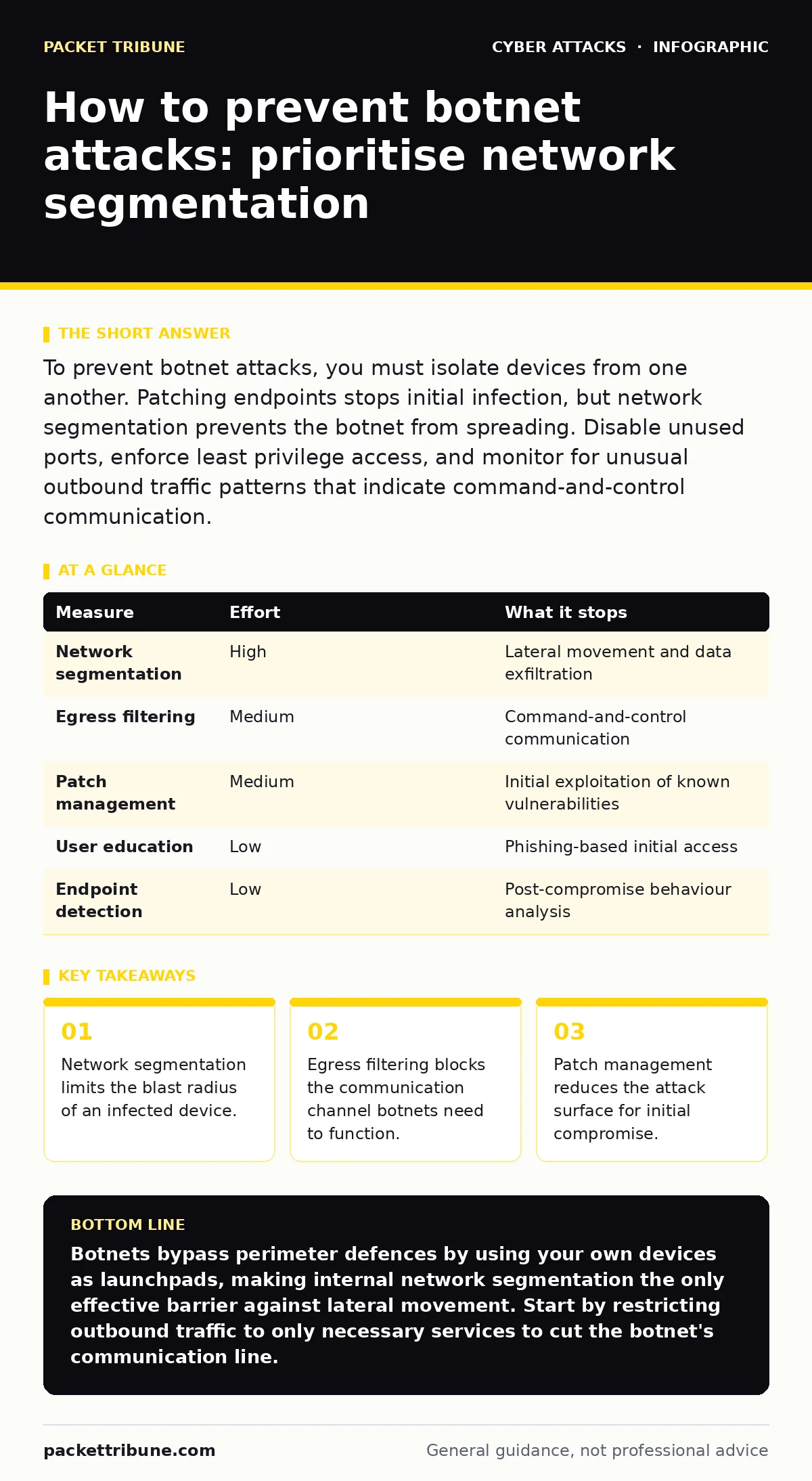
To prevent botnet attacks, you must isolate devices from one another. Patching endpoints stops initial infection, but network segmentation prevents the botnet from spreading. Disable unused ports, enforce least privilege access, and monitor for unusual outbound traffic patterns that indicate command-and-control communication.
How to prevent botnet attacks with immediate effect
Preventing botnet attacks requires shifting focus from the perimeter to the internal network structure. A botnet is a network of compromised computers controlled remotely by an attacker, often referred to as a botmaster. These devices, or bots, perform coordinated actions such as sending spam, launching denial-of-service attacks, or stealing data. The immediate priority is to stop the communication between the bot and its controller.
You cannot stop every infection, but you can stop the coordination. Botnets rely on constant dialogue with command-and-control servers. If you block this dialogue, the bot becomes useless to the attacker. This is why egress filtering is the first line of defence. Most organisations focus heavily on inbound traffic, allowing outbound connections to flow freely. This assumption fails when malware initiates the connection.
Imagine a user downloads a seemingly harmless file that contains malicious code. The malware executes and attempts to phone home. If your network allows unrestricted outbound traffic to any port, the bot joins the network. If you restrict outbound traffic to only necessary services, the bot remains isolated and ineffective. This single change removes the utility of the compromise.
Rank prevention measures by risk reduction
Not all security measures offer equal protection against botnets. Some measures are administrative overhead with little technical impact, while others fundamentally alter the attack surface. You must rank your efforts by how much risk they remove. The table below outlines the most effective measures, ranked from highest risk reduction to lowest.
| Measure | Effort | What it stops |
|---|---|---|
| Network segmentation | High | Lateral movement and data exfiltration |
| Egress filtering | Medium | Command-and-control communication |
| Patch management | Medium | Initial exploitation of known vulnerabilities |
| User education | Low | Phishing-based initial access |
| Endpoint detection | Low | Post-compromise behaviour analysis |
Network segmentation sits at the top because it physically or logically separates parts of your network. Even if a device is compromised, the attacker cannot easily reach other systems. Egress filtering follows, as it cuts the lifeline to the botmaster. Patch management prevents the initial entry but does nothing once the malware is inside. User education is the least effective on its own because human error is inevitable.
The hidden cost of relying on perimeter firewalls
A popular measure that does not work on its own is the traditional perimeter firewall. Many organisations believe that a strong firewall prevents botnet attacks. This is a misconception. Modern botnets do not always breach the firewall; they often enter through legitimate user actions, such as clicking a link or opening an attachment.
Once inside, the botnet uses the compromised device to communicate with external servers. If your firewall allows all outbound traffic, the botnet operates freely. The firewall sees the traffic as legitimate user activity. You must inspect outbound traffic, not just inbound. This requires a different mindset and more complex configuration. It also means that your internal network architecture matters more than your external defences.
Implementing effective egress filtering
Egress filtering restricts outbound network traffic to only authorised destinations and ports. This is the most technical but most effective step. You must identify which services your users and systems need to access externally. Common services include web browsing, email, and software updates. Anything else should be blocked by default.
Start by blocking all outbound traffic except for specific ports, such as 80 and 443 for web traffic. Then, refine this by blocking connections to known malicious IP addresses or domains. Use DNS filtering to prevent bots from resolving the addresses of command-and-control servers. This adds a layer of obscurity that makes it harder for the botnet to function.
You must also monitor for anomalies. A printer suddenly sending large amounts of data to an unknown server is a red flag. A workstation initiating connections to multiple foreign IP addresses is another. These patterns indicate botnet activity. Automated tools can help detect these anomalies, but you must configure them to alert on unusual outbound behaviour, not just known threats.
The role of network segmentation in containment
Network segmentation divides your network into smaller, isolated zones. Each zone has its own security policies. If a botnet infects a device in one zone, it cannot easily move to another. This containment strategy limits the damage. You should segment based on function, such as separating guest Wi-Fi from corporate devices, or separating IoT devices from critical servers.
IoT devices are particularly vulnerable to botnets. They often have weak security and are difficult to patch. By placing them on a separate network segment, you prevent them from accessing your core infrastructure. Even if an IoT device becomes a bot, it can only attack other devices in its segment, not your sensitive data.
Segmentation also simplifies monitoring. You can apply stricter rules to high-value segments and more relaxed rules to low-risk segments. This allows you to focus your resources where they matter most. It also reduces the noise in your security alerts, making it easier to spot genuine threats.
See also: Data Centre Security for Small Teams: What to Keep Internal
Patch management and vulnerability reduction
Patch management involves regularly updating software and firmware to fix security vulnerabilities. Botnets often exploit known vulnerabilities to gain initial access. If your systems are unpatched, you are inviting infection. You must prioritise patching for internet-facing devices and critical servers.
However, patching is not a silver bullet. It requires discipline and automation. Manual patching is error-prone and slow. Use automated tools to deploy patches quickly. Test patches in a non-production environment first to avoid breaking critical systems. This balance between speed and stability is key to effective patch management.
You should also consider the lifecycle of your devices. Old devices that no longer receive security updates are permanent risks. Plan to replace them before they become liabilities. This is a long-term strategy, but it reduces the overall attack surface of your organisation.
Monitoring and incident response
No prevention is perfect. You must assume that some bots will slip through. Monitoring for botnet activity is therefore essential. Look for signs of command-and-control communication, such as regular, small data packets sent to unknown servers. Also, watch for unusual outbound traffic volumes.
When you detect botnet activity, your incident response plan must include isolation. Disconnect the infected device from the network immediately. Investigate the extent of the compromise. Check other devices in the same segment for signs of infection. This rapid response limits the damage and prevents the botnet from expanding.
You should also review your logs after an incident. Identify how the botnet entered and what it did. Use this information to improve your defences. This continuous improvement cycle is vital for staying ahead of evolving threats.
Closing checklist for today
You can take three actions today to reduce your risk of botnet attacks. First, review your egress filtering rules. Ensure that outbound traffic is restricted to necessary services. Second, check your network segmentation. Verify that IoT devices and guest networks are isolated from your core infrastructure. Third, update your incident response plan to include botnet-specific procedures.
- Review and tighten egress filtering rules to block unnecessary outbound traffic.
- Verify network segmentation isolates high-risk devices from critical systems.
- Update incident response procedures to include botnet detection and containment steps.
Key takeaways
- Network segmentation limits the blast radius of an infected device.
- Egress filtering blocks the communication channel botnets need to function.
- Patch management reduces the attack surface for initial compromise.
Botnets bypass perimeter defences by using your own devices as launchpads, making internal network segmentation the only effective barrier against lateral movement. Start by restricting outbound traffic to only necessary services to cut the botnet's communication line.
Frequently asked questions
Can antivirus software prevent botnet attacks?
Antivirus can detect known botnet malware, but it cannot stop new or customised variants. It is a supplementary tool, not a primary defence.
How do I know if my network is segmented correctly?
Test your segmentation by attempting to access devices in other segments from a compromised device. If access is denied, your segmentation is effective.
What is the difference between a botnet and a worm?
A worm is a type of malware that spreads automatically. A botnet is a network of compromised devices. A worm can be used to create a botnet.
Should I block all outbound traffic?
No, this will break legitimate services. You should block all outbound traffic except for specific, authorised services and destinations.
How this guide was produced: written by the Packet Tribune editorial team with AI assistance, checked against the public references listed below, and reviewed when the facts change. See our editorial policy or report an error.