Data Centre Security for Small Teams: What to Keep Internal
Small organisations often waste budget securing hardware while leaving the software configuration and identity management exposed to trivial extraction.

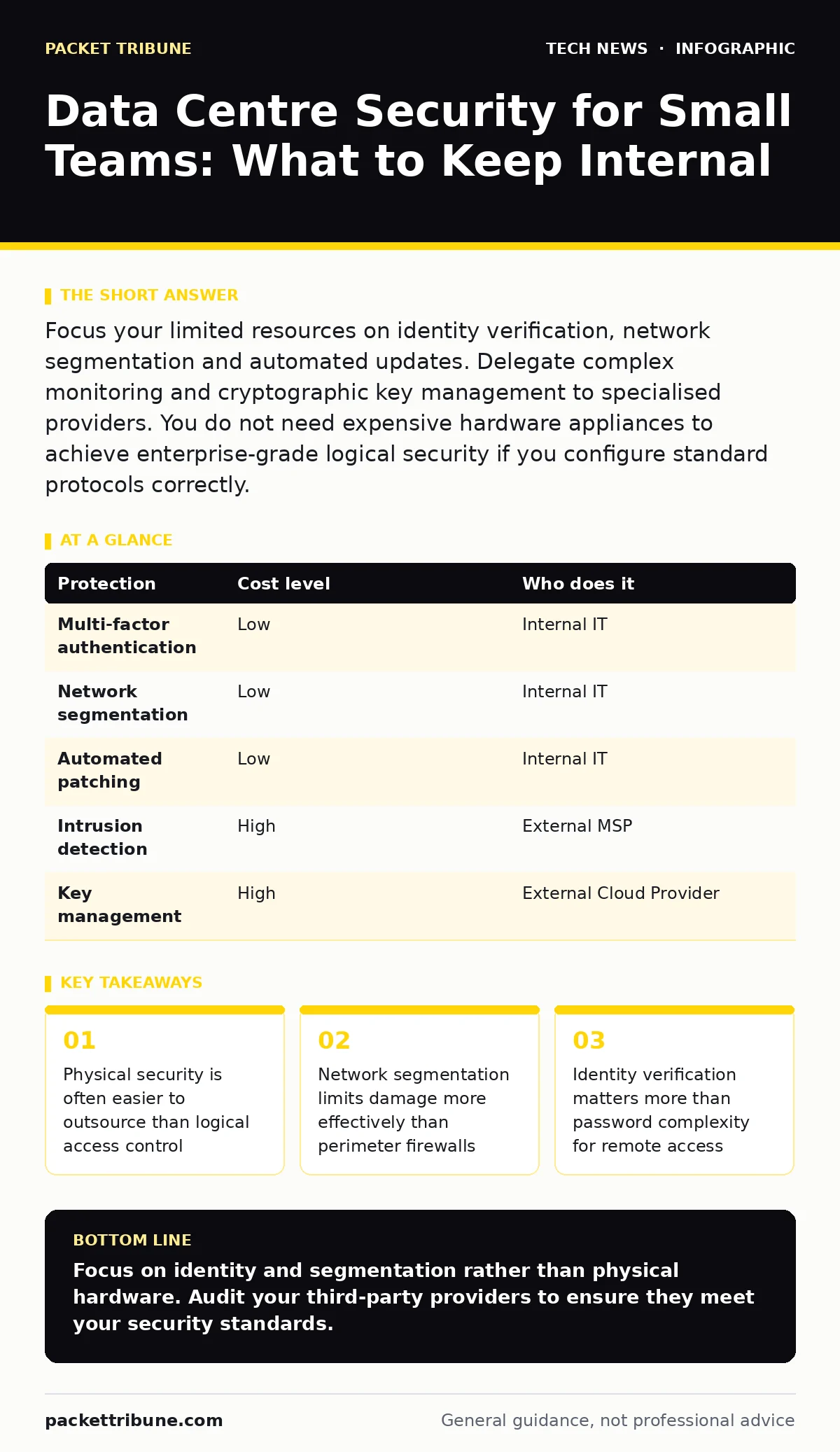
Focus your limited resources on identity verification, network segmentation and automated updates. Delegate complex monitoring and cryptographic key management to specialised providers. You do not need expensive hardware appliances to achieve enterprise-grade logical security if you configure standard protocols correctly.
The Illusion of Physical Protection
Small organisations often equate security with locks and cameras. This is a logical error. Once data leaves the building via the internet, physical barriers become irrelevant. An attacker does not need to break into your office to steal your customer database. They only need to intercept a packet or exploit a software vulnerability.
Physical security protects against theft of hardware, not theft of information. A stolen laptop is a nuisance; a compromised cloud account is a disaster. You must shift your mental model from guarding a room to guarding a session. The session is the active connection between a user and your data. Securing that session is where most small teams fail.
Identity Over Perimeter
The traditional perimeter firewall is no longer the primary defence. Users work from cafes, homes and trains. The perimeter has dissolved. Your new perimeter is the identity of the user. If you cannot prove who a person is, you cannot trust their access.
Multi-factor authentication adds a layer of proof beyond a password. It requires something you know and something you have. This stops attackers who have stolen credentials from logging in. It is cheap to implement and difficult to bypass. You should enable it for every service that allows remote access. This includes email, cloud storage and remote desktop tools.
Network Segmentation for Isolation
Imagine your network is a single room. If a thief enters, they can take everything. Now imagine the network is a series of locked offices. If a thief enters one office, they cannot reach the others. This is network segmentation. It divides your network into smaller zones.
You do not need expensive hardware to do this. Virtual local area networks allow you to separate guest Wi-Fi from corporate devices. You can isolate Internet of Things devices like smart printers from your main servers. This limits the lateral movement of an attacker. If one device is infected, the malware cannot easily jump to your financial records.
For deeper technical implementation, review our guide on network access control to understand how to enforce these boundaries at the port level.
The Hidden Cost of Updates
Software updates are not just feature improvements. They are patches for security holes. Attackers scan for known vulnerabilities in outdated software. If you run an old version of an operating system, you are advertising your weakness.
The cost of updating is time, not money. Automated update policies reduce this friction. However, automation can break things. You must test updates in a non-production environment before rolling them out. This balance between security and stability is the core challenge of IT management.
Regular software updates are the cheapest defence available. They close doors that attackers have already mapped. Neglecting them is like leaving your front door unlocked because you do not want to turn the key.
| Protection | Cost level | Who does it |
|---|---|---|
| Multi-factor authentication | Low | Internal IT |
| Network segmentation | Low | Internal IT |
| Automated patching | Low | Internal IT |
| Intrusion detection | High | External MSP |
| Key management | High | External Cloud Provider |
Delegation Strategy
You cannot do everything. Some tasks require specialised skills and 24/7 attention. Monitoring logs for suspicious activity is one such task. It requires pattern recognition and immediate response. This is expensive to do in-house.
Managed service providers can offer security information and event management services. They aggregate logs from multiple sources and alert you to anomalies. This shifts the burden of detection from your small team to a larger operation. You retain control over policy, but they handle the noise.
When choosing a provider, ask specific questions. Do not accept vague promises. You need to know exactly what they monitor and how they respond.
- What is the mean time to detect a breach?
- How do they handle false positives?
- Who has access to our logs?
- What is their incident response plan?
- How do they verify their own security?
See also: Tenant Isolation Explained: How Cloud Boundaries Prevent Data Bleed · Printer Security: Benefits, Limits and When to Invest
Cryptographic Foundations
Encryption protects data at rest and in transit. It renders stolen data unreadable without the key. You do not need to manage encryption keys yourself. Cloud providers offer managed key services. This reduces the risk of key loss or misuse.
However, you must ensure the right algorithms are in use. Older methods like RSA encryption are still common but require larger key sizes to remain secure. As computing power increases, these keys must grow. This adds overhead.
Looking ahead, post-quantum cryptography will replace current standards. Quantum computers could break today’s encryption. While this is a future threat, you should begin inventorying your cryptographic assets now. This prepares you for the transition. For web services, ensuring valid TLS certificates is the immediate priority. These certificates verify the identity of the server you are connecting to.
Practical Edge Cases
Security often fails at the edges. Printers are computers with network interfaces. They can be used as pivot points to access internal networks. Many small businesses ignore printer security. This is a mistake. Update printer firmware and disable unnecessary services.
Similarly, mobile devices are entry points. Smartphone security updates are critical. Employees often connect personal phones to corporate Wi-Fi. This bridges the gap between untrusted devices and trusted networks. Use a separate guest network for personal devices. Do not allow them to access internal resources.
For development teams, secure software development practices prevent vulnerabilities from entering your codebase. Code reviews and static analysis tools catch errors before they reach production. This is cheaper than fixing breaches later.
Key takeaways
- Physical security is often easier to outsource than logical access control
- Network segmentation limits damage more effectively than perimeter firewalls
- Identity verification matters more than password complexity for remote access
Focus on identity and segmentation rather than physical hardware. Audit your third-party providers to ensure they meet your security standards.
Frequently asked questions
Do we need a security operations centre?
No. Small teams can outsource monitoring to a managed service provider. This gives you enterprise-grade detection without the full-time staff cost.
Is cloud storage more secure than on-premise?
It depends on configuration. Cloud providers secure the infrastructure, but you secure the access. Misconfigured cloud storage is a common cause of data leaks.
How often should we review access rights?
Quarterly is a good baseline. Review who has access to what. Remove access for employees who have changed roles or left the company.
What is the biggest mistake small businesses make?
They assume default settings are secure. They fail to segment their network. This allows a single compromised device to threaten the entire organisation.
How this guide was produced: written by the Packet Tribune editorial team with AI assistance, checked against the public references listed below, and reviewed when the facts change. See our editorial policy or report an error.