Post-Quantum Cryptography: How Lattice Algorithms Replace RSA
Post-quantum cryptography relies on mathematical structures that quantum computers cannot simplify, ensuring data remains secure even when processing power scales exponentially.

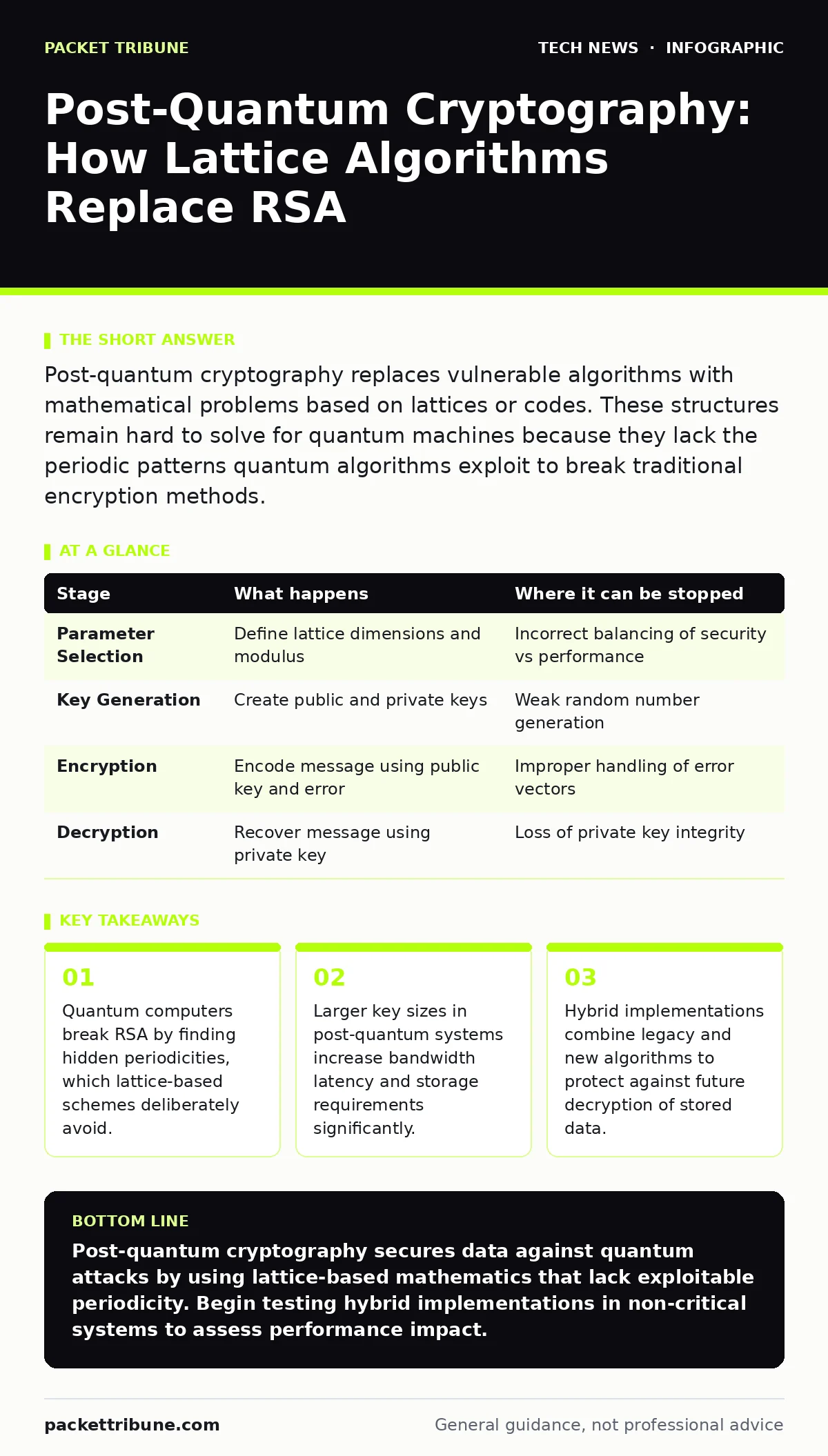
Post-quantum cryptography replaces vulnerable algorithms with mathematical problems based on lattices or codes. These structures remain hard to solve for quantum machines because they lack the periodic patterns quantum algorithms exploit to break traditional encryption methods.
The Quantum Threat Model
Traditional public-key cryptography relies on the difficulty of factoring large numbers or solving discrete logarithms. You likely use these methods daily for TLS certificates and secure messaging. Quantum computers threaten this foundation not through brute force, but through algorithmic efficiency. Shor’s algorithm allows a sufficiently powerful quantum machine to find the periodic structure within these mathematical problems. This reduces a task that would take classical supercomputers millennia to seconds.
Post-quantum cryptography (PQC) addresses this by shifting to problems that have no known efficient quantum solution. These algorithms do not rely on number theory properties that quantum Fourier transforms can exploit. Instead, they use geometric or algebraic structures that remain complex regardless of the computational model. Understanding this shift requires looking at the mechanism step by step, from key generation to verification.
The Mechanics of Lattice-Based Security
Most standardized PQC candidates rely on lattice-based cryptography. A lattice is a regular grid of points in multi-dimensional space. Imagine a grid in two dimensions where every point has integer coordinates. Now imagine this grid in 500 dimensions, rotated at a complex angle. Finding the shortest vector in this rotated grid is computationally hard. This is known as the Shortest Vector Problem (SVP).
Unlike factoring, SVP does not exhibit the periodicity that quantum algorithms need to gain an advantage. No known quantum algorithm solves SVP significantly faster than classical algorithms. This makes lattices a robust foundation for encryption. The security comes from the geometric complexity, not the size of prime numbers.
Stage 1: Parameter Selection
The process begins with choosing mathematical parameters that define the lattice structure. You select the dimension of the space and the modulus for the calculations. These parameters determine the security level and the size of the keys. Higher dimensions increase security but also increase computational overhead. You must balance these factors against your performance requirements.
If the parameters are too small, the lattice becomes easy to attack using classical sieving methods. If they are too large, the system becomes sluggish. This stage sets the baseline for all subsequent operations. It is a static configuration that rarely changes once the system is deployed.
| Stage | What happens | Where it can be stopped |
|---|---|---|
| Parameter Selection | Define lattice dimensions and modulus | Incorrect balancing of security vs performance |
| Key Generation | Create public and private keys | Weak random number generation |
| Encryption | Encode message using public key and error | Improper handling of error vectors |
| Decryption | Recover message using private key | Loss of private key integrity |
Stage 2: Key Generation
You generate a public key and a private key. The public key is a matrix derived from the lattice parameters. The private key is a short vector within that lattice. The security property ensures that knowing the public matrix does not reveal the short vector. This is a one-way function.
The generation process uses a secure random number generator. If the randomness is flawed, the resulting keys may have predictable patterns. This is a critical failure point. You must ensure your entropy source is robust. The private key must remain secret, while the public key is shared openly.
Stage 3: Encryption
To send a secure message, the sender uses the recipient’s public key. They encode the message into a vector and add a small error term. This error term is crucial. It destroys any linear structure that might allow an attacker to reverse the process. The result is a ciphertext that looks like random noise.
Without the private key, decrypting this ciphertext requires solving the SVP in the presence of noise. This is computationally infeasible. The error term ensures that even if an attacker knows the public matrix, they cannot isolate the original message. This step adds computational cost but ensures confidentiality.
Stage 4: Decryption
The recipient uses their private key to decrypt the message. They multiply the ciphertext by the private key and subtract the known error component. The result is the original message. The private key allows the recipient to navigate the lattice structure efficiently.
This process is deterministic but sensitive to errors. If the noise in the ciphertext is too large, decryption fails. This is a trade-off in lattice cryptography. Higher security requires larger noise, which increases the chance of decryption failure. You must implement retry mechanisms or error correction codes.
Limits and Trade-Offs
PQC is not a drop-in replacement for current systems. The key sizes are significantly larger. A typical lattice-based public key might be several kilobytes, compared to a few hundred bytes for RSA. This increases bandwidth usage and storage requirements.
Latency is another concern. Encryption and decryption take longer due to the complex matrix operations. This impacts real-time applications. You must test your infrastructure to ensure it can handle the increased load. Performance penalties vary by implementation and hardware.
Integration with Legacy Systems
You cannot switch to PQC overnight. Many systems still rely on older algorithms for compatibility. A hybrid approach is recommended. This involves using both traditional and post-quantum algorithms simultaneously. If one is broken, the other still provides protection.
This strategy mitigates risk during the transition period. It also allows you to test PQC implementations in production without compromising security. You should prioritize protecting long-lived data and critical infrastructure. Short-term communications may be less urgent.
Hardware and Firmware Considerations
Hardware acceleration can mitigate performance issues. Specialized chips can handle lattice operations more efficiently than general-purpose CPUs. You should evaluate hardware support before deploying PQC at scale.
Firmware updates may be necessary to support new algorithms. Devices with limited storage or processing power may struggle. Printer security and IoT devices are particularly vulnerable. You must plan for firmware upgrades or hardware replacements.
See also: Wifi router security: Stop hidden admin access from leaking data
Future-Proofing Your Infrastructure
PQC is an evolving field. Algorithms may be updated or replaced as new attacks emerge. You should design your systems to be modular. This allows you to swap out cryptographic primitives without major refactoring.
Monitor standards bodies for updates. Adopt new algorithms as they are standardized and validated. Do not rely on a single algorithm. Diversity in cryptographic methods reduces risk.
Key takeaways
- Quantum computers break RSA by finding hidden periodicities, which lattice-based schemes deliberately avoid.
- Larger key sizes in post-quantum systems increase bandwidth latency and storage requirements significantly.
- Hybrid implementations combine legacy and new algorithms to protect against future decryption of stored data.
Post-quantum cryptography secures data against quantum attacks by using lattice-based mathematics that lack exploitable periodicity. Begin testing hybrid implementations in non-critical systems to assess performance impact.
Frequently asked questions
Will post-quantum cryptography work with my existing TLS certificates?
No, you need new certificates that support post-quantum algorithms. Current TLS certificates use RSA or ECC, which are vulnerable to quantum attacks.
How much larger are post-quantum keys compared to RSA?
Post-quantum public keys can be 10 to 100 times larger than RSA keys. This increases storage and bandwidth requirements.
Can quantum computers break symmetric encryption like AES?
Quantum computers can speed up brute-force attacks on symmetric encryption, but AES-256 remains secure. You may need to double key sizes for extra margin.
Is post-quantum cryptography ready for production use?
Standardized algorithms are available and secure. However, performance and integration challenges remain. Test thoroughly before full deployment.
How this guide was produced: written by the Packet Tribune editorial team with AI assistance, checked against the public references listed below, and reviewed when the facts change. See our editorial policy or report an error.