Are digital signatures legally binding? The conditions for validity
Digital signatures gain legal standing through cryptographic proof of identity and integrity, not merely through the visual appearance of a signed document.

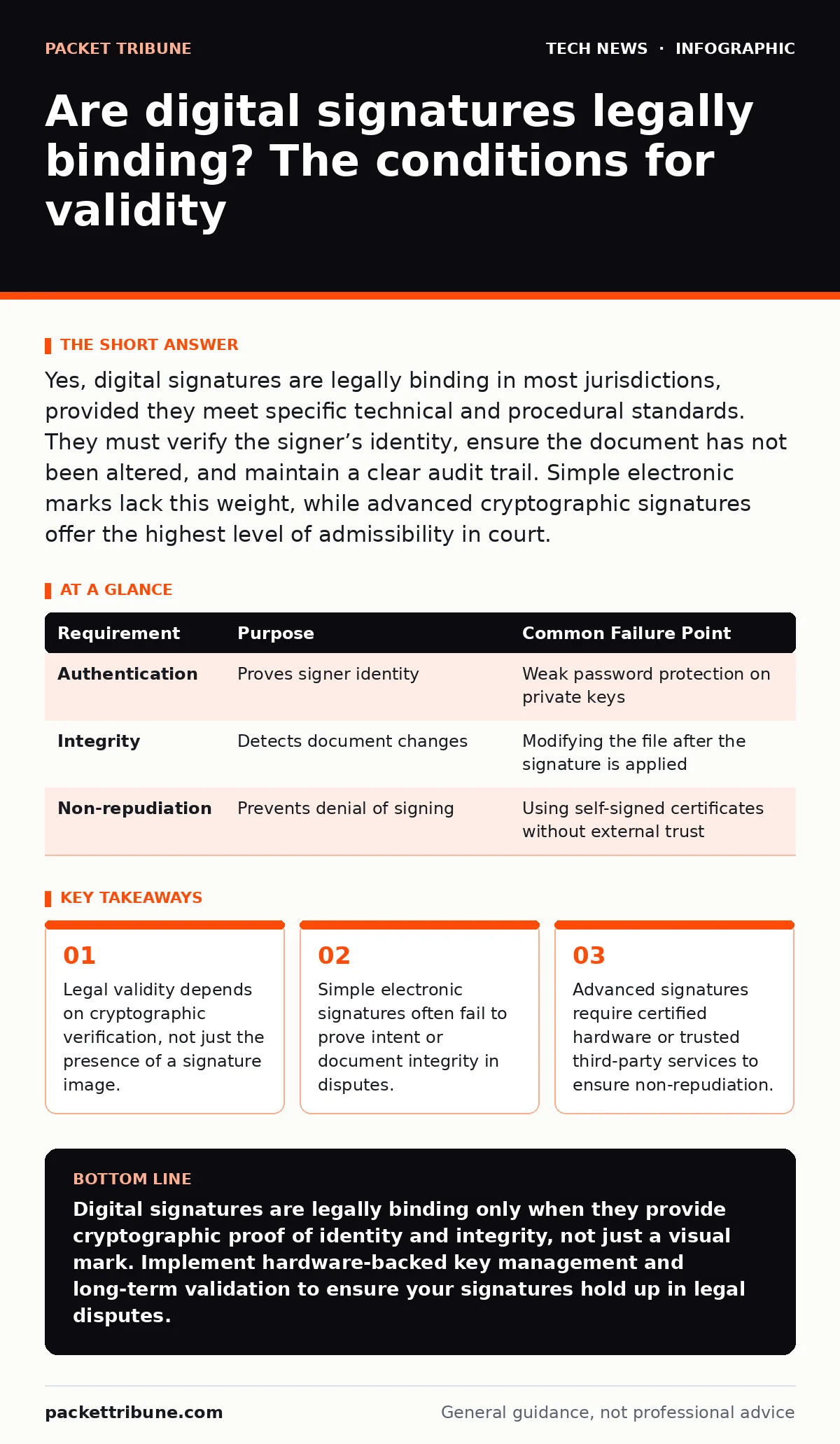
Yes, digital signatures are legally binding in most jurisdictions, provided they meet specific technical and procedural standards. They must verify the signer’s identity, ensure the document has not been altered, and maintain a clear audit trail. Simple electronic marks lack this weight, while advanced cryptographic signatures offer the highest level of admissibility in court.
Are digital signatures legally binding?
Digital signatures are legally binding when they satisfy the technical requirements of applicable laws and regulations. Most modern legal frameworks distinguish between simple electronic marks and cryptographically secured signatures. A simple image of a name pasted into a PDF does not inherently prove who applied it or whether the document changed afterwards. True digital signatures use public key infrastructure to create a unique mathematical link between the signer and the data. This link allows any party to verify the origin and integrity of the record without contacting the signer.
What distinguishes an electronic signature from a digital signature?
An electronic signature is a broad term for any electronic sound, symbol, or process attached to a contract, while a digital signature is a specific cryptographic implementation. Electronic signatures include typed names, scanned images, or click-to-agree buttons. Digital signatures involve a hash function and asymmetric cryptography to seal the document. The key difference lies in verification. You can visually inspect an electronic signature, but you must use software to verify a digital signature. This software checks the mathematical integrity of the file, ensuring that even a single character change invalidates the signature.
Which legal frameworks govern digital signature validity?
The Electronic Signatures in Global and National Commerce Act and similar international regulations provide the baseline for validity. These laws generally grant electronic signatures the same legal standing as handwritten ones, provided certain conditions are met. The conditions usually include intent to sign, consent to use electronic records, and the ability to retain the record for future reference. Some jurisdictions impose higher standards for specific document types, such as wills, real estate transfers, or court orders. Understanding these distinctions prevents the accidental use of insufficient signature methods for high-stakes transactions.
What technical requirements must a signature meet?
A valid digital signature must demonstrate signer authentication, data integrity, and non-repudiation. Signer authentication proves the identity of the person applying the signature. Data integrity ensures the document has not been modified since signing. Non-repudiation prevents the signer from denying their involvement. These requirements are typically met through a digital certificate issued by a trusted certificate authority. The certificate binds the signer’s public key to their verified identity. Without this third-party verification, a signature may be technically valid but legally fragile.
| Requirement | Purpose | Common Failure Point |
|---|---|---|
| Authentication | Proves signer identity | Weak password protection on private keys |
| Integrity | Detects document changes | Modifying the file after the signature is applied |
| Non-repudiation | Prevents denial of signing | Using self-signed certificates without external trust |
When might a digital signature be rejected in court?
A digital signature may be rejected if the signing process lacks sufficient controls or evidence. Courts often examine how the private key was protected and whether the signer had exclusive access. If multiple people share a signing key, the signature cannot prove which individual acted. Similarly, if the timestamping service is unreliable, the exact time of signing becomes disputed. These gaps allow a party to argue that the signature does not reliably reflect their intent. Proper logging and key management are necessary to close these evidentiary loopholes.
See also: RSA Encryption Misconceptions: Six Errors Undermining Your Security · Post-Quantum Cryptography: How Lattice Algorithms Replace RSA
How does key management affect legal standing?
Key management directly influences the admissibility of a digital signature in legal proceedings. The private key must remain secret and under the exclusive control of the signer. If the key is stored on a shared server or transmitted insecurely, its compromise undermines the signature’s validity. Hardware security modules provide a higher level of protection by keeping keys isolated from the operating system. This isolation makes extraction extremely difficult. For high-value contracts, using hardware-backed keys strengthens the argument that the signer acted intentionally and exclusively.
What role do certificate authorities play?
Certificate authorities act as trusted third parties that verify the identity of signers and issue digital certificates. These certificates contain the signer’s public key and identity information. When you verify a signature, your software checks the certificate against a list of trusted authorities. If the certificate is revoked or expired, the signature verification fails. This chain of trust is critical for legal validity. Without a reputable authority, there is no external validation of the signer’s identity, reducing the signature to a mere technical artifact.
How do you ensure long-term validity of signed documents?
Long-term validity requires addressing certificate expiration and algorithm obsolescence. Digital certificates have finite lifespans. Once a certificate expires, verifying software may reject the signature, even if it was valid when applied. Long-term validation formats embed the certificate and revocation status at the time of signing. This snapshot allows future verification without relying on live servers. Additionally, cryptographic algorithms weaken over time. Migrating to stronger algorithms before they become vulnerable ensures the signature remains verifiable for years.
What are the risks of using simple electronic signatures?
Simple electronic signatures carry higher legal risks in contentious disputes. They lack the cryptographic proof of integrity and identity that digital signatures provide. A party can easily claim they did not authorise a document containing a simple scanned signature. Proving otherwise requires additional evidence, such as email trails or witness testimony. For routine internal approvals, this risk may be acceptable. For external contracts, the lack of non-repudiation creates significant exposure. The convenience of simple signatures often comes at the cost of legal certainty.
How does this relate to other security controls?
Digital signatures complement other security mechanisms by providing end-to-end integrity. While code signing ensures software has not been tampered with, document signatures protect contractual agreements. Similarly, BitLocker encrypts data at rest, but it does not prove who created or modified a file. Combining encryption with digital signatures creates a robust security posture. This approach ensures that only authorised users can read the data and that any changes are detectable. Understanding these distinctions helps you apply the right control to each risk.
What steps should you take to implement valid signatures?
Implementing valid digital signatures requires a structured approach to identity and key management. First, identify the legal requirements for your specific document types. Second, select a certificate authority that issues certificates suitable for your use case. Third, enforce strict access controls on private keys, preferably using hardware security modules. Fourth, train users on the proper signing process and verification steps. Finally, establish a policy for long-term validation to ensure future accessibility. This structured approach minimises legal risk and maximises operational efficiency.
Key takeaways
- Legal validity depends on cryptographic verification, not just the presence of a signature image.
- Simple electronic signatures often fail to prove intent or document integrity in disputes.
- Advanced signatures require certified hardware or trusted third-party services to ensure non-repudiation.
Digital signatures are legally binding only when they provide cryptographic proof of identity and integrity, not just a visual mark. Implement hardware-backed key management and long-term validation to ensure your signatures hold up in legal disputes.
Frequently asked questions
Can I use a digital signature for a will?
Most jurisdictions require specific formalities for wills, such as witnesses, which digital signatures alone cannot satisfy. Check local laws before using electronic methods for estate planning documents.
Do digital signatures expire?
The cryptographic validity does not expire, but the certificate used to sign may. If the certificate expires, verification may fail unless long-term validation data was embedded at the time of signing.
Are digital signatures secure against quantum computers?
Current digital signatures rely on algorithms that quantum computers could potentially break. Post-quantum cryptography is being developed to address this future risk, but adoption is not yet universal.
How do I verify a digital signature?
Use standard PDF readers or email clients that support digital signatures. These applications automatically check the certificate chain and document integrity, displaying a clear status indicator.
How this guide was produced: written by the Packet Tribune editorial team with AI assistance, checked against the public references listed below, and reviewed when the facts change. See our editorial policy or report an error.