Is Data Scraping Legal? The Compliance Risks You Are Ignoring
Publicly visible data remains protected by intellectual property rights and computer misuse laws, meaning accessibility does not equal permission to harvest or reuse information.

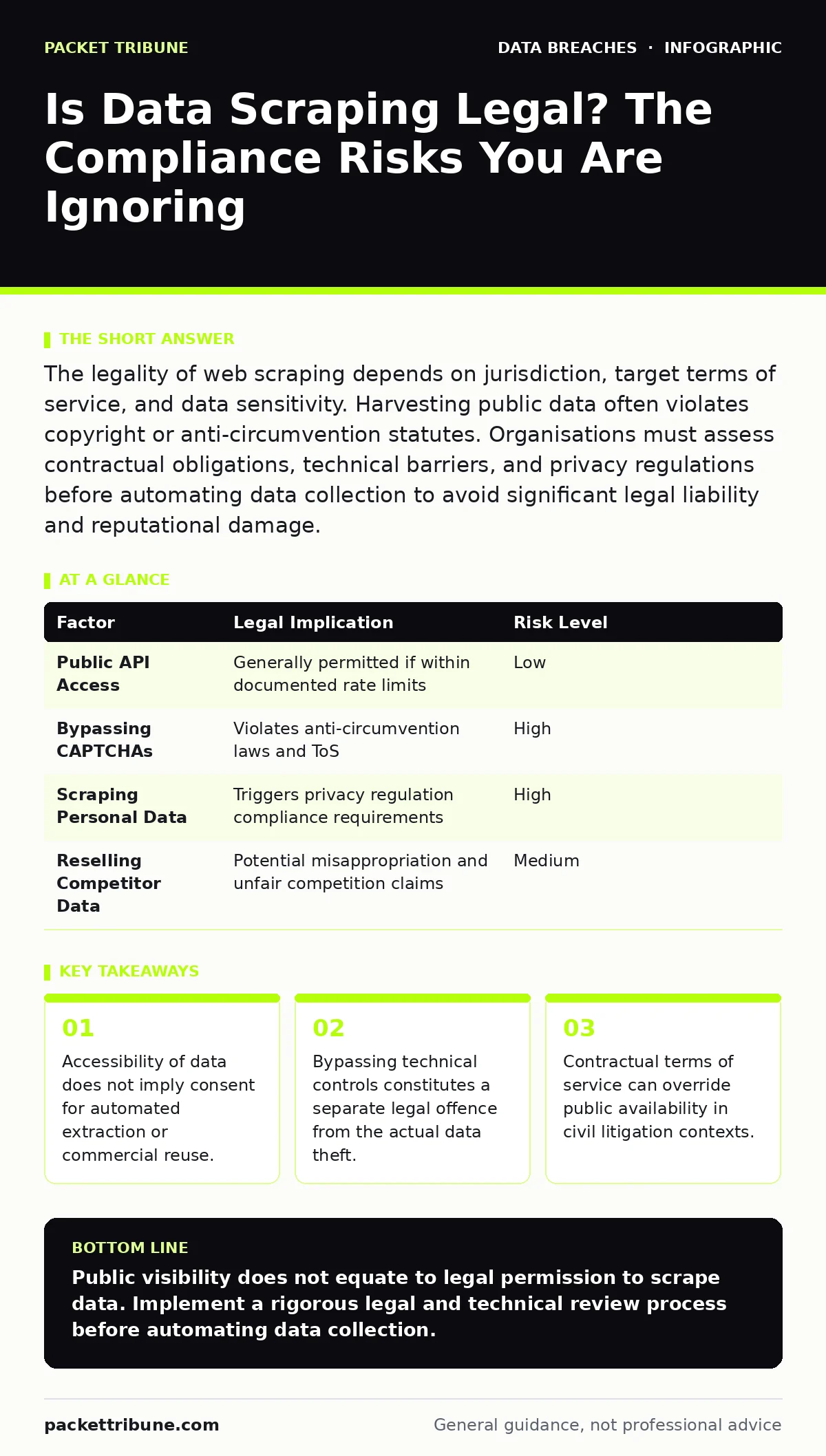
The legality of web scraping depends on jurisdiction, target terms of service, and data sensitivity. Harvesting public data often violates copyright or anti-circumvention statutes. Organisations must assess contractual obligations, technical barriers, and privacy regulations before automating data collection to avoid significant legal liability and reputational damage.
Is data scraping legal?
Data scraping operates in a complex legal grey area where no single global statute defines its legality. The act of collecting data from the internet is not inherently illegal, but the method, volume, and subsequent use of that data determine compliance. Courts examine whether the scraper respected copyright, violated computer fraud statutes, or breached contractual agreements. You cannot assume that because information is visible in a browser, you possess the right to extract it systematically. The legal framework treats the technical act of access and the intellectual property rights separately.
Does public availability grant permission to scrape?
Public availability does not grant permission to scrape data for commercial or competitive purposes. Just because a website displays information to human users does not mean the owner consents to automated bulk extraction. Copyright law protects the selection and arrangement of data, even if individual facts are not copyrightable. Database rights in certain jurisdictions protect substantial investments in obtaining and verifying data. Scrapers often ignore these protections, assuming that open access equals open permission. This assumption fails when targets pursue civil damages for misappropriation.
How do terms of service affect scraping legality?
Terms of service (ToS) create a binding contractual relationship that can prohibit scraping even on public pages. When you access a website, you implicitly agree to its ToS if they are reasonably conspicuous. Courts have ruled that violating these terms constitutes breach of contract, regardless of whether technical barriers exist. Some legal frameworks treat the circumvention of ToS as a form of unauthorised access. You must read the specific provisions regarding automated access, data mining, and redistribution. Ignoring these clauses exposes your organisation to injunctions and damages claims.
What constitutes unauthorised access under computer misuse laws?
Unauthorised access occurs when you bypass technical measures designed to restrict entry or limit data extraction. Computer misuse laws criminalise the act of accessing a computer system without permission, which includes exceeding authorised access levels. If a website employs rate limiting, IP blocking, or login walls, interacting with these controls may trigger criminal liability. The offence is the bypass, not necessarily the data taken. You must distinguish between passive viewing and active circumvention. Technical barriers signal a clear intent to restrict access, and ignoring them escalates the legal risk significantly.
How does copyright law apply to scraped data?
Copyright law protects original works of authorship, including the structure and presentation of web content. While raw facts are not copyrightable, the creative compilation of data is. Scraping that copies substantial portions of a website’s layout or text infringes these rights. Fair use doctrines provide limited exceptions for commentary, criticism, or research, but commercial scraping rarely qualifies. You must evaluate whether your use transforms the data or merely replicates it. Republishing scraped content without alteration is a direct infringement, inviting cease-and-desist orders and litigation.
| Factor | Legal Implication | Risk Level |
|---|---|---|
| Public API Access | Generally permitted if within documented rate limits | Low |
| Bypassing CAPTCHAs | Violates anti-circumvention laws and ToS | High |
| Scraping Personal Data | Triggers privacy regulation compliance requirements | High |
| Reselling Competitor Data | Potential misappropriation and unfair competition claims | Medium |
See also: Is doxxing a crime? Legal status, corporate liability and response steps
Are there privacy regulations that restrict scraping?
Privacy regulations strictly limit the scraping of personally identifiable information (PII). Laws such as the General Data Protection Regulation and the California Consumer Privacy Act require a lawful basis for processing personal data. Consent is the most reliable basis, and scraping rarely obtains valid consent from data subjects. Even if data is publicly posted, aggregating it into profiles can violate privacy expectations. You must anonymise or pseudonymise data before storage. Failure to comply results in substantial fines and mandatory audits. See our guide on identity theft protection to understand the downstream risks of mishandling PII.
What technical defences indicate legal boundaries?
Technical defences such as robots.txt files, CAPTCHAs, and rate limiting indicate where legal boundaries likely exist. While robots.txt is a technical protocol rather than a legal barrier, ignoring it demonstrates bad faith in litigation. CAPTCHAs are designed to prevent automated access; bypassing them is a clear violation of computer misuse statutes. Rate limiting protects server resources; exceeding limits can be construed as a denial-of-service attack. You should respect these signals as indicators of the owner’s intent. Disregarding them increases the likelihood of being sued for unauthorised access.
How should organisations manage scraping compliance risks?
Organisations must implement a governance framework that evaluates legal, technical, and ethical risks before scraping. This includes legal review of target ToS, assessment of copyright status, and privacy impact assessments. Technical teams should implement rate limiting and respect robots.txt directives. Data storage policies must align with retention laws and security standards. Regular audits ensure ongoing compliance as laws and technologies evolve. You should also consider the reputational damage of aggressive scraping practices. See our guide on data breaches to understand how poor data handling practices amplify liability.
What are the consequences of non-compliant scraping?
Non-compliant scraping exposes organisations to civil lawsuits, criminal charges, and regulatory fines. Civil claims may seek damages for copyright infringement, breach of contract, or misappropriation. Criminal charges can arise from computer misuse violations, particularly when technical barriers are bypassed. Regulatory bodies may impose heavy fines for privacy violations.
Reputational harm can lead to loss of customer trust and business partners. You must weigh the value of the data against these potential costs. Legal defence costs alone can exceed the value of the scraped information. See our guide on credential leaks to see how exposed data can further compound these liabilities.
Key takeaways
- Accessibility of data does not imply consent for automated extraction or commercial reuse.
- Bypassing technical controls constitutes a separate legal offence from the actual data theft.
- Contractual terms of service can override public availability in civil litigation contexts.
Public visibility does not equate to legal permission to scrape data. Implement a rigorous legal and technical review process before automating data collection.
Frequently asked questions
Can I scrape data from social media platforms?
Most social media platforms explicitly prohibit scraping in their terms of service. Violating these terms can result in account suspension and legal action for breach of contract and computer misuse.
Is scraping public government data legal?
Government data is often in the public domain, but you must check specific usage policies. Some agencies impose restrictions on automated access or require attribution. Always verify the specific jurisdiction's rules.
How do I handle robots.txt files?
Robots.txt is a voluntary standard, but ignoring it demonstrates bad faith. Respect these files to maintain ethical standards and reduce legal risk. Courts may consider this behaviour when assessing intent.
Can I sell data I have scraped?
Selling scraped data increases legal risk significantly. It implies commercial intent, which weakens fair use defences. You must ensure you have the right to redistribute the data commercially.
How this guide was produced: written by the Packet Tribune editorial team with AI assistance, checked against the public references listed below, and reviewed when the facts change. See our editorial policy or report an error.