Sensitive Personal Data: Classification, Risks and Control Strategies
Organisations often misclassify data by focusing on format rather than context, leading to unprotected assets that regulatory frameworks explicitly require securing.

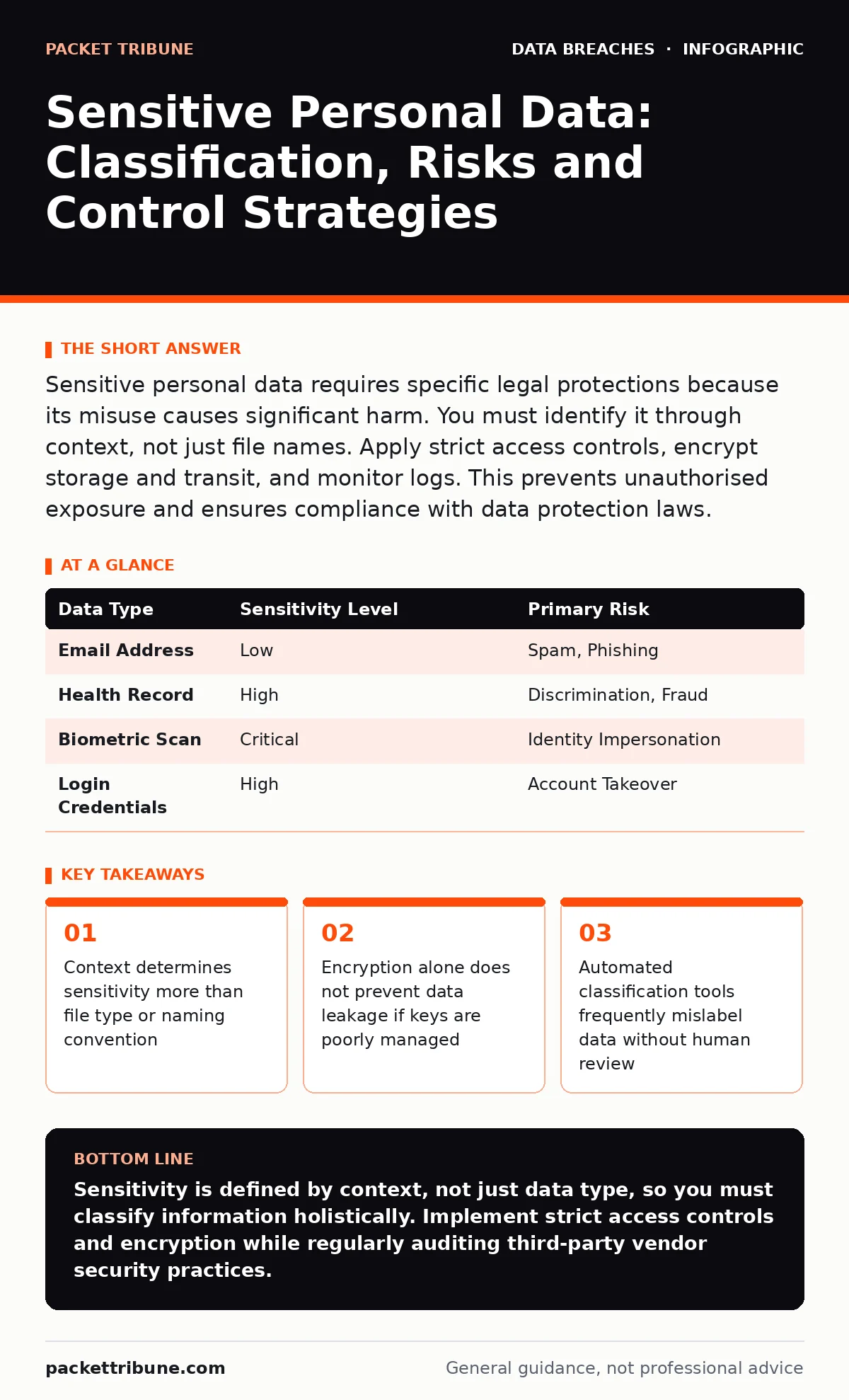
Sensitive personal data requires specific legal protections because its misuse causes significant harm. You must identify it through context, not just file names. Apply strict access controls, encrypt storage and transit, and monitor logs. This prevents unauthorised exposure and ensures compliance with data protection laws.
What defines sensitive personal data?
Sensitive personal data refers to information that, if exposed, could cause significant harm to the individual. This category extends beyond basic contact details to include health records, genetic information, biometric data, political opinions and religious beliefs. The definition varies by jurisdiction, but the core principle remains consistent: the data reveals intimate aspects of a person's identity or status. You must treat any data that could lead to discrimination or financial loss as sensitive.
How do you identify sensitive data in unstructured stores?
You identify sensitive data by analysing content patterns rather than relying on file names or directory structures. Unstructured data, such as emails or documents, often contains sensitive information hidden within plain text. Regular expressions and machine learning models can scan for patterns like national identification numbers or medical codes. However, these tools generate false positives. You must validate automated findings manually to avoid over-classifying benign data as sensitive.
| Data Type | Sensitivity Level | Primary Risk |
|---|---|---|
| Email Address | Low | Spam, Phishing |
| Health Record | High | Discrimination, Fraud |
| Biometric Scan | Critical | Identity Impersonation |
| Login Credentials | High | Account Takeover |
Why does context change data sensitivity?
Context changes data sensitivity because information that is harmless in isolation becomes sensitive when combined with other data points. A first name and postcode may seem benign, but together they can identify a specific individual in a small community. This phenomenon, known as re-identification, means you must evaluate datasets holistically. Isolating fields in a report might appear safe, but linking them back to the source reveals private details.
What are the regulatory consequences of mishandling data?
Mishandling sensitive data breaches privacy laws and exposes your organisation to substantial fines and legal action. Regulatory frameworks impose strict obligations on data controllers and processors. You must demonstrate accountability by documenting how you collect, process and store this information. Failure to protect data adequately results in penalties that scale with the severity of the breach and the size of the organisation.
How does encryption protect sensitive information at rest?
Encryption transforms readable data into ciphertext using mathematical algorithms, rendering it useless to unauthorised users. When data is stored on disks or databases, encryption at rest ensures that physical theft of hardware does not lead to data exposure. You must manage the encryption keys separately from the data itself. If attackers obtain both the encrypted files and the keys, the protection fails. See our guide on encryption key management for secure storage practices.
See also: API Vulnerabilities Explained: How Hidden Doors Risk Your Data
Why is encryption insufficient for in-transit data?
Encryption protects data while it moves across networks, but it does not prevent endpoint compromise. If an attacker intercepts data before it is encrypted or after it is decrypted, the protection is bypassed. You must enforce secure protocols for all communications, including internal transfers. Additionally, metadata often reveals sensitive information about who is communicating and when, even if the content is encrypted.
What role do access controls play in protection?
Access controls restrict who can view or modify sensitive data based on their role and need. Principle of least privilege ensures users only access the minimum data required for their tasks. You must implement multi-factor authentication to verify identity before granting access. Regular audits of access logs help detect unusual behaviour, such as bulk downloads or access outside working hours. Refer to our guide on unauthorized access for deeper strategies.
How does data retention impact security risks?
Keeping data longer than necessary increases the window of opportunity for attackers. Every day data sits in storage, it faces potential threats from insider threats, system vulnerabilities or physical breaches. You must establish clear retention policies that define how long data is kept and when it is securely deleted. Secure deletion ensures that data cannot be recovered from discarded storage media.
What is the impact of third-party vendors?
Third-party vendors often process sensitive data on your behalf, extending your security perimeter. If a vendor suffers a breach, your organisation may face regulatory scrutiny and reputational damage. You must assess vendor security practices before sharing data. Contracts should specify security requirements and incident response procedures. See our guide on mobile device management if vendors use mobile devices to access your data.
How can you prevent data leakage effectively?
Preventing data leakage requires a combination of technical controls and user awareness. Data loss prevention tools monitor and block unauthorised transfers of sensitive information. You must train users to recognise phishing attempts and social engineering tactics. Regular testing of security controls helps identify gaps before attackers exploit them. Consider our guide on public file share exposure to secure cloud storage accounts.
Key takeaways
- Context determines sensitivity more than file type or naming convention
- Encryption alone does not prevent data leakage if keys are poorly managed
- Automated classification tools frequently mislabel data without human review
Sensitivity is defined by context, not just data type, so you must classify information holistically. Implement strict access controls and encryption while regularly auditing third-party vendor security practices.
Frequently asked questions
Is anonymised data still considered sensitive?
Anonymised data is generally not considered sensitive if it cannot be linked back to an individual. However, if re-identification is possible, it retains its sensitive status.
How often should access permissions be reviewed?
Access permissions should be reviewed regularly, at least quarterly, to ensure they align with current job roles and responsibilities.
What is the difference between pseudonymisation and anonymisation?
Pseudonymisation replaces identifiable information with artificial identifiers, while anonymisation removes all links to the individual, making re-identification impossible.
Can internal staff cause data breaches?
Yes, internal staff can cause breaches through negligence, accidental exposure or malicious intent. Training and monitoring are essential to mitigate these risks.
How this guide was produced: written by the Packet Tribune editorial team with AI assistance, checked against the public references listed below, and reviewed when the facts change. See our editorial policy or report an error.