Encryption Key Management: How to Stop Keys from Becoming the Breach
Your encryption is only as secure as the administrative process that creates, stores and retires the cryptographic keys that protect your data.

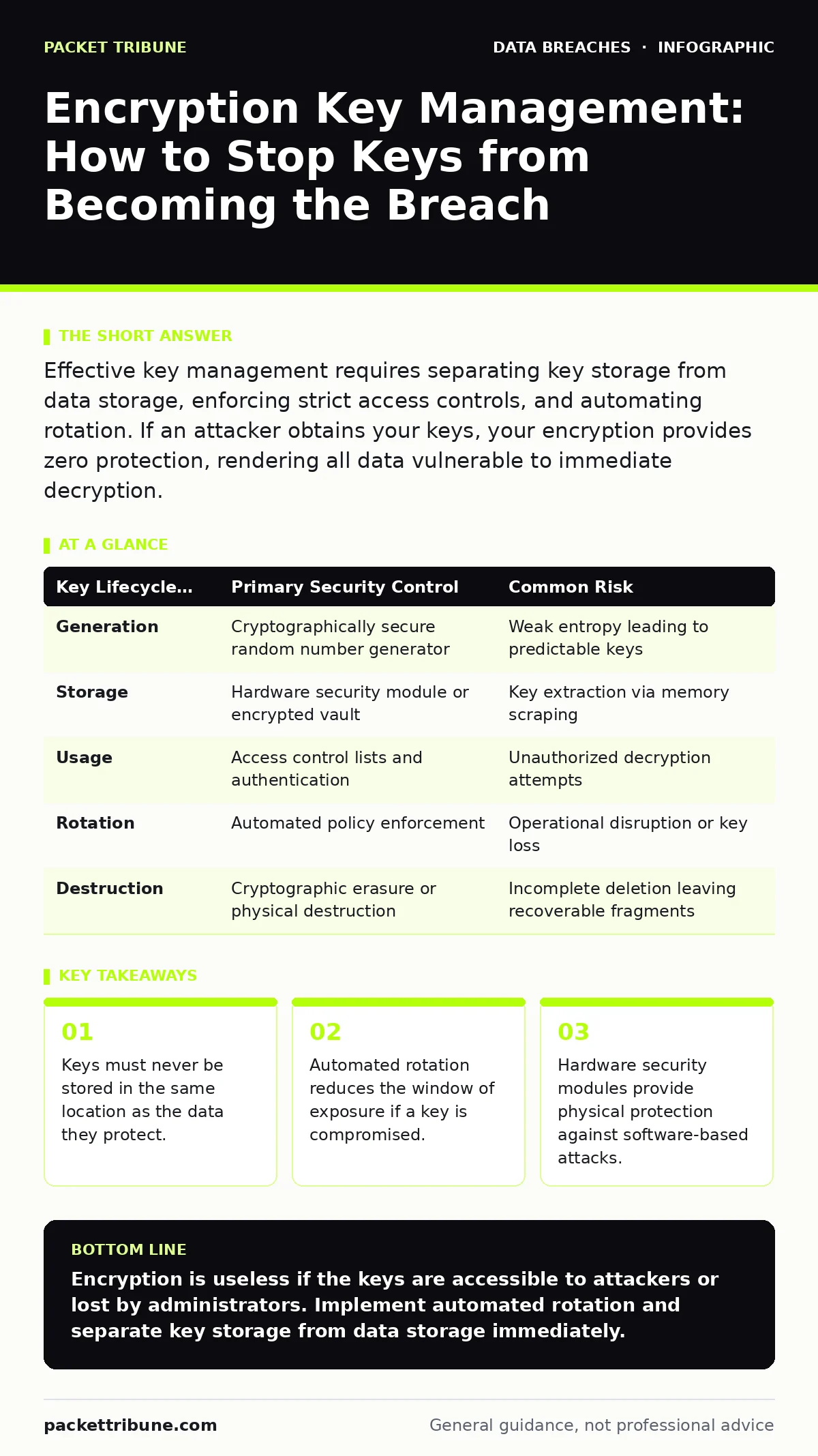
Effective key management requires separating key storage from data storage, enforcing strict access controls, and automating rotation. If an attacker obtains your keys, your encryption provides zero protection, rendering all data vulnerable to immediate decryption.
Why does storing keys with data defeat encryption?
Storing cryptographic keys alongside the data they encrypt creates a single point of failure. If an attacker breaches your storage system, they gain access to both the locked container and the key required to open it. This practice renders encryption meaningless because the attacker can decrypt the data immediately upon access.
Encryption is a mathematical function that transforms readable data into unreadable ciphertext using a key. The security relies on the secrecy of the key, not the complexity of the algorithm. When you separate the key from the data, you force an attacker to compromise two distinct systems. This separation is a core aspect of defense in depth, a strategy that uses multiple layers of security controls to protect assets.
How do hardware security modules improve key security?
Hardware security modules (HSMs) are physical devices designed to safeguard and manage digital keys for encryption and decryption. They provide a tamper-resistant environment that prevents keys from leaving the device in plaintext. Software-based key storage is vulnerable to memory scraping and remote exploitation, whereas HSMs isolate cryptographic operations.
An HSM ensures that private keys never leave the secure boundary of the hardware. Even if the host server is compromised, the attacker cannot extract the keys to decrypt data elsewhere. This physical isolation is critical for high-value assets. You should refer to our guide on encryption at rest to understand how HSMs integrate with storage arrays and databases.
What is the risk of hardcoding keys in application code?
Hardcoding keys directly into source code exposes them to anyone who can access the repository. Version control systems often store history, meaning deleted keys may remain accessible to former employees or attackers who breach the repository. This is a common cause of credential leaks that lead to wider system compromise.
Dynamic key retrieval from a secure vault eliminates this risk. Applications should request keys at runtime using short-lived tokens. This approach ensures that keys are never present in static files or logs. It also simplifies the process of revoking access when an employee leaves or a service is decommissioned.
How often should encryption keys be rotated?
Key rotation involves replacing an old cryptographic key with a new one at regular intervals. The frequency depends on the sensitivity of the data and the risk of exposure. Frequent rotation limits the amount of data exposed if a key is compromised. However, excessive rotation introduces operational complexity and performance overhead.
Automated rotation policies ensure consistency and reduce human error. You must balance security requirements with system performance. Large datasets may require lazy re-encryption, where data is updated with the new key only when accessed. This method avoids the computational cost of re-encrypting everything at once.
Who should have access to encryption keys?
Access to encryption keys should be restricted to the minimum number of people necessary. This follows the principle of least privilege, which grants users only the permissions required to perform their specific tasks. Broad access increases the risk of insider threats and accidental misuse.
Role-based access control (RBAC) defines who can create, use, or delete keys. Administrative roles should be separated from operational roles. No single individual should have unrestricted access to all keys. This separation of duties prevents malicious insiders from acting alone without detection.
See also: RSA Encryption Misconceptions: Six Errors Undermining Your Security · DNSSEC Mistakes That Break Resolution and How to Fix Them
How does key management relate to data privacy?
Proper key management is fundamental to protecting personally identifiable information (PII). If keys are lost or compromised, PII may be exposed, leading to regulatory penalties and reputational damage. Encryption transforms PII into ciphertext, but only the key can reverse this process.
You must ensure that keys are protected with the same rigor as the data itself. Loss of keys can result in permanent data loss, while compromise leads to data breaches. Both outcomes violate privacy principles and trust. Refer to our guide on accidental data disclosure for strategies to prevent unintended exposure of sensitive data.
What happens if you lose an encryption key?
Losing an encryption key results in permanent data loss. Without the key, the ciphertext cannot be decrypted back into readable format. This is known as cryptographic erasure, which is irreversible. Backup strategies must include secure storage of keys, separate from the data.
Key escrow services can provide recovery options, but they introduce trust risks. You must evaluate the provider's security posture and legal jurisdiction. Losing keys is often more damaging than a breach because the data is unrecoverable. Ensure your backup plan includes regular testing of key restoration procedures.
How do you manage keys in a cloud environment?
Cloud providers offer managed key services that simplify key lifecycle management. These services handle generation, storage, rotation, and access logging. Using cloud-managed keys reduces the operational burden on your team. However, you remain responsible for configuring access controls correctly.
Shared responsibility models define the provider's and customer's duties. The provider secures the infrastructure, while you manage the keys and permissions. Misconfigurations are a leading cause of unauthorized access in cloud environments. Regular audits of key access policies are necessary to maintain security.
How do you audit encryption key usage?
Auditing involves monitoring and logging all key-related activities. This includes generation, usage, rotation, and deletion. Logs provide evidence of who accessed keys and when. They are essential for detecting anomalies and investigating incidents.
Centralized logging systems aggregate data from multiple sources. You should set up alerts for unusual patterns, such as access from unexpected locations or times. Regular reviews of logs help identify potential threats early. This process supports compliance with various security standards and frameworks.
| Key Lifecycle Stage | Primary Security Control | Common Risk |
|---|---|---|
| Generation | Cryptographically secure random number generator | Weak entropy leading to predictable keys |
| Storage | Hardware security module or encrypted vault | Key extraction via memory scraping |
| Usage | Access control lists and authentication | Unauthorized decryption attempts |
| Rotation | Automated policy enforcement | Operational disruption or key loss |
| Destruction | Cryptographic erasure or physical destruction | Incomplete deletion leaving recoverable fragments |
How does key management affect system performance?
Encryption and decryption require computational resources. Poorly managed key operations can introduce latency and reduce throughput. Hardware acceleration modules can offload cryptographic tasks from the main processor. This improves performance while maintaining security.
You must benchmark your system to understand the impact of encryption. Different algorithms have varying performance characteristics. Choose algorithms that balance security strength with operational efficiency. Regular monitoring helps identify bottlenecks and optimize key usage patterns.
Key takeaways
- Keys must never be stored in the same location as the data they protect.
- Automated rotation reduces the window of exposure if a key is compromised.
- Hardware security modules provide physical protection against software-based attacks.
Encryption is useless if the keys are accessible to attackers or lost by administrators. Implement automated rotation and separate key storage from data storage immediately.
Frequently asked questions
Can I use the same key for multiple applications?
No, using a single key across multiple systems creates a cascading risk. If one application is compromised, all data protected by that key is vulnerable. Unique keys per application limit the blast radius of a breach.
Is cloud-based key management secure?
Yes, when configured correctly. Cloud providers offer robust security controls, but you must manage access permissions. Misconfigurations are the primary risk, not the provider's infrastructure. Regular audits ensure compliance.
How do I recover from a lost key?
Prevention is the only reliable recovery method. Ensure you have secure, redundant backups of your keys. Test restoration procedures regularly. Without a key, encrypted data is permanently unrecoverable.
What is the difference between symmetric and asymmetric keys?
Symmetric keys use the same key for encryption and decryption, offering speed. Asymmetric keys use a public/private pair, providing better access control but slower performance. Both require careful management to remain secure.
How this guide was produced: written by the Packet Tribune editorial team with AI assistance, checked against the public references listed below, and reviewed when the facts change. See our editorial policy or report an error.