Principle of Least Privilege: Correcting Common Misinterpretations
Least privilege is not a static list of denied permissions but a dynamic constraint that limits the blast radius of accidental data disclosure and credential leaks.

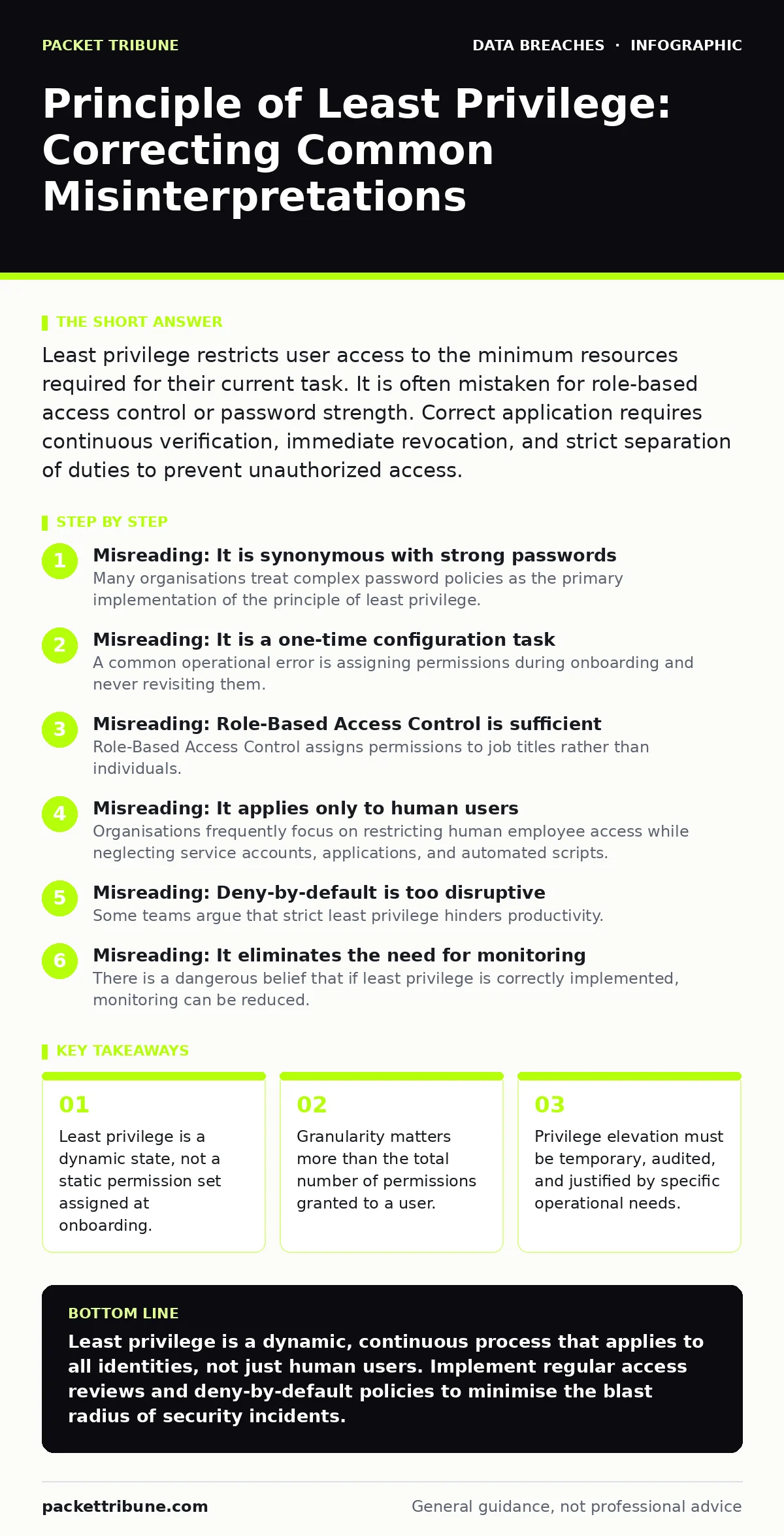
Least privilege restricts user access to the minimum resources required for their current task. It is often mistaken for role-based access control or password strength. Correct application requires continuous verification, immediate revocation, and strict separation of duties to prevent unauthorized access.
Misreading: It is synonymous with strong passwords
Many organisations treat complex password policies as the primary implementation of the principle of least privilege. This confuses authentication with authorisation. A strong password proves who you are, but it does not determine what you are allowed to do. If a user with a twenty-character password has administrative rights over the entire network, they violate least privilege despite having excellent credentials.
Correct reading: Least privilege governs authorisation, which is the process of verifying what an authenticated user is permitted to access. You must separate the mechanism of proving identity from the mechanism of granting access. Even with perfect identity verification, the system must enforce strict boundaries on resource consumption. This approach limits the impact of credential leaks by ensuring that stolen credentials only grant access to a narrow subset of data.
Misreading: It is a one-time configuration task
A common operational error is assigning permissions during onboarding and never revisiting them. Users acquire new responsibilities, change teams, or leave the organisation. Static permission sets quickly become obsolete, leading to privilege creep. This accumulation of unused rights expands the attack surface and increases the risk of accidental data disclosure.
Correct reading: Least privilege is a continuous lifecycle management process. Permissions must be reviewed regularly to ensure they align with current job functions. You should implement a process for periodic access recertification, where managers confirm that each user’s access rights are still necessary. This dynamic approach ensures that access rights shrink as roles change, rather than expanding indefinitely. It also supports effective encryption key management by limiting who can request or rotate keys.
Misreading: Role-Based Access Control is sufficient
Role-Based Access Control assigns permissions to job titles rather than individuals. While efficient for initial setup, it often grants excessive permissions to fit the "worst-case" scenario for a role. This violates the spirit of least privilege by granting broad access based on potential need rather than actual requirement.
Correct reading: Use Attribute-Based Access Control or Just-In-Time access to refine permissions beyond static roles. Grant access based on specific attributes such as location, time of day, or the sensitivity of the resource being accessed. This allows you to grant temporary, specific privileges for unique tasks without altering the user’s baseline role. This precision reduces the likelihood of unauthorised access during social engineering attacks or insider threats.
Misreading: It applies only to human users
Organisations frequently focus on restricting human employee access while neglecting service accounts, applications, and automated scripts. These non-human identities often hold elevated privileges to facilitate system integration. If a compromised web application has root access to the database, the principle of least privilege has failed, regardless of how tightly you control human administrator accounts.
Correct reading: Apply least privilege to all identities, including service accounts and application identities. Each automated process should operate with the minimum permissions required to perform its specific function. For instance, a backup script should only have read access to the data it needs to archive, not administrative rights over the server. This containment strategy limits the blast radius if an application is compromised, preventing lateral movement within the network.
Misreading: Deny-by-default is too disruptive
Some teams argue that strict least privilege hinders productivity. They believe that granting broader access initially saves time, with the assumption that users will only use what they need. This assumption is flawed. Users tend to exploit available permissions for convenience, and attackers exploit unused permissions for persistence. The friction of requesting access is a feature, not a bug, as it forces justification for every privilege escalation.
Correct reading: Implement a deny-by-default posture where access is explicitly granted rather than implicitly allowed. Use privileged access management solutions to provide temporary elevation when needed. This creates an audit trail for every privileged action, allowing you to detect anomalies. The slight increase in operational friction is the hidden cost of security, but it significantly reduces the risk of data breaches caused by over-privileged accounts.
See also: Implement Database Security: A Step-by-Step Technical Guide · Prevent Public File Share Exposure With This Technical Checklist
Misreading: It eliminates the need for monitoring
There is a dangerous belief that if least privilege is correctly implemented, monitoring can be reduced. This is false. Least privilege limits the damage an attacker can do, but it does not prevent the initial compromise. An attacker can still move laterally between low-privilege accounts or exfiltrate small amounts of personally identifiable information over time.
Correct reading: Least privilege must be paired with continuous monitoring and logging. You must track who accesses what resources and when. Anomalies in access patterns, such as a user accessing files outside their usual scope, should trigger alerts. This layered defence ensures that even if an attacker bypasses initial controls, their actions are detected and contained. This approach complements encryption at rest by ensuring that access to decrypted data is strictly controlled and monitored.
Key takeaways
- Least privilege is a dynamic state, not a static permission set assigned at onboarding.
- Granularity matters more than the total number of permissions granted to a user.
- Privilege elevation must be temporary, audited, and justified by specific operational needs.
- Separation of duties prevents single points of failure and reduces insider threat risk.
Least privilege is a dynamic, continuous process that applies to all identities, not just human users. Implement regular access reviews and deny-by-default policies to minimise the blast radius of security incidents.
Frequently asked questions
How do I handle break-glass accounts for emergencies?
Break-glass accounts should be stored securely, monitored closely, and disabled by default. Access requires multi-factor authentication and triggers immediate alerting for auditing purposes.
Does least privilege affect user productivity?
Initially, there may be a learning curve. However, clear access paths and automated request workflows often streamline operations by reducing confusion and unnecessary permission requests.
How do I measure the effectiveness of least privilege?
Track the number of privileged accounts, the frequency of privilege escalation requests, and the time taken to revoke access after role changes. Fewer privileged accounts and faster revocation indicate better adherence.
How this guide was produced: written by the Packet Tribune editorial team with AI assistance, checked against the public references listed below, and reviewed when the facts change. See our editorial policy or report an error.