Data Breaches: The Hidden Costs and Real Mechanics of Exfiltration
Most data breaches stem from misconfigured systems rather than sophisticated hacking, meaning administrative discipline often matters more than advanced defensive tools.

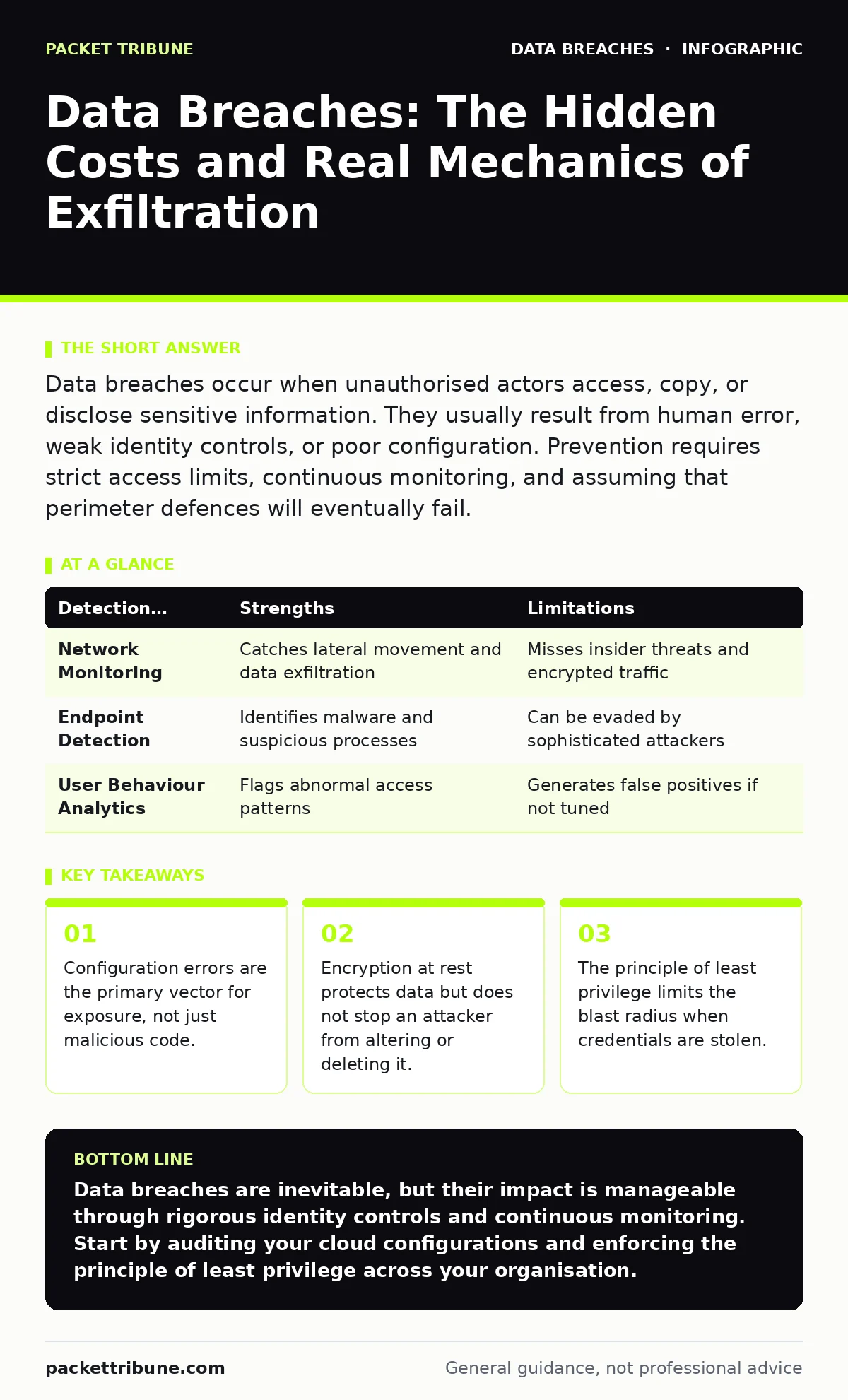
Data breaches occur when unauthorised actors access, copy, or disclose sensitive information. They usually result from human error, weak identity controls, or poor configuration. Prevention requires strict access limits, continuous monitoring, and assuming that perimeter defences will eventually fail.
What actually constitutes a data breach?
A data breach is any event where protected data is accessed, stolen, or viewed by an unauthorised person. It is not limited to theft; accidental disclosure, loss of a laptop, or misdirected emails also qualify. The core issue is the violation of confidentiality, integrity, or availability of the information. You must treat any unauthorised exposure as a breach, regardless of whether the data was exfiltrated or merely viewed.
Why do configuration errors cause more breaches than hacking?
Misconfigurations leave backdoors open that attackers can walk through without breaking any locks. Cloud storage buckets, databases, and servers often default to public access if the administrator does not explicitly restrict them. This is far more common than a sophisticated exploit because it requires no technical skill to discover. You should audit your infrastructure regularly to ensure default settings are tightened. See our guide on accidental data disclosure for strategies to prevent these human errors.
How do attackers gain initial access?
Initial access typically happens through phishing emails, compromised credentials, or unpatched software vulnerabilities. Attackers look for the path of least resistance, often targeting remote workers or third-party vendors. Once inside, they move laterally to find valuable data. You must assume that an attacker will eventually find an entry point, so your focus should be on limiting what they can do once they are in. Refer to our section on unauthorized access for deeper technical controls.
What is the role of identity management?
Identity management ensures that only authorised users can access specific resources. Weak passwords and reused credentials make this system fragile. Multi-factor authentication adds a layer of security that is difficult for attackers to bypass. However, identity theft protection services only help individuals, not corporate systems. You need enterprise-grade identity solutions that enforce the principle of least privilege to minimise risk.
How do you detect a breach in progress?
Detection relies on monitoring network traffic and user behaviour for anomalies. Standard firewalls cannot see encrypted traffic or insider threats. You need tools that analyse patterns, such as a user logging in from two distant locations simultaneously. Early detection reduces the damage by allowing you to isolate affected systems. Delaying detection increases the cost and complexity of remediation.
| Detection Method | Strengths | Limitations |
|---|---|---|
| Network Monitoring | Catches lateral movement and data exfiltration | Misses insider threats and encrypted traffic |
| Endpoint Detection | Identifies malware and suspicious processes | Can be evaded by sophisticated attackers |
| User Behaviour Analytics | Flags abnormal access patterns | Generates false positives if not tuned |
See also: Encryption Key Management: How to Stop Keys from Becoming the Breach · Encryption at Rest: The Hidden Costs and Real Protection Limits
What happens during the containment phase?
Containment aims to stop the spread of the breach while preserving evidence for investigation. You must isolate affected systems from the network to prevent lateral movement. Shutting down servers immediately can destroy volatile memory evidence, so coordinate with your forensic team. Document every step you take, as this affects your legal and regulatory obligations. Balance the need to stop the bleed with the need to understand the scope.
Why is encryption not a silver bullet?
Encryption at rest protects data if physical devices are stolen or hard drives are accessed directly. It does not protect data while it is in use or in transit if keys are compromised. Attackers can still encrypt your data for ransom or delete it entirely. You must manage your encryption keys securely, as losing them means losing your data forever. Read our guide on encryption key management to understand the lifecycle of cryptographic assets.
How do you recover and rebuild trust?
Recovery involves restoring systems from clean backups and verifying their integrity. You must verify that the attacker has been fully removed before reconnecting to the network. Communicate transparently with affected parties, as silence erodes trust faster than the breach itself. Update your security policies to address the root cause of the incident. Consider our guide on credential leaks to prevent the same vectors from being used again.
What are the long-term implications?
A breach increases scrutiny from regulators, partners, and customers. You may face higher insurance premiums and stricter contractual requirements. The reputational damage can persist for years, affecting customer retention and employee morale. Continuous improvement of your security posture is necessary to demonstrate resilience. Treat every breach as a lesson that strengthens your defences against future attacks.
Key takeaways
- Configuration errors are the primary vector for exposure, not just malicious code.
- Encryption at rest protects data but does not stop an attacker from altering or deleting it.
- The principle of least privilege limits the blast radius when credentials are stolen.
Data breaches are inevitable, but their impact is manageable through rigorous identity controls and continuous monitoring. Start by auditing your cloud configurations and enforcing the principle of least privilege across your organisation.
Frequently asked questions
How long does it take to detect a data breach?
Detection times vary widely based on the sophistication of the attacker and the quality of your monitoring. Average detection times can range from weeks to months, but improved analytics can reduce this to days.
Do small businesses need the same protections as large enterprises?
Yes, attackers often target smaller organisations because they have weaker defences. The fundamental principles of identity management and least privilege apply to organisations of all sizes.
Can antivirus software prevent a data breach?
Antivirus software can block known malware, but it cannot stop phishing, misconfigurations, or zero-day exploits. It is one layer of defence, not a complete solution.
What should I do if I suspect a breach?
Immediately isolate affected systems, preserve evidence, and engage your incident response team. Do not attempt to fix the issue yourself without proper forensic procedures.
How this guide was produced: written by the Packet Tribune editorial team with AI assistance, checked against the public references listed below, and reviewed when the facts change. See our editorial policy or report an error.