AES Encryption Explained: Answers to 9 Common Technical Questions
AES relies on substitution-permutation networks rather than simple key swapping, making it resistant to most linear cryptanalysis methods used against older ciphers.

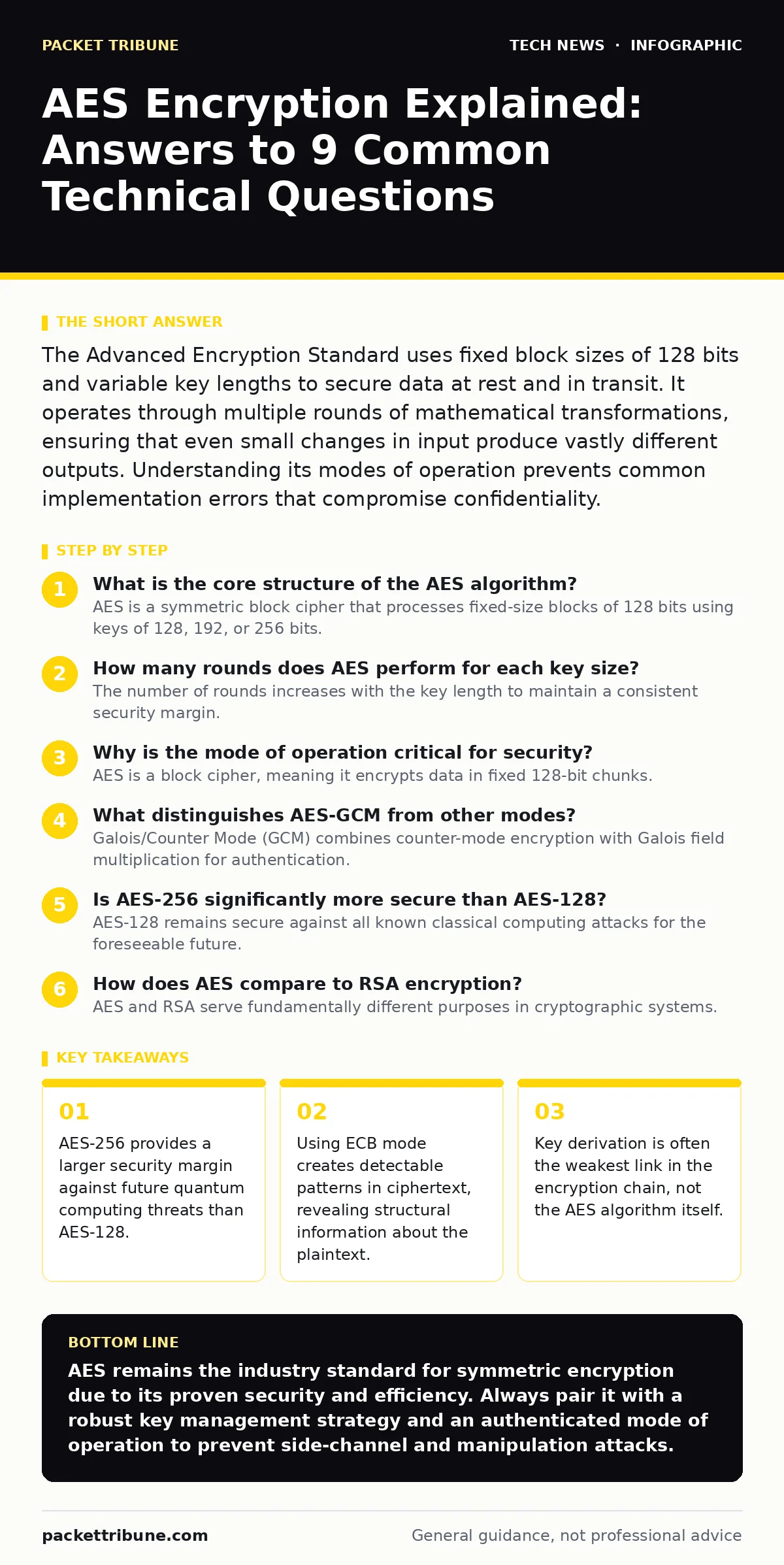
The Advanced Encryption Standard uses fixed block sizes of 128 bits and variable key lengths to secure data at rest and in transit. It operates through multiple rounds of mathematical transformations, ensuring that even small changes in input produce vastly different outputs. Understanding its modes of operation prevents common implementation errors that compromise confidentiality.
What is the core structure of the AES algorithm?
AES is a symmetric block cipher that processes fixed-size blocks of 128 bits using keys of 128, 192, or 256 bits. It does not use a single substitution step but instead applies a series of four distinct transformations repeatedly. These rounds mix the input data thoroughly, ensuring that every bit of the output depends on every bit of the input and the key. This design prevents attackers from deducing the key by analysing small fragments of ciphertext.
The algorithm was selected through an open, public competition, ensuring its design has been scrutinised by cryptographers worldwide for decades. Its mathematical basis relies on finite field arithmetic, specifically within the Galois Field. This complexity makes it computationally infeasible to reverse without the correct key, even with modern processing power.
How many rounds does AES perform for each key size?
The number of rounds increases with the key length to maintain a consistent security margin. AES-128 performs 10 rounds, AES-192 performs 12 rounds, and AES-256 performs 14 rounds. Each round consists of four steps: SubBytes, ShiftRows, MixColumns, and AddRoundKey. These steps are applied in a specific order to diffuse confusion throughout the block.
Adding more rounds does not significantly slow down modern processors due to hardware accelerations like the AES-NI instruction set. However, the increased round count in AES-256 provides a stronger barrier against meet-in-the-middle attacks. This extra layer of transformation ensures that the relationship between the plaintext and the ciphertext remains opaque.
Why is the mode of operation critical for security?
AES is a block cipher, meaning it encrypts data in fixed 128-bit chunks. If you encrypt two identical blocks with the same key, they produce identical ciphertext blocks. This repetition reveals patterns in the data, which attackers can exploit to infer content. Modes of operation introduce randomness or dependency between blocks to hide these patterns.
Electronic Codebook (ECB) mode should never be used for variable-length data because it lacks this diffusion. It encrypts each block independently, leaving visual structures intact in images or structured data. Instead, use modes like Cipher Block Chaining (CBC) or Galois/Counter Mode (GCM) which introduce an initialisation vector or nonce. These ensure that identical plaintext blocks result in different ciphertext outputs.
What distinguishes AES-GCM from other modes?
Galois/Counter Mode (GCM) combines counter-mode encryption with Galois field multiplication for authentication. It provides both confidentiality and integrity, preventing an attacker from altering the ciphertext without detection. This makes it an authenticated encryption with associated data (AEAD) scheme. Many modern protocols prefer GCM because it is parallelisable and efficient.
Unlike CBC, which requires padding and separate message authentication codes, GCM handles both tasks in a single pass. However, reusing a nonce with the same key in GCM mode catastrophically compromises security. It allows attackers to recover the keystream and decrypt all messages encrypted with that nonce. Therefore, strict nonce management is required when implementing GCM.
Is AES-256 significantly more secure than AES-128?
AES-128 remains secure against all known classical computing attacks for the foreseeable future. The key space is large enough that brute-forcing it is computationally impossible with current technology. AES-256 offers a larger margin of safety, primarily against hypothetical future threats. These threats include advancements in cryptanalysis or the advent of quantum computers.
Quantum algorithms like Grover’s algorithm can reduce the effective key strength by half. AES-128 would effectively become AES-64, which is breakable, while AES-256 becomes AES-128, which remains secure. For long-term data storage or high-security government applications, AES-256 is the preferred choice. For most commercial applications, AES-128 provides sufficient protection with lower computational overhead.
| Key Size | Number of Rounds | Effective Security vs Quantum | Typical Use Case |
|---|---|---|---|
| 128-bit | 10 | Weak | Standard web traffic, temporary files |
| 192-bit | 12 | Moderate | Balanced security and performance |
| 256-bit | 14 | Strong | Long-term archives, state secrets |
See also: Encryption at Rest: The Hidden Costs and Real Protection Limits · Wifi router security: Stop hidden admin access from leaking data
How does AES compare to RSA encryption?
AES and RSA serve fundamentally different purposes in cryptographic systems. AES is a symmetric algorithm, meaning the same key encrypts and decrypts data. It is fast and efficient for bulk data encryption. RSA is an asymmetric algorithm, using a public key for encryption and a private key for decryption. It is slow and suitable only for small amounts of data, such as keys.
In practice, systems use both. TLS certificates and the TLS handshake often use RSA or Elliptic Curve Cryptography to securely exchange a symmetric session key. Once the key is exchanged, AES takes over for the actual data transfer. This hybrid approach combines the key management benefits of asymmetric cryptography with the speed of symmetric encryption.
What is the role of key derivation in AES security?
The strength of AES encryption is entirely dependent on the quality of the key. A strong algorithm with a weak key is easily compromised. Key derivation functions (KDFs) transform passwords or other secrets into cryptographically secure keys. They add salt and apply hashing algorithms to prevent rainbow table attacks.
Using a simple hash like MD5 for key derivation is insufficient because it is too fast. Attackers can guess millions of passwords per second. Modern KDFs like Argon2 or PBKDF2 are designed to be slow and memory-intensive. This slowness protects against brute-force attacks by making each guess computationally expensive. Always use a dedicated KDF rather than raw hashes for key generation.
Can AES protect data in transit and at rest equally well?
AES is versatile and can secure data in both states, but the implementation differs. For data at rest, such as on hard drives, full-disk encryption uses AES in XTS mode. This mode allows random access to encrypted sectors without decrypting the entire drive. It is standard for operating system-level encryption.
For data in transit, AES operates within protocols like TLS. Here, the focus shifts to integrity and forward secrecy. The encryption keys are ephemeral, changing with each session. This ensures that if a long-term key is compromised, past communications remain secure. Understanding the difference helps in selecting the right mode for your specific storage or transmission needs.
Does AES require regular key rotation?
Key rotation is a risk management practice, not a strict mathematical requirement for AES. The algorithm itself does not degrade over time or usage. However, limiting the amount of data encrypted with a single key reduces the impact if that key is leaked. It also limits the window of opportunity for an attacker to gather enough ciphertext for statistical analysis.
For high-volume systems, rotating keys regularly is advisable. For low-volume or one-time uses, frequent rotation adds operational complexity without significant security gains. Balance the administrative burden against the sensitivity of the data. Refer to our guide on API key security for broader strategies on managing credential lifecycles.
What are the common implementation mistakes with AES?
Developers often overlook the importance of initialisation vectors (IVs) or nonces. Reusing an IV with the same key in certain modes breaks confidentiality. Another common error is failing to authenticate ciphertext. Without authentication, an attacker can modify the ciphertext, and the decryption process may produce misleading or harmful data.
Padding oracle attacks exploit improper error handling during decryption. If the system reveals whether padding was valid or not, attackers can decrypt messages byte by byte. Always use authenticated modes like GCM or apply HMAC separately. Ensure that your error messages do not leak information about the decryption state.
Key takeaways
- AES-256 provides a larger security margin against future quantum computing threats than AES-128.
- Using ECB mode creates detectable patterns in ciphertext, revealing structural information about the plaintext.
- Key derivation is often the weakest link in the encryption chain, not the AES algorithm itself.
AES remains the industry standard for symmetric encryption due to its proven security and efficiency. Always pair it with a robust key management strategy and an authenticated mode of operation to prevent side-channel and manipulation attacks.
Frequently asked questions
Is AES encryption unbreakable?
No encryption is mathematically unbreakable, but AES is currently resistant to all known practical attacks when implemented correctly. Security depends on key secrecy and proper mode usage.
Can I use AES for encrypting passwords?
No, use a dedicated password hashing function like Argon2 or bcrypt. AES is reversible, which is dangerous for password storage if the key is compromised.
What is the difference between AES and DES?
DES uses a 56-bit key and is considered insecure due to its short key length. AES uses 128-bit or larger keys and a more complex structure, making it vastly stronger.
Does AES slow down my application?
Modern CPUs include hardware instructions for AES, making it nearly as fast as unencrypted data transfer. Software implementations are slower but still efficient for most applications.
How this guide was produced: written by the Packet Tribune editorial team with AI assistance, checked against the public references listed below, and reviewed when the facts change. See our editorial policy or report an error.