Encryption at Rest: The Hidden Costs and Real Protection Limits
Encrypting stored data stops thieves from reading files, but it fails to protect your information once the system is running and the keys are in memory.

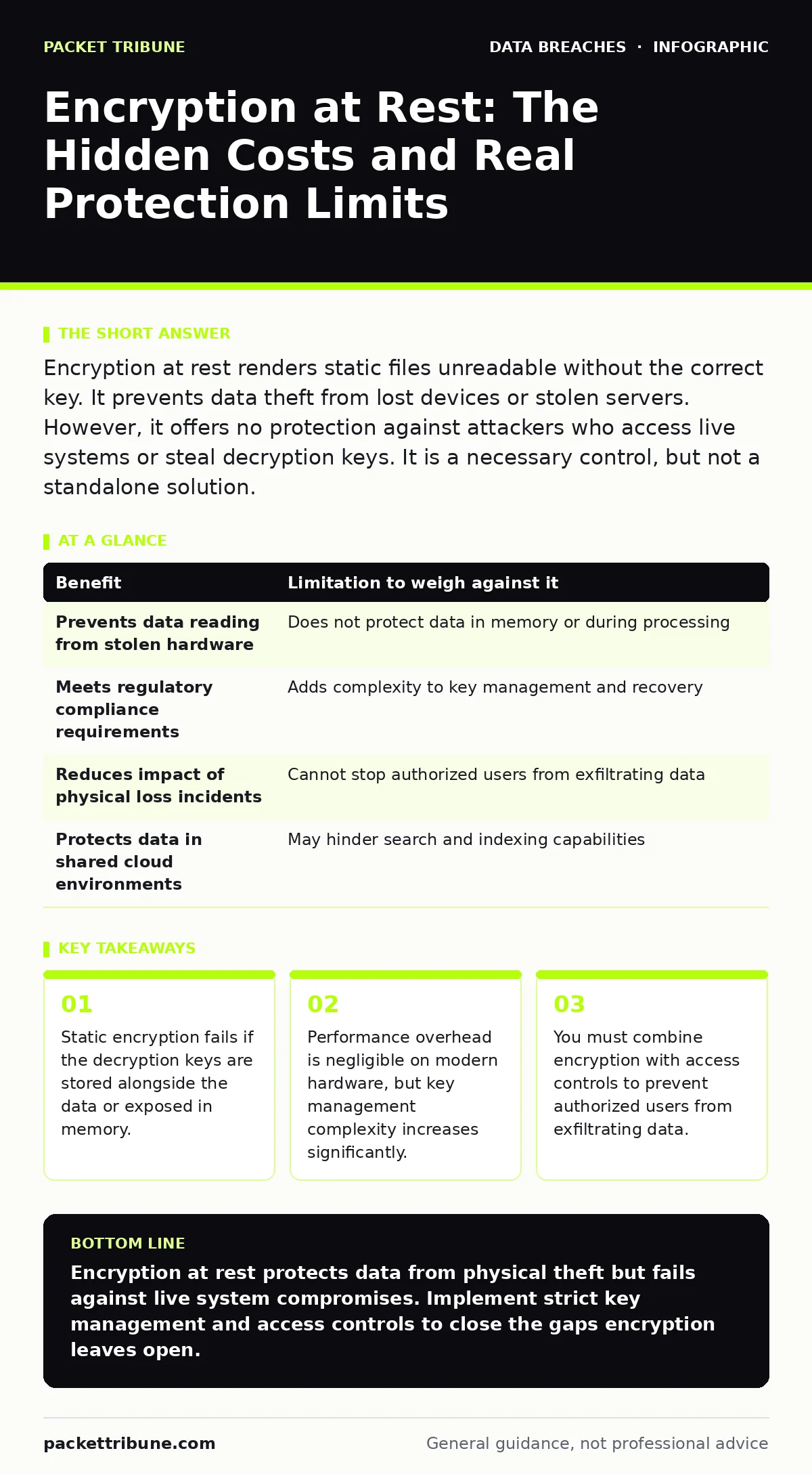
Encryption at rest renders static files unreadable without the correct key. It prevents data theft from lost devices or stolen servers. However, it offers no protection against attackers who access live systems or steal decryption keys. It is a necessary control, but not a standalone solution.
The Illusion of Static Security
When data sits on a disk, it is vulnerable to physical theft or direct file system access. Encryption at rest solves this by transforming readable data into ciphertext. Without the corresponding decryption key, the data remains unintelligible. This mechanism protects against scenarios where an attacker gains physical possession of a hard drive or steals a backup tape.
However, this protection vanishes the moment the data is accessed. To use the data, the system must decrypt it. This means the data exists in plain text within the system memory, or RAM, while being processed. An attacker who compromises a running server can capture this data before it is re-encrypted. Encryption at rest does not protect data in use.
The Key Management Paradox
The security of your encrypted data depends entirely on the secrecy of the key. If an attacker finds the key, the encryption is useless. This creates a difficult trade-off. You must store the key somewhere secure, yet make it available to the system when needed.
Storing keys on the same device as the data defeats the purpose. If the device is compromised, the attacker gets both the lock and the key. You need a separate system for key storage. This introduces complexity. If the key management system fails, or if you lose the keys, the data becomes permanently inaccessible. This is often worse than a breach, as it causes operational paralysis.
Poor encryption key management is the most common point of failure. Many organisations generate keys but store them in configuration files or source code repositories. This is equivalent to leaving a house key under the doormat. The door is locked, but anyone who looks carefully will find the key.
Performance and Operational Friction
Modern processors include instructions for fast encryption. For most workloads, the performance hit is negligible. However, high-throughput systems may experience latency. Every byte written must be encrypted, and every byte read must be decrypted. This adds processing cycles.
The bigger cost is operational. When you encrypt data, you lose the ability to search or index it efficiently. You cannot run standard database queries on ciphertext. You must decrypt the data first, which exposes it. This forces a choice between security and functionality. If you need to search through millions of records, full disk encryption may hinder your ability to do so quickly.
When Encryption Is Worth It
You should encrypt data at rest when the device or storage medium can be physically separated from your control. Laptops, smartphones, and external drives are prime candidates. These devices are small, mobile, and easy to steal. If lost, encryption ensures the data remains safe.
Cloud storage volumes are also good candidates. Even though you do not physically hold the drive, you share the infrastructure with other tenants. Encryption ensures that a failure in the cloud provider's isolation controls does not expose your data. It is a baseline requirement for any data that leaves your direct physical custody.
Data containing personally identifiable information should always be encrypted at rest. Regulatory frameworks often mandate this. More importantly, it reduces the impact of a breach. If you encrypt PII, you may avoid mandatory notification requirements, depending on local laws. This can save significant reputational damage and legal costs.
When Encryption Is Not Worth It
Encryption is not a substitute for access controls. If your primary risk is an insider with legitimate access, encryption does not help. They can still read and copy the data. You need to focus on the principle of least privilege instead. Restrict who can access the data, rather than just hiding it.
For low-value data, the cost of encryption may outweigh the benefit. If the data is public or has no commercial value, encrypting it wastes resources. It adds complexity to your backup and recovery processes. If the data is lost, the impact is minimal. Do not encrypt everything. Encrypt what matters.
Also, avoid encrypting data that is frequently accessed for real-time analytics. The decryption overhead can degrade user experience. If you can isolate this data on a secure network segment with strict access controls, you may achieve better security without the performance penalty.
See also: Encryption Key Management: How to Stop Keys from Becoming the Breach · TLS Certificates Explained: How Digital IDs Secure Your Data
Balancing Benefits and Limitations
Understanding the trade-offs helps you make informed decisions. Encryption is a tool, not a strategy. It must be part of a broader security posture. Here is how the benefits stack up against the limitations.
| Benefit | Limitation to weigh against it |
|---|---|
| Prevents data reading from stolen hardware | Does not protect data in memory or during processing |
| Meets regulatory compliance requirements | Adds complexity to key management and recovery |
| Reduces impact of physical loss incidents | Cannot stop authorized users from exfiltrating data |
| Protects data in shared cloud environments | May hinder search and indexing capabilities |
Integrating with Broader Controls
Encryption at rest works best when combined with other measures. You must prevent unauthorized access to the systems that hold the keys. Use hardware security modules or cloud key management services to store keys separately. Monitor access to these services for unusual activity.
Consider the risk of accidental data disclosure. Employees may copy encrypted files to unsecured locations. If they decrypt the files for work, they may save the plain text versions elsewhere. Encryption at rest does not prevent this leakage. You need data loss prevention tools to track and block unauthorized transfers.
Finally, remember that data breaches often start with credential leaks. If an attacker steals admin credentials, they can access your management console. From there, they can export keys or disable encryption. Protecting your identities is as important as protecting your data. See our guide on identity theft protection for strategies to secure access credentials.
Key takeaways
- Static encryption fails if the decryption keys are stored alongside the data or exposed in memory.
- Performance overhead is negligible on modern hardware, but key management complexity increases significantly.
- You must combine encryption with access controls to prevent authorized users from exfiltrating data.
Encryption at rest protects data from physical theft but fails against live system compromises. Implement strict key management and access controls to close the gaps encryption leaves open.
Frequently asked questions
Does full disk encryption protect my data from ransomware?
No. Ransomware encrypts data while the system is running and the disk is unlocked. Full disk encryption does not stop this. You need backups and endpoint protection to defend against ransomware.
Is client-side encryption better than server-side encryption?
Client-side encryption is more secure because the data is encrypted before it leaves your device. The server never sees the plaintext or the keys. However, it is harder to manage and loses search functionality.
How do I recover data if I lose my encryption keys?
You cannot. If you lose the keys, the data is permanently lost. You must maintain secure, redundant backups of your keys. Test your recovery process regularly to ensure it works.
Does encryption slow down my database significantly?
For most modern databases, the overhead is minimal. High-performance databases may see a slight increase in latency. Monitor your performance metrics after enabling encryption to assess the impact on your specific workload.
How this guide was produced: written by the Packet Tribune editorial team with AI assistance, checked against the public references listed below, and reviewed when the facts change. See our editorial policy or report an error.