Oversharing on social media examples and how they enable breaches
Attackers assemble fragmented public posts into precise profiles that bypass multi-factor authentication and reveal physical security weaknesses.

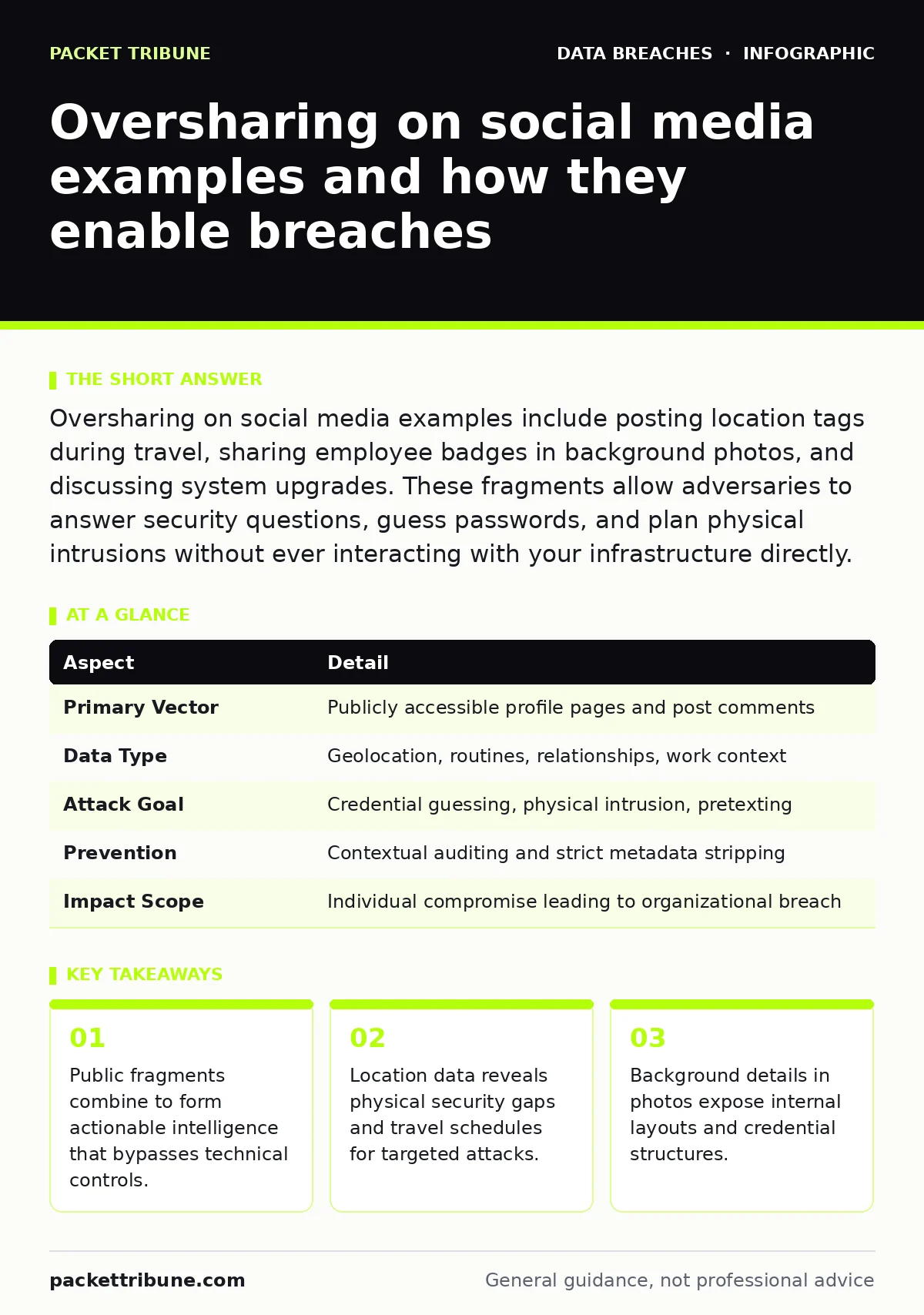
Oversharing on social media examples include posting location tags during travel, sharing employee badges in background photos, and discussing system upgrades. These fragments allow adversaries to answer security questions, guess passwords, and plan physical intrusions without ever interacting with your infrastructure directly.
The digital footprint analogy
Imagine leaving a trail of breadcrumbs from your front door to your car. Each crumb is harmless alone. A hungry animal might ignore one. But a determined predator can follow the line to your vehicle. Social media posts function like those crumbs. You drop a fact here, a photo there. Individually, they seem trivial. Collectively, they map your life.
Attackers do not need a single massive leak. They need consistency. When you post regularly, you create a predictable pattern. Predictability is the enemy of security. This process is often called OSINT, or Open Source Intelligence gathering. It relies entirely on data you voluntarily published.
What is oversharing and how it works
Oversharing on social media is the voluntary publication of granular personal or professional details that, when combined, reveal sensitive information. It is not a technical failure of your software. It is a behavioral failure of context. You share a moment, forgetting that the moment contains metadata.
The mechanism works through aggregation. An attacker collects public posts from multiple platforms. They cross-reference timestamps, locations, and relationships. This creates a dossier. The dossier reveals habits, security question answers, and physical vulnerabilities. No hacking tool is required. Only patience and search engines.
| Aspect | Detail |
|---|---|
| Primary Vector | Publicly accessible profile pages and post comments |
| Data Type | Geolocation, routines, relationships, work context |
| Attack Goal | Credential guessing, physical intrusion, pretexting |
| Prevention | Contextual auditing and strict metadata stripping |
| Impact Scope | Individual compromise leading to organizational breach |
Common oversharing on social media examples
People type exactly this query to understand the risk. You want to see oversharing on social media examples that lead to real damage. Consider these three common scenarios.
First, the travel post. You check in at an airport. You post a photo of your boarding pass. The pass contains your name, frequent flyer number, and sometimes your home address. Even if you blur the barcode, the text remains. An attacker uses this to guess your password or verify your identity for a password reset.
Second, the office selfie. You celebrate a promotion with a team photo. In the background, a whiteboard lists project codes. A monitor displays a login screen with a username. A badge hangs around a colleague's neck. These details reveal internal naming conventions. They help attackers craft believable phishing emails.
Third, the security question answer. You post about your first pet's name. You mention your mother's maiden name in a birthday tribute. You share the street you grew up on. These are classic security questions. If your employer uses them for account recovery, you have just handed the key to the attacker.
Who is affected by this exposure
You might think only celebrities face this risk. That assumption is dangerous. Attackers target mid-level managers and engineers. These roles have access to critical systems. They are visible online but lack executive-level security training.
Your employees are the primary vector. Their personal accounts reflect on your organization. If an employee posts about a new security tool, attackers know what to attack. If they post about office hours, attackers know when to strike. The risk extends to contractors and partners. Their oversharing can provide an entry point to your network.
This affects you because your defenses rely on the weakest link. A firewall cannot stop an attacker who knows your employee's pet name. That knowledge bypasses the firewall entirely. It enters through the human element.
What people usually get wrong
Most people believe that deleting posts removes the risk. This is incorrect. Cached copies exist. Screenshots persist. Search engines index old content. Once data is public, you lose control over its distribution.
Another mistake is assuming private accounts offer safety. Private accounts limit who sees new posts. They do not hide old posts. Friends can screenshot and share content. Friends' accounts can be compromised. The data escapes the bubble.
Many also think that only professional profiles matter. They ignore personal accounts. Attackers merge data from both. A personal photo reveals a hobby. A professional post reveals a conference. Together, they predict your location at a specific time. This prediction enables social engineering.
See also: Implement Database Security: A Step-by-Step Technical Guide · Prevent Public File Share Exposure With This Technical Checklist
How to mitigate the risk effectively
You must treat your personal data as an asset. Apply the same scrutiny to your social media as you do to your servers. Start with an audit. Search your own name. See what appears. View the results as an outsider would.
Remove unnecessary context. Do not tag locations in real-time. Wait until you have left the place. Strip metadata from photos before uploading. Most smartphones embed GPS coordinates in image files. These coordinates pinpoint your location.
Review security questions. Avoid answers that are public. Use a password manager to store fake answers. Do not use real answers for trivial questions. This prevents attackers from using your social media posts to reset your accounts.
Integrating social media hygiene into security policy
Your security policy must address personal conduct. It is not enough to secure devices. You must secure the data those devices publish. Include social media guidelines in your onboarding process.
Train employees on the concept of digital footprint. Show them how fragments combine. Use hypothetical scenarios to demonstrate the impact. This makes the abstract risk concrete.
Consider the related risks of credential leaks. If an employee oversharies their role, they become a high-value target for credential stuffing attacks. Your password hygiene practices must account for this increased visibility.
Also, review your mobile device management policies. Personal devices often access work email. If those devices are used for social media, the boundary blurs. Ensure that personal apps do not have access to corporate data.
The hidden cost of convenience
Convenience drives oversharing. Posting is easy. Deleting is hard. The effort to curate your digital presence is high. This creates a hidden cost. You trade security for social validation.
This trade-off is rarely calculated. You post because it feels good. You do not calculate the risk of exposure. This behavioral gap is where breaches begin.
You must reframe the cost. Think of each post as a potential vulnerability. The cost of one careless post can exceed the cost of years of security investments. The return on investment for careful posting is high. It prevents the breach entirely.
Related topics like encryption key management and encryption at rest protect data at rest. They do not protect data in motion on social media. You need behavioral controls to complement technical ones.
Unauthorized access often starts with information gathering. By reducing the available information, you reduce the attack surface. This is a proactive defense. It stops the attack before it begins.
Sensitive personal data includes more than financial records. It includes your habits, your location, and your relationships. Protect these with the same rigor as your financial data.
Doxxing is a severe consequence of oversharing. It involves publishing private information to harass or threaten. By limiting what you share, you reduce the material available for doxxing. This protects your safety and your reputation.
Key takeaways
- Public fragments combine to form actionable intelligence that bypasses technical controls.
- Location data reveals physical security gaps and travel schedules for targeted attacks.
- Background details in photos expose internal layouts and credential structures.
Frequently asked questions
Does changing my username stop attackers from finding my data?
No. Attackers use other identifiers like email addresses, phone numbers, and mutual connections. Your old username may still be linked to public archives and cached pages.
Can an employer legally monitor my personal social media accounts?
Laws vary by jurisdiction. Generally, employers cannot access private accounts without consent. However, they can monitor public posts. Always assume your public content is visible to your employer.
How often should I review my social media settings?
Review your settings every three months. Platforms frequently update their privacy policies. New features may expose more data than you intended. Regular audits catch these changes.
What is the best way to remove old posts?
Bulk-download your data first for your records. Then delete posts in batches. Check for cached versions on search engines. Request removal from third-party sites if possible. BOTTOM LINE: Your public posts are intelligence assets for attackers. Audit your digital footprint regularly and remove contextual details that reveal your routines and identity.
How this guide was produced: written by the Packet Tribune editorial team with AI assistance, checked against the public references listed below, and reviewed when the facts change. See our editorial policy or report an error.