RSA Encryption Online: How Public Key Cryptography Secures Your Data
RSA encryption relies on the mathematical difficulty of factoring large prime numbers, creating a system where anyone can lock data but only the key holder can unlock it.

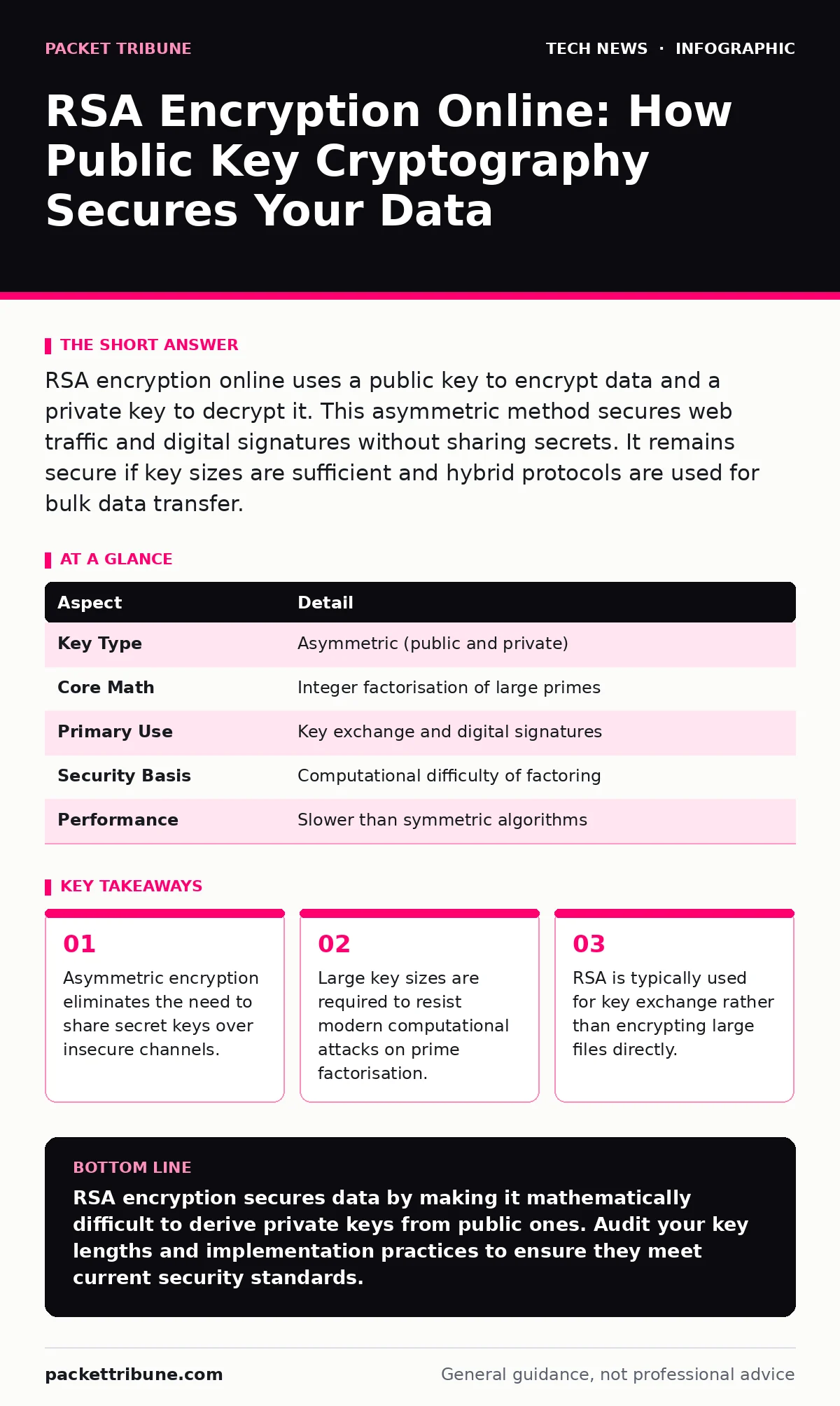
RSA encryption online uses a public key to encrypt data and a private key to decrypt it. This asymmetric method secures web traffic and digital signatures without sharing secrets. It remains secure if key sizes are sufficient and hybrid protocols are used for bulk data transfer.
What Is RSA Encryption Online?
RSA encryption online is an asymmetric cryptographic algorithm that uses two different keys for security operations. One key is public and can be shared openly, while the other is private and must be kept secret. This dual-key system allows you to send sensitive information over the internet without first establishing a secure channel for secret sharing. The name derives from the initials of its three inventors, Rivest, Shamir and Adleman.
The mechanism solves the key distribution problem inherent in symmetric encryption. In symmetric systems, both parties need the same secret key. Exchanging this key over the internet risks interception. RSA allows you to encrypt a message with a recipient's public key. Only the recipient's private key can decrypt it. This ensures confidentiality even if an attacker intercepts the encrypted data.
| Aspect | Detail |
|---|---|
| Key Type | Asymmetric (public and private) |
| Core Math | Integer factorisation of large primes |
| Primary Use | Key exchange and digital signatures |
| Security Basis | Computational difficulty of factoring |
| Performance | Slower than symmetric algorithms |
How RSA Encryption Works Mathematically
The security of RSA rests on the difficulty of factoring the product of two large prime numbers. Generating keys involves selecting two distinct large primes and multiplying them to create a modulus. The public key includes this modulus and an exponent. The private key includes the same modulus and a different exponent derived from the original primes.
Anyone can compute the product of two primes. However, deriving the original primes from their product is computationally intensive. Current classical computers require significant time to factor large moduli. This asymmetry in computational effort forms the security boundary. If an attacker factors the modulus, they can derive the private key. Therefore, key length determines security strength. Larger keys increase the difficulty of factorisation exponentially.
Imagine you want to send a locked box to a colleague. You ask them to send you an unlocked padlock and a box. They send the padlock, which represents the public key. You place your document in the box, close it and attach the padlock. You send the locked box back. Only your colleague has the key to open that specific padlock. Even if someone steals the box in transit, they cannot open it without the key. This analogy illustrates the flow of asymmetric encryption without sharing the secret key.
Why RSA Is Not Used for Bulk Data
RSA is computationally expensive compared to symmetric algorithms like AES. Encrypting large amounts of data with RSA would severely impact system performance. Processing times increase with key size and data volume. For this reason, RSA is rarely used to encrypt entire files or streams of data directly.
Instead, RSA facilitates the exchange of symmetric session keys. During a secure connection, RSA encrypts a randomly generated symmetric key. The recipient decrypts this key using their private key. Both parties then use the symmetric key for the remainder of the session. This hybrid approach combines the security of asymmetric key exchange with the speed of symmetric encryption. This pattern is standard in protocols like TLS that secure web traffic.
Understanding this distinction is vital for IT asset management teams. They must track which systems rely on RSA for key exchange versus those that might incorrectly use it for data encryption. Misconfiguration can lead to performance bottlenecks or security gaps. Proper configuration ensures that RSA handles only the initial handshake and signature verification.
What People Usually Get Wrong
Many assume RSA encryption online provides perfect secrecy regardless of implementation. This is incorrect. RSA security depends on proper random number generation and sufficient key size. Weak random number generators can produce predictable keys. Attackers can exploit these weaknesses to reconstruct the private key without factoring the modulus.
Another common misconception is that RSA is immune to future technological advances. While currently secure against classical computers, quantum computers pose a theoretical threat. Shor's algorithm can factor large integers efficiently on a sufficiently powerful quantum machine. This does not break current RSA immediately but highlights the need for DNSSEC and other systems to plan for post-quantum cryptography. Transitioning away from RSA will be a gradual process requiring significant infrastructure changes.
Key Management and Practical Risks
Key management is the most critical operational aspect of RSA. Private keys must be stored securely and never exposed. If a private key is compromised, an attacker can decrypt intercepted traffic or forge digital signatures. There is no way to change a key without generating a new pair and updating all dependent systems.
Organisations often struggle with key rotation and revocation. Old keys may remain active in systems for years. This increases the attack surface. Email security systems frequently use RSA for signing messages. If a signing key is compromised, an attacker can forge emails that appear to come from legitimate staff. This undermines trust in communication channels. Regular audits of key usage and expiration dates are necessary to maintain integrity.
See also: Encryption Key Management: How to Stop Keys from Becoming the Breach · Encryption at Rest: The Hidden Costs and Real Protection Limits
Integration with Modern Infrastructure
RSA integrates deeply into modern digital infrastructure. It secures APIs by signing requests and verifying identities. It protects software updates by ensuring code has not been tampered with. It underpins the security of operating system kernels by verifying boot loaders and drivers. Each of these applications relies on the integrity of the private key.
Network access control systems often use certificates signed with RSA to authenticate devices. This prevents unauthorised hardware from joining the network. However, certificate authorities must manage their own root keys carefully. A compromised root key allows an attacker to issue valid certificates for any domain. This enables man-in-the-middle attacks that bypass standard security checks. Monitoring certificate transparency logs helps detect such abuse early.
The Future of Asymmetric Encryption
The transition to post-quantum cryptography is underway. New algorithms designed to resist quantum attacks are being standardised. These algorithms often use different mathematical problems, such as lattice-based cryptography. Migration will require updating hardware, software and protocols. RSA will likely coexist with these new standards for some time.
Organisations should assess their reliance on RSA. Identify systems that cannot easily upgrade to new algorithms. Prioritise replacing these high-risk components. BitLocker and other disk encryption tools often use symmetric keys, but the keys themselves may be protected by RSA. Understanding these dependencies helps in planning a resilient security posture.
Key takeaways
- Asymmetric encryption eliminates the need to share secret keys over insecure channels.
- Large key sizes are required to resist modern computational attacks on prime factorisation.
- RSA is typically used for key exchange rather than encrypting large files directly.
RSA encryption secures data by making it mathematically difficult to derive private keys from public ones. Audit your key lengths and implementation practices to ensure they meet current security standards.
Frequently asked questions
Is RSA encryption still considered secure for online transactions?
Yes, RSA remains secure for online transactions when implemented with key sizes of at least 2048 bits and used for key exchange rather than bulk data encryption.
How does RSA differ from AES encryption?
RSA is asymmetric, using different keys for encryption and decryption, while AES is symmetric, using the same key for both operations and is faster for large data volumes.
What happens if my private RSA key is stolen?
If your private key is stolen, you must immediately revoke any associated certificates and generate a new key pair to prevent decryption of past or future communications.
Will quantum computers break RSA encryption?
Quantum computers with sufficient power could theoretically break RSA using Shor's algorithm, which is why the industry is transitioning to post-quantum cryptographic standards.
How this guide was produced: written by the Packet Tribune editorial team with AI assistance, checked against the public references listed below, and reviewed when the facts change. See our editorial policy or report an error.