RSA Encryption Misconceptions: Six Errors Undermining Your Security
RSA’s mathematical hardness does not guarantee security when implementation flaws, poor key management, or algorithmic misuse expose private data to trivial extraction.

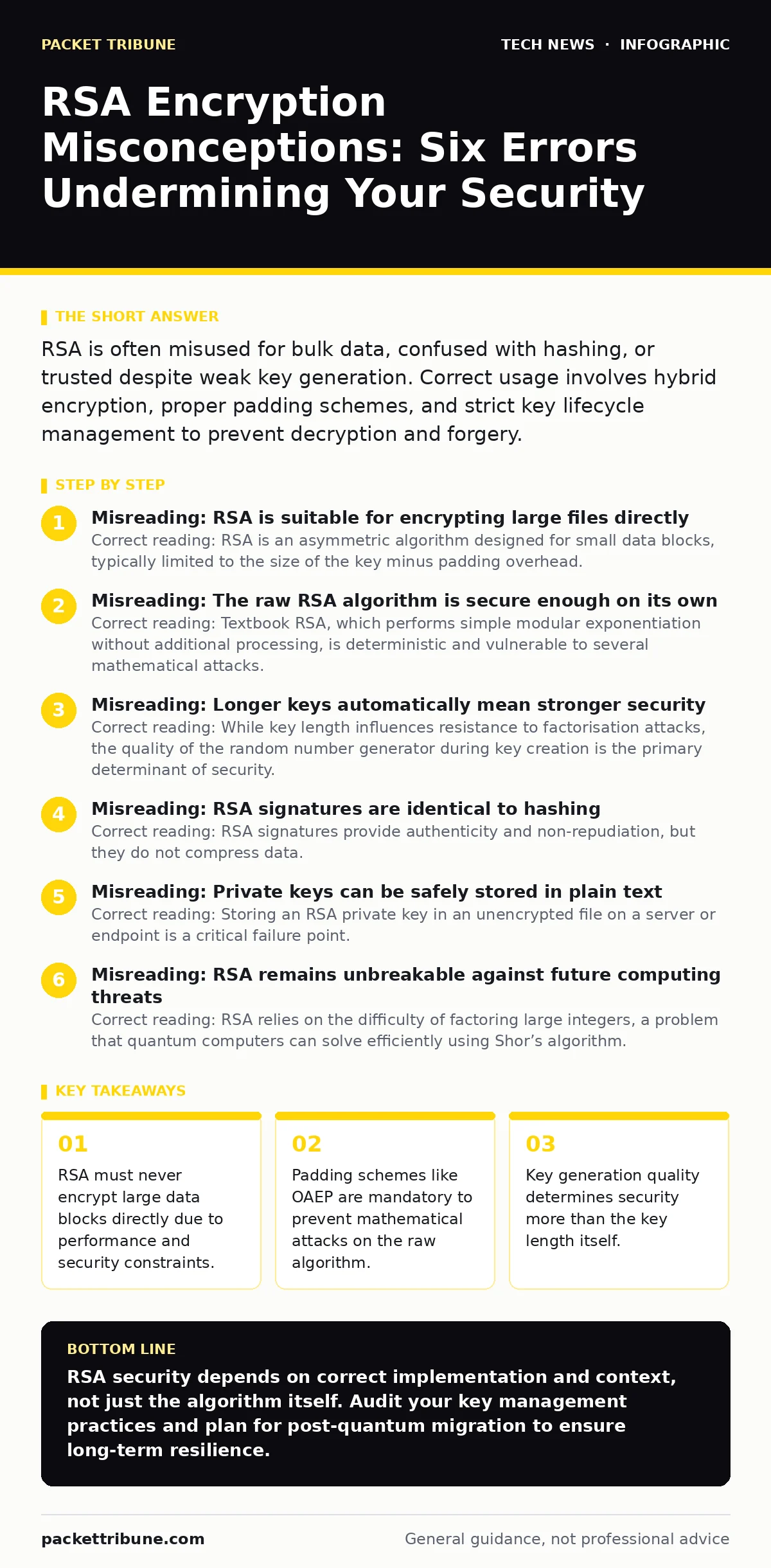
RSA is often misused for bulk data, confused with hashing, or trusted despite weak key generation. Correct usage involves hybrid encryption, proper padding schemes, and strict key lifecycle management to prevent decryption and forgery.
Misreading: RSA is suitable for encrypting large files directly
Correct reading: RSA is an asymmetric algorithm designed for small data blocks, typically limited to the size of the key minus padding overhead. Using it to encrypt megabytes of data is computationally expensive and introduces unnecessary risk. The standard approach is hybrid encryption.
You generate a random symmetric key, encrypt the bulk data with a fast symmetric algorithm like AES encryption, and then encrypt only that small symmetric key with RSA. This combines the speed of symmetric cryptography with the key exchange benefits of asymmetric cryptography. If you attempt to force RSA to handle large payloads, you risk buffer overflow vulnerabilities and severe performance degradation across your infrastructure.
Misreading: The raw RSA algorithm is secure enough on its own
Correct reading: Textbook RSA, which performs simple modular exponentiation without additional processing, is deterministic and vulnerable to several mathematical attacks. An attacker can deduce information about the plaintext by observing the ciphertext patterns. You must apply a probabilistic padding scheme, such as OAEP (Optimal Asymmetric Encryption Padding), before encryption.
Padding adds random bytes to the message, ensuring that encrypting the same message twice produces different ciphertexts. Without this randomness, the encryption is not semantically secure. This requirement is often overlooked in custom implementations that seek to minimise code complexity, leaving the system exposed to chosen-ciphertext attacks.
Misreading: Longer keys automatically mean stronger security
Correct reading: While key length influences resistance to factorisation attacks, the quality of the random number generator during key creation is the primary determinant of security. A 4096-bit key generated with a predictable or weak random source is easier to break than a properly generated 2048-bit key. Many historical compromises occurred because the entropy pool was insufficient, causing keys to share common factors.
You must ensure your key generation process draws from a cryptographically secure pseudo-random number generator. Furthermore, excessively long keys offer diminishing returns against classical computers while significantly increasing computational load. The focus should be on correct generation rather than arbitrary length inflation.
Misreading: RSA signatures are identical to hashing
Correct reading: RSA signatures provide authenticity and non-repudiation, but they do not compress data. You cannot sign a large document directly with RSA. Instead, you first compute a cryptographic hash of the document using a secure hash function, and then encrypt that hash with your private key. This process binds the signature to the specific content.
If you skip the hashing step, you face the same size limitations as encryption. Additionally, using weak hash functions alongside RSA creates a vulnerability where two different messages produce the same hash, allowing an attacker to forge a valid signature for a malicious document. This distinction is critical when reviewing code that handles digital signatures, as conflating the two processes leads to structural flaws.
Misreading: Private keys can be safely stored in plain text
Correct reading: Storing an RSA private key in an unencrypted file on a server or endpoint is a critical failure point. If an attacker gains read access to the file system, they obtain the key immediately. You must encrypt the private key at rest using a strong symmetric cipher, protected by a passphrase or a hardware security module. This adds a layer of defence where file system access alone is insufficient for compromise.
However, this introduces an operational trade-off: automated services cannot prompt for a passphrase. For servers, you must use a secure key store or a trusted platform module to manage the decryption process without exposing the key in memory longer than necessary. This mirrors the principles found in API key security, where credential isolation is paramount.
See also: Post-Quantum Cryptography: How Lattice Algorithms Replace RSA · DNSSEC Mistakes That Break Resolution and How to Fix Them
Misreading: RSA remains unbreakable against future computing threats
Correct reading: RSA relies on the difficulty of factoring large integers, a problem that quantum computers can solve efficiently using Shor’s algorithm. While practical quantum computers capable of breaking current key lengths do not yet exist, the threat is algorithmic, not merely theoretical. Data encrypted today with RSA could be harvested and decrypted once quantum hardware matures.
This is known as "harvest now, decrypt later." To mitigate this, you should plan a migration path toward post-quantum cryptography standards. These new algorithms rely on mathematical problems that are believed to be resistant to both classical and quantum attacks. Waiting for a breach to act is not a viable strategy for long-term data confidentiality.
Misreading: RSA provides confidentiality and integrity simultaneously
Correct reading: RSA encryption ensures confidentiality, but it does not inherently verify that the message has not been altered. An attacker with the public key can modify the ciphertext in specific ways that result in predictable changes to the plaintext upon decryption.
To ensure integrity, you must combine encryption with a message authentication code or use a scheme that provides authenticated encryption. Relying on RSA alone for both purposes creates a false sense of security. This separation of concerns is similar to how TLS certificates validate identity while the underlying protocol handles data integrity and confidentiality through separate mechanisms.
Misreading: Implementation details do not matter if the math is sound
Correct reading: Side-channel attacks exploit physical information leaked during computation, such as power consumption, electromagnetic emissions, or execution time. Even if the RSA mathematics are perfect, a flawed implementation can reveal the private key. For example, timing attacks measure how long decryption takes for different inputs, inferring bits of the key based on variance.
You must use constant-time implementations that perform the same operations regardless of the input data. This requires careful coding practices and often hardware-level protections. Ignoring these physical leaks renders the mathematical hardness of RSA irrelevant. This is a common pitfall in custom cryptographic libraries that prioritise speed over uniformity.
Misreading: RSA is the only viable asymmetric algorithm
Correct reading: RSA is one of several public-key algorithms, each with different trade-offs. Elliptic Curve Cryptography offers similar security with shorter keys, reducing bandwidth and processing requirements. This is particularly relevant for constrained devices or mobile applications. Choosing RSA solely because it is familiar can lead to suboptimal performance.
You should evaluate your specific requirements for latency, storage, and computational resources. In some contexts, such as DNSSEC for domain name security, different algorithms may be preferred for their efficiency in verifying signatures at scale. Understanding the broader ecosystem allows you to select the most appropriate tool for each specific use case.
Key takeaways
- RSA must never encrypt large data blocks directly due to performance and security constraints.
- Padding schemes like OAEP are mandatory to prevent mathematical attacks on the raw algorithm.
- Key generation quality determines security more than the key length itself.
RSA security depends on correct implementation and context, not just the algorithm itself. Audit your key management practices and plan for post-quantum migration to ensure long-term resilience.
Frequently asked questions
What is the difference between RSA and AES?
RSA is an asymmetric algorithm used for key exchange and signing, while AES is a symmetric algorithm used for fast bulk data encryption. They are typically used together in hybrid systems.
How long should an RSA key be?
Current standards recommend a minimum of 2048 bits, with 3072 or 4096 bits for higher security requirements. The length must balance security needs with performance constraints.
Can RSA be used for both encryption and signing?
Yes, but you should use separate key pairs for each purpose to maintain clear security boundaries and simplify key management and rotation procedures.
Is RSA secure against quantum computers?
No, RSA is vulnerable to quantum algorithms like Shor’s algorithm. You should prepare to transition to post-quantum cryptographic standards in the coming years.
How this guide was produced: written by the Packet Tribune editorial team with AI assistance, checked against the public references listed below, and reviewed when the facts change. See our editorial policy or report an error.