API Vulnerabilities Explained: How Hidden Doors Risk Your Data
Most API flaws stem from poor access controls rather than complex code errors, leaving user data exposed through misconfigured digital doors.

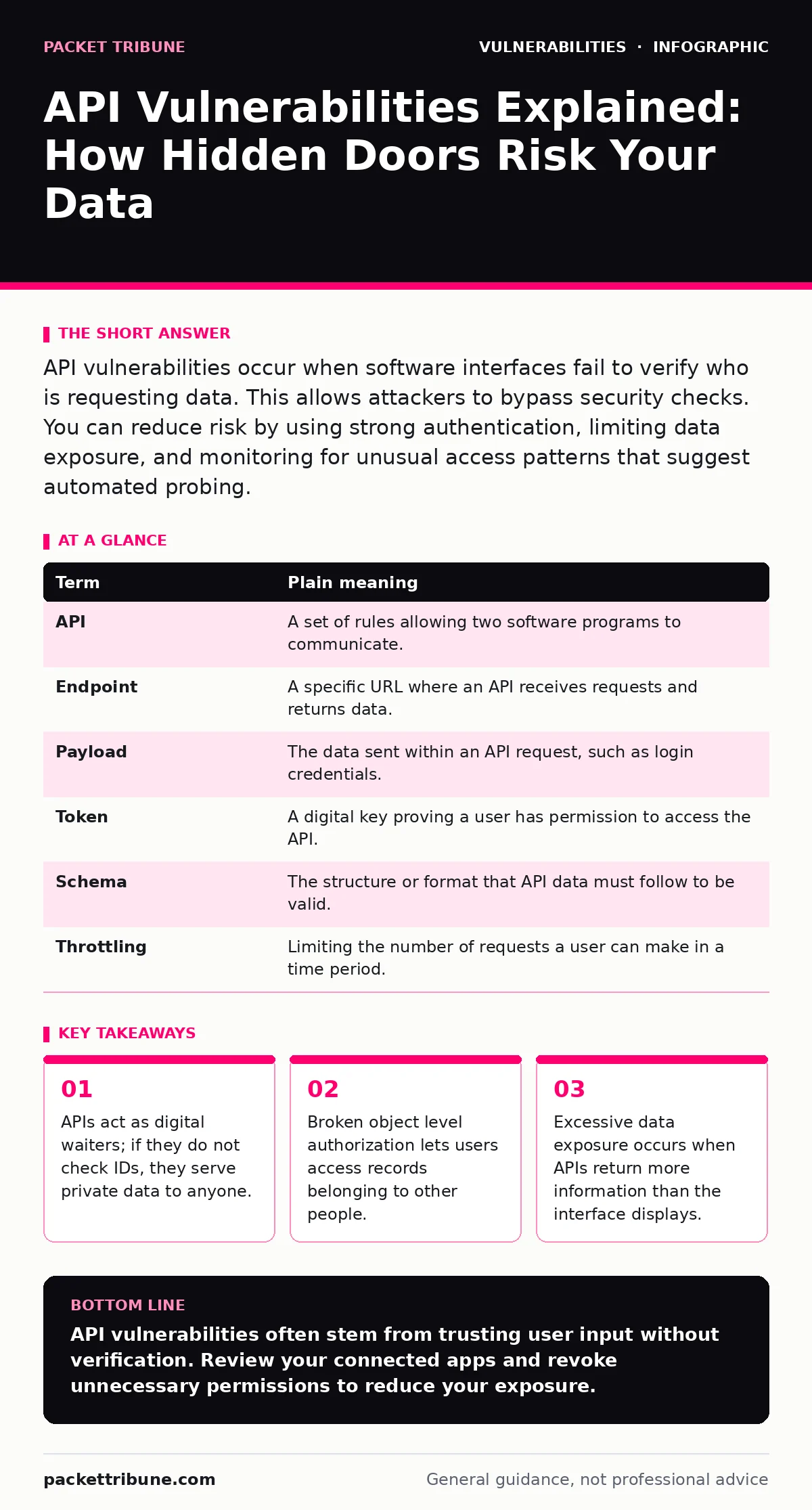
API vulnerabilities occur when software interfaces fail to verify who is requesting data. This allows attackers to bypass security checks. You can reduce risk by using strong authentication, limiting data exposure, and monitoring for unusual access patterns that suggest automated probing.
The Digital Waiter Metaphor
Imagine a restaurant where the waiter takes your order to the kitchen. In this scenario, the waiter is the Application Programming Interface. The API is a set of rules that allows different software systems to talk to each other. The kitchen is your database, containing sensitive ingredients like passwords and personal details. The waiter should only bring food to the person who ordered it. If the waiter gives your meal to a stranger because they forgot to check the table number, you have a security failure. This is the core of most API vulnerabilities. The system works, but the verification step is missing or flawed.
Why Traditional Walls Fail Here
Traditional web security relies on firewalls that inspect incoming traffic. These tools look for known malicious patterns in data packets. APIs behave differently because they are designed to be open and accessible to legitimate applications. A firewall cannot easily tell the difference between a legitimate mobile app request and a malicious script if both follow the correct format. This creates a blind spot. Attackers do not need to break down the front door. They simply walk in through the service entrance, pretending to be a valid customer. This is why understanding the mechanics of the interface is more useful than relying solely on perimeter defence.
Broken Object Level Authorization
The most common flaw involves Broken Object Level Authorization. This occurs when the server assumes a user is allowed to access a specific resource because they are logged in. It does not check if that specific resource belongs to them. Suppose you change the user ID in your browser URL from 100 to 101. If the API does not verify ownership, it returns the data for user 101.
This is not a hacking trick. It is a logic error in how the software handles requests. The system trusts the input blindly. For an ordinary user, this means your private messages or financial history could be visible to anyone who guesses a nearby ID number. See the related concepts in exposed admin panels for similar logic failures in management interfaces.
Excessive Data Exposure
Developers often build APIs to return large amounts of data for internal use. They then display only a small subset on the user interface. The rest remains hidden from the user but is still transmitted over the network. This is excessive data exposure. An attacker can inspect the raw data stream and extract sensitive fields. These fields might include internal notes, full addresses, or unhashed passwords. The application works correctly for the user, but it leaks data to anyone who knows how to read the underlying code. This happens because the developer trusted the client-side filtering rather than the server-side response.
Mass Assignment and Input Trust
Mass assignment happens when an API accepts all user input and applies it to the database object without filtering. Imagine telling the waiter you want extra fries. He writes this down. Now imagine you also whisper that you want admin privileges. If the waiter writes that down too and gives it to the kitchen, you have escalated your role. This is mass assignment. Attackers send extra parameters in their requests to change hidden fields. If the API trusts this input, a normal user can become an administrator. This flaw is closely related to NoSQL injection where malicious input alters the query structure. Both rely on the server trusting client data.
See also: Prevent Public File Share Exposure With This Technical Checklist · Network Access Control Mistakes That Compromise Your Infrastructure
Rate Limiting and Resource Exhaustion
APIs are often designed to handle high volumes of requests. This openness makes them vulnerable to abuse. Without rate limiting, an attacker can send thousands of requests per second. This can slow down the service for everyone else. This is a denial of service attack. It does not require sophisticated tools. Simple scripts can generate enough traffic to overwhelm the server. The cost is not just downtime. It is the distraction it causes for your security team. You must distinguish between legitimate traffic spikes and malicious floods. This requires careful monitoring and adjustment of thresholds.
| Term | Plain meaning |
|---|---|
| API | A set of rules allowing two software programs to communicate. |
| Endpoint | A specific URL where an API receives requests and returns data. |
| Payload | The data sent within an API request, such as login credentials. |
| Token | A digital key proving a user has permission to access the API. |
| Schema | The structure or format that API data must follow to be valid. |
| Throttling | Limiting the number of requests a user can make in a time period. |
Practical Safety Habits
You can protect yourself by adopting simple habits. First, never reuse passwords across services that use APIs. If one service suffers a breach, attackers often try those credentials on other platforms. Second, enable multi-factor authentication wherever possible. This adds a layer of security that is not dependent on the API's logic. Third, review application permissions regularly. Revoke access for apps you no longer use. This reduces the number of active tokens that could be stolen. These steps do not fix the vendor's code, but they limit your exposure.
- Check your account settings for connected apps and remove old entries.
- Use a unique password for any service that manages sensitive data.
- Review your privacy settings to limit what data is shared by default.
Understanding Your Exposure
You do not need to read code to understand your risk. Look for signs of poor security design. If a service allows you to change your email address without re-entering your password, it may have weak verification. If it sends error messages that reveal internal details, it is likely leaking information. These are surface indicators of deeper issues. You should treat such services with caution. The goal is not to find every flaw. It is to identify services that do not treat your data with care. This approach complements risk-based vulnerability management by focusing on high-impact user interactions.
The Cost of Convenience
APIs enable the modern digital experience. They allow seamless integration between banking apps, social media, and health trackers. This convenience comes with a hidden cost. Each connection is a potential entry point. The more integrations you use, the larger your attack surface. You cannot control the security of every third-party service. You can only control your access. By limiting the scope of permissions and monitoring for anomalies, you mitigate the risk. This is similar to managing dependency updates in software, where each new component introduces potential flaws.
Key takeaways
- APIs act as digital waiters; if they do not check IDs, they serve private data to anyone.
- Broken object level authorization lets users access records belonging to other people.
- Excessive data exposure occurs when APIs return more information than the interface displays.
API vulnerabilities often stem from trusting user input without verification. Review your connected apps and revoke unnecessary permissions to reduce your exposure.
Frequently asked questions
Can a firewall stop API attacks?
Firewalls block known malicious traffic but cannot easily detect logic errors within legitimate API requests. You need additional application-level security measures to address these flaws.
How do I know if an API is secure?
Look for indicators like strong authentication requirements and minimal data exposure. If a service asks for excessive permissions, it may not handle data securely.
Are mobile apps more vulnerable than websites?
Both use APIs, so the underlying risks are similar. Mobile apps may store tokens locally, which can be extracted if the device is compromised.
Should I avoid using APIs?
No, APIs are fundamental to modern technology. Instead, manage your risk by using strong credentials and limiting the data you share with third-party services.
How this guide was produced: written by the Packet Tribune editorial team with AI assistance, checked against the public references listed below, and reviewed when the facts change. See our editorial policy or report an error.