Risk-Based Vulnerability Management: Prioritise Exploitability Over CVSS Scores
Treating all vulnerabilities equally wastes resources; ranking by exploitability and asset value reveals which flaws actually endanger your organisation.

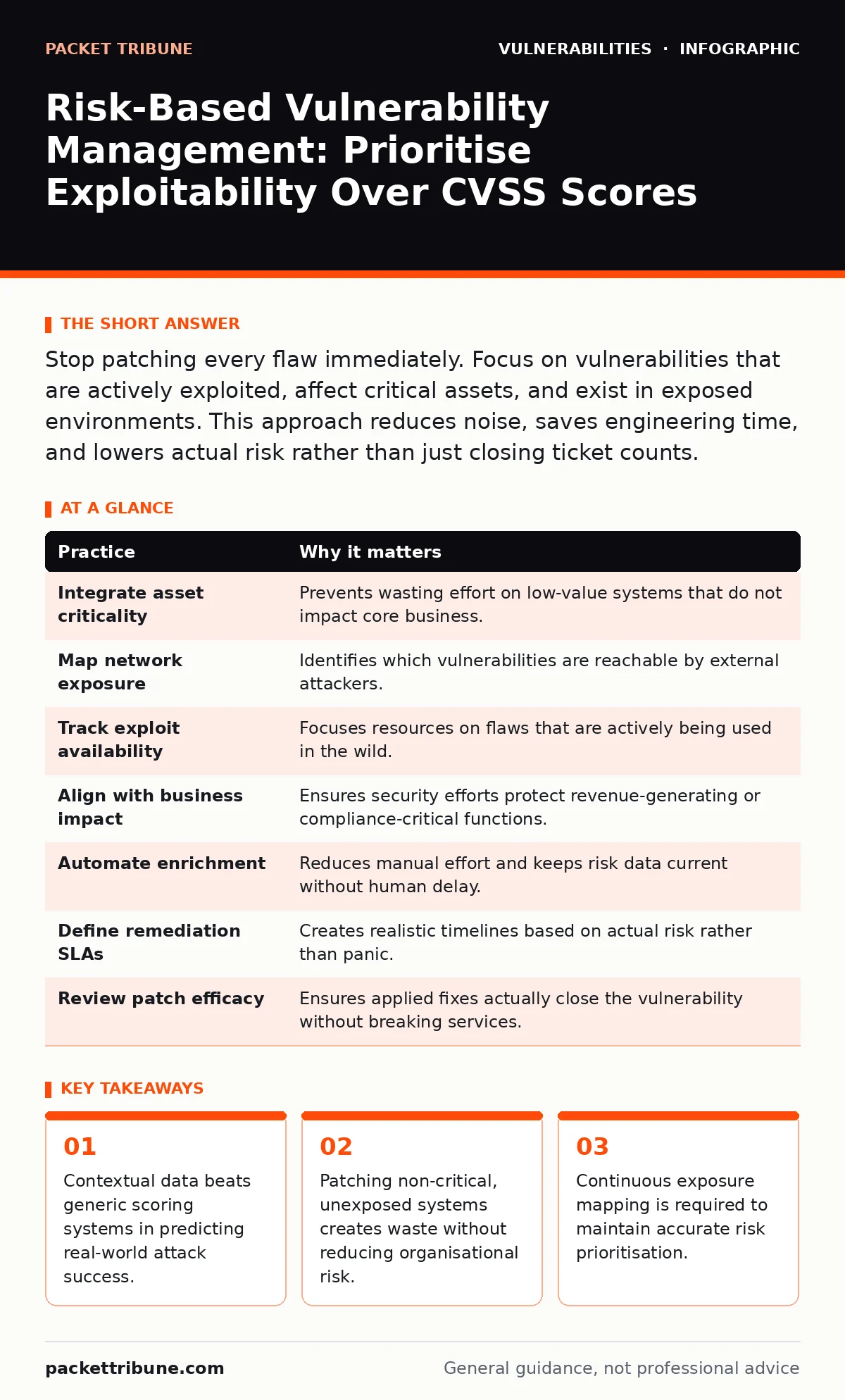
Stop patching every flaw immediately. Focus on vulnerabilities that are actively exploited, affect critical assets, and exist in exposed environments. This approach reduces noise, saves engineering time, and lowers actual risk rather than just closing ticket counts.
The Flaw in Generic Scoring
Vulnerability scanners generate long lists of issues, most of which pose little immediate danger. Using only standard severity scores creates a false sense of urgency. These scores measure potential impact in an abstract vacuum, ignoring your specific environment. You cannot manage risk if you treat every finding as equally dangerous.
Context determines danger. A flaw in an internal development server differs from one in a public-facing web portal. You must enrich scanner data with contextual facts. This includes asset criticality, network exposure, and whether an exploit exists. This process turns raw data into actionable intelligence.
| Practice | Why it matters |
|---|---|
| Integrate asset criticality | Prevents wasting effort on low-value systems that do not impact core business. |
| Map network exposure | Identifies which vulnerabilities are reachable by external attackers. |
| Track exploit availability | Focuses resources on flaws that are actively being used in the wild. |
| Align with business impact | Ensures security efforts protect revenue-generating or compliance-critical functions. |
| Automate enrichment | Reduces manual effort and keeps risk data current without human delay. |
| Define remediation SLAs | Creates realistic timelines based on actual risk rather than panic. |
| Review patch efficacy | Ensures applied fixes actually close the vulnerability without breaking services. |
1. Classify Assets by Business Value
Not all systems serve the same purpose. A testing database holds less value than a customer payment processor. You must define asset criticality within your organisation. This classification drives priority. If a system falls, what is the consequence? Is it financial loss, regulatory breach, or operational delay?
Group assets into tiers. Tier one assets require immediate attention. Tier three assets may wait for scheduled maintenance. This structure prevents alert fatigue. It ensures your team works on what protects the business first.
2. Map External Attack Surface
Vulnerabilities hidden behind firewalls pose less immediate threat. An internal printer flaw is different from a flaw in a public API. You need to know which assets are reachable from the internet. Use external scanning to verify your internal inventory. Discrepancies between internal records and external visibility are common.
Unmapped assets are blind spots. Attackers often target forgotten internet-facing services. These services may lack recent dependency updates or security patches. Regularly reconcile your internal asset list with external scan results. This ensures you are prioritising flaws that attackers can actually reach.
3. Prioritise Exploitable Vulnerabilities
Not all flaws have working exploits. Some vulnerabilities require complex conditions that rarely occur. You should focus on flaws that are actively exploited. Threat intelligence feeds provide data on which vulnerabilities are in use. This data allows you to skip theoretical risks.
Check for proof-of-concept code. If no public exploit exists, the risk is lower. This does not mean you ignore the flaw forever. It means you defer it. This strategy allows you to close high-risk gaps quickly. It prevents attackers from using known, easy-to-exploit weaknesses.
4. Integrate Context from Multiple Sources
Scanner data is incomplete. It tells you what is broken, not what matters. You must combine this data with other sources. This includes configuration management databases, cloud provider metadata, and security logs. This integration creates a single view of risk.
For example, a CVE Numbering Authorities entry provides technical details. Your internal system provides ownership and location. Combining these allows for accurate scoring. Without this integration, you are guessing at risk. Automated pipelines can merge these data streams continuously.
See also: CVE Numbering Authorities Explained: How Vulnerability IDs Are Assigned · Emergency Patching: How to Fix Critical Flaws Without Breaking Production
5. Set Dynamic Remediation Timelines
Fixed deadlines for all patches are inefficient. Critical flaws on critical assets need fast fixes. Low-risk flaws on internal systems can wait. Define Service Level Agreements based on risk tiers. This approach respects engineering capacity.
Avoid one-size-fits-all rules. A thirty-day window may be too long for a critical internet-facing flaw. It may be too short for a minor internal issue. Dynamic timelines reduce friction. They align security needs with operational reality. This balance improves compliance and reduces burnout.
6. Monitor for Mitigations and Workarounds
Patching is not always possible immediately. Some systems are legacy or vendor-locked. In these cases, mitigations and workarounds provide temporary protection. You must track these controls. They reduce risk until a permanent fix is applied.
For instance, disabling a feature may block an exploit. Filtering traffic at the firewall can prevent access. These measures lower the effective risk. They buy time for development teams. Document these controls clearly. They must be removed once the patch is applied.
7. Verify Patch Effectiveness
Applying a patch does not guarantee safety. The patch may fail to install. It may be bypassed by a variant of the exploit. You must verify that the fix works. Re-scan the asset after remediation. This confirms the vulnerability is gone.
Some backported security fixes apply only to specific versions. Ensure your verification process checks for these nuances. False negatives waste time. They create a false sense of security. Automated verification tools can streamline this process. They ensure consistency across large environments.
8. Review and Refine Processes
Vulnerability management is not static. New flaws emerge daily. Your processes must adapt. Review your prioritisation logic regularly. Check if your risk models reflect current threats. Adjust based on lessons learned.
This includes reviewing how you handle API vulnerabilities or router vulnerabilities. These areas often have unique challenges. Tailor your approach to these specific contexts. Continuous improvement ensures your strategy remains effective. It prevents stagnation in a changing environment.
9. Automate Data Enrichment
Manual data entry is slow and error-prone. Automation ensures consistency. Use tools to automatically tag assets with criticality. Integrate threat intelligence feeds for exploit data. This reduces the burden on analysts.
Automated pipelines can score vulnerabilities in real-time. This provides up-to-date risk views. It allows for faster decision-making. Automation scales with your environment. It handles complexity that humans cannot manage manually.
Key takeaways
- Contextual data beats generic scoring systems in predicting real-world attack success.
- Patching non-critical, unexposed systems creates waste without reducing organisational risk.
- Continuous exposure mapping is required to maintain accurate risk prioritisation.
Frequently asked questions
How do I determine asset criticality?
Consult business unit owners to define the impact of downtime or data loss for each system. Categorise based on financial, regulatory, and operational consequences.
Can I ignore low-severity vulnerabilities?
You can defer them if they affect non-critical, unexposed assets. However, you must monitor them. They may become relevant if the asset role changes.
What if a vendor does not provide a patch?
Implement mitigations such as network segmentation or feature disabling. Consider isolating the asset. Evaluate replacement options if risk remains unacceptable.
How often should I review my risk model?
Review quarterly or after significant infrastructure changes. Ensure your scoring logic reflects current threat data and business priorities. BOTTOM LINE: Context transforms vulnerability data into actionable risk management. Start by classifying your assets and mapping your external attack surface today.
How this guide was produced: written by the Packet Tribune editorial team with AI assistance, checked against the public references listed below, and reviewed when the facts change. See our editorial policy or report an error.