Emergency Patching: How to Fix Critical Flaws Without Breaking Production
Emergency patching bypasses standard change controls to neutralise active threats, trading procedural safety for immediate risk reduction.

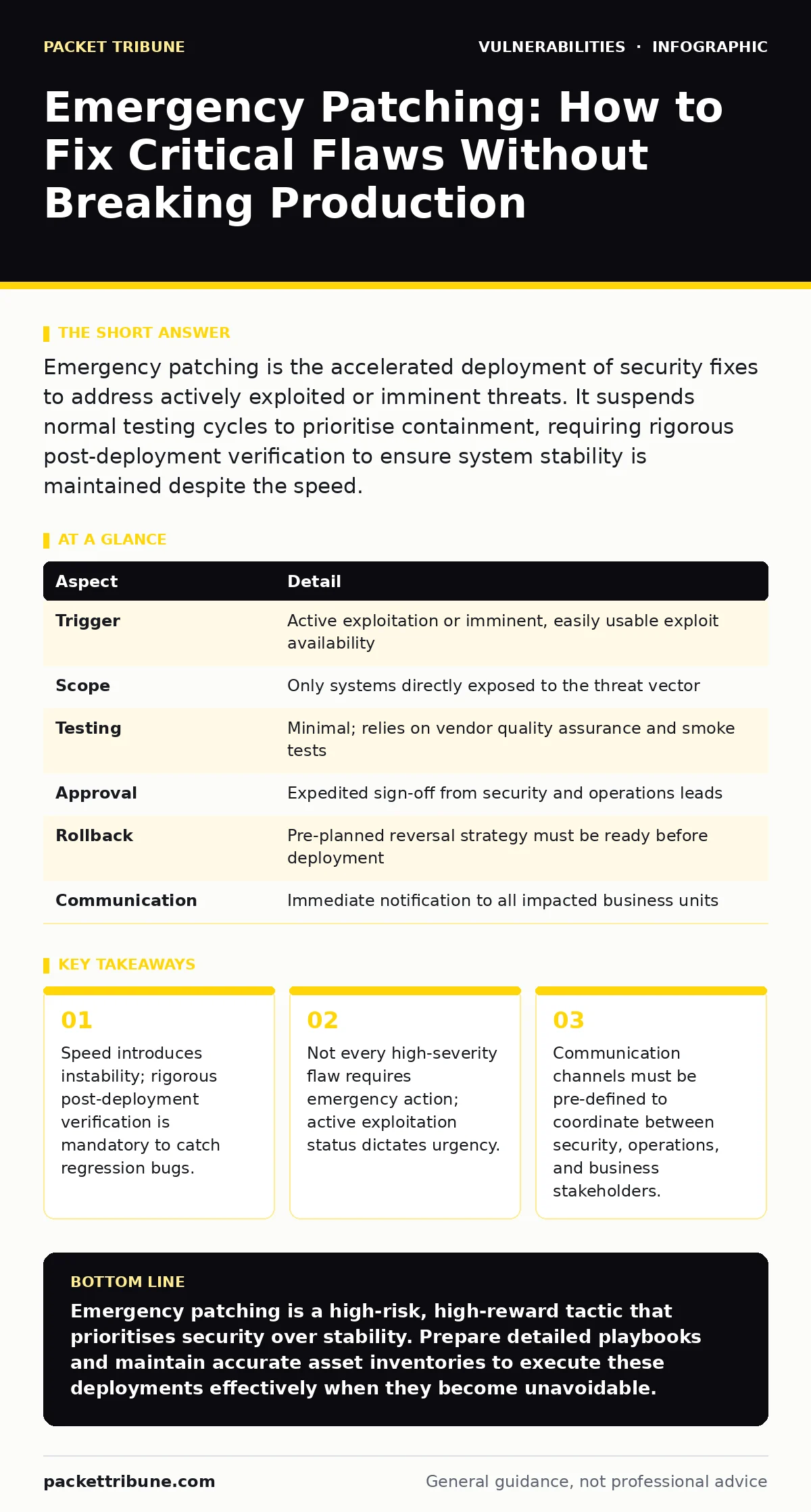
Emergency patching is the accelerated deployment of security fixes to address actively exploited or imminent threats. It suspends normal testing cycles to prioritise containment, requiring rigorous post-deployment verification to ensure system stability is maintained despite the speed.
The Fire Drill Analogy
Imagine a building where the main exit is blocked by debris. The standard procedure for removing debris involves a permit, a structural engineer’s sign-off, and a two-week notice. However, if a fire starts, you cannot wait for the engineer. You clear the path immediately, knowing the process is messy and potentially dangerous, because the alternative is catastrophic.
Emergency patching operates on this same principle. It is the rapid deployment of a security fix that bypasses standard change management protocols. You accept the risk of instability to mitigate the risk of a breach.
This approach is not about fixing every bug quickly. It is about managing the tension between security and availability when time is the most scarce resource.
Defining the Mechanism
Emergency patching is a specific subset of vulnerability management. It applies only when a vulnerability poses an immediate, tangible threat to your organisation’s assets. This usually means the flaw is being actively exploited in the wild, or a proof-of-concept exploit has become publicly available and easily usable.
The core mechanism involves three distinct phases. First, you identify the scope of affected systems. Second, you apply the fix with minimal testing, relying on vendor assurances rather than internal validation. Third, you perform rapid verification to ensure critical services remain operational.
This process sits outside your regular patching cadence. It is an exception, not a rule. Using it for routine updates erodes its effectiveness and creates operational chaos.
| Aspect | Detail |
|---|---|
| Trigger | Active exploitation or imminent, easily usable exploit availability |
| Scope | Only systems directly exposed to the threat vector |
| Testing | Minimal; relies on vendor quality assurance and smoke tests |
| Approval | Expedited sign-off from security and operations leads |
| Rollback | Pre-planned reversal strategy must be ready before deployment |
| Communication | Immediate notification to all impacted business units |
What Problem It Solves
Standard patching processes are designed to prevent outages. They involve weeks of testing, staging, and scheduled maintenance windows. This safety is a luxury you cannot afford when attackers are already scanning for your vulnerable systems.
The problem emergency patching solves is the gap between vulnerability disclosure and full mitigation. Attackers often begin exploiting flaws within hours of a disclosure. If you wait for your monthly patch cycle, you remain exposed during that window.
This method closes that window. It acknowledges that a brief period of operational instability is preferable to a confirmed data breach or service compromise. It shifts the priority from "perfect stability" to "rapid containment".
Integration With Other Defences
Emergency patching does not exist in isolation. It is one layer in a broader security strategy. Relying on it exclusively is dangerous because it is reactive. You must combine it with proactive measures to reduce the frequency of these crises.
For instance, risk-based vulnerability management helps you prioritise which flaws need emergency attention. By understanding your asset criticality, you can ignore low-risk vulnerabilities and focus resources on the systems that matter most. This prevents patch fatigue and ensures your emergency team is not overwhelmed by noise.
Additionally, mitigations and workarounds often provide a temporary shield while you prepare the patch. If a vendor has not yet released a fix, you might adjust firewall rules or disable specific features to reduce exposure. This buys you time to test the patch properly, turning an emergency situation into a controlled update.
Common Misconceptions
Many organisations misunderstand the scope and purpose of emergency patching. The most common error is treating every high-severity rating as an emergency. A vulnerability with a high Common Vulnerability Scoring System score is not automatically urgent if it requires physical access or complex prerequisites to exploit.
Another misconception is that emergency patching eliminates the need for testing. You can skip the full regression test suite, but you cannot skip validation entirely. Deploying a patch that breaks your core banking application is worse than leaving a non-exploitable vulnerability unpatched. You must verify that the primary function of the system still works.
Some teams also believe that emergency patching is a permanent state. It is not. Once the immediate threat subsides, you must return to standard procedures. Keeping systems in a state of constant emergency leads to technical debt and burnout.
See also: CVE Numbering Authorities Explained: How Vulnerability IDs Are Assigned · Risk-Based Vulnerability Management: Prioritise Exploitability Over CVSS Scores
The Hidden Costs of Speed
Speed has a price. When you bypass standard change controls, you lose visibility. You may not know exactly what changed in the code, or how it interacts with other custom configurations on your servers. This lack of visibility increases the risk of unintended consequences.
There is also a human cost. Emergency patching requires immediate attention from operations staff. If this happens frequently, it disrupts their workflow and leads to fatigue. Fatigued staff make mistakes. These mistakes often manifest as configuration errors or failed rollbacks, which can cause more downtime than the original vulnerability would have.
Furthermore, emergency patching can mask underlying issues. If you are constantly rushing to patch systems, it may indicate that your procurement or development processes are flawed. You might be introducing new vulnerabilities faster than you can fix them. Addressing this root cause is more effective than accelerating the patching process.
Preparing for the Unavoidable
You cannot prevent every emergency, but you can prepare for it. The key to effective emergency patching is preparation. You should have pre-defined playbooks that outline the steps for identification, approval, deployment, and verification.
These playbooks must include communication templates. When you deploy an emergency patch, you must inform users of potential downtime or changes. Silence breeds confusion and panic. Clear, concise communication helps manage expectations and reduces the load on your support teams.
You should also maintain an updated inventory of your assets. Knowing exactly which systems run which versions of software is critical. Without this visibility, you cannot determine the scope of the patching effort, leading to either over-patching or under-patching.
Beyond the Immediate Fix
Once the emergency is over, you must conduct a review. This is not about assigning blame, but about improving the process. Did the playbook work? Were the communication channels effective? How long did it take to identify the affected systems?
Use this review to refine your processes. Perhaps you need better automated scanning tools to detect vulnerabilities faster. Maybe you need to improve your dependency updates process to ensure you are not relying on outdated libraries.
Remember that backported security fixes can sometimes offer a safer alternative. If your systems are running a stable release that is no longer receiving new features, the vendor might provide a patch that applies only the security fix to your version. This reduces the risk of introducing new features or bugs into your stable environment.
Finally, consider how this incident fits into your broader strategy. Are you exposing exposed admin panels that make you more vulnerable? Are your developers aware of how to avoid NoSQL injection or integer overflow vulnerabilities? Emergency patching is a bandage. Good architecture and secure coding practices are the cure.
Key takeaways
- Speed introduces instability; rigorous post-deployment verification is mandatory to catch regression bugs.
- Not every high-severity flaw requires emergency action; active exploitation status dictates urgency.
- Communication channels must be pre-defined to coordinate between security, operations, and business stakeholders.
Emergency patching is a high-risk, high-reward tactic that prioritises security over stability. Prepare detailed playbooks and maintain accurate asset inventories to execute these deployments effectively when they become unavoidable.
Frequently asked questions
How do I decide if a vulnerability requires emergency patching?
Assess whether the vulnerability is being actively exploited and if your exposed systems are at risk. If the answer is yes to both, treat it as an emergency.
Can I use emergency patching for internal-only systems?
Yes, if the internal system is connected to a network that could be compromised or if the vulnerability allows lateral movement from other breached systems.
What if the vendor has not released a patch yet?
Implement mitigations and workarounds to reduce exposure. Monitor for vendor updates and be ready to deploy the patch as soon as it is available.
How do I handle rollback if the emergency patch fails?
Have a pre-tested rollback plan ready before deployment. Ensure you have backups or snapshots that allow you to revert to the previous state quickly.
How this guide was produced: written by the Packet Tribune editorial team with AI assistance, checked against the public references listed below, and reviewed when the facts change. See our editorial policy or report an error.