CVE Numbering Authorities Explained: How Vulnerability IDs Are Assigned
The global system relies on local coordinators who assign IDs based on product scope, not severity, creating a fragmented but scalable identification network.
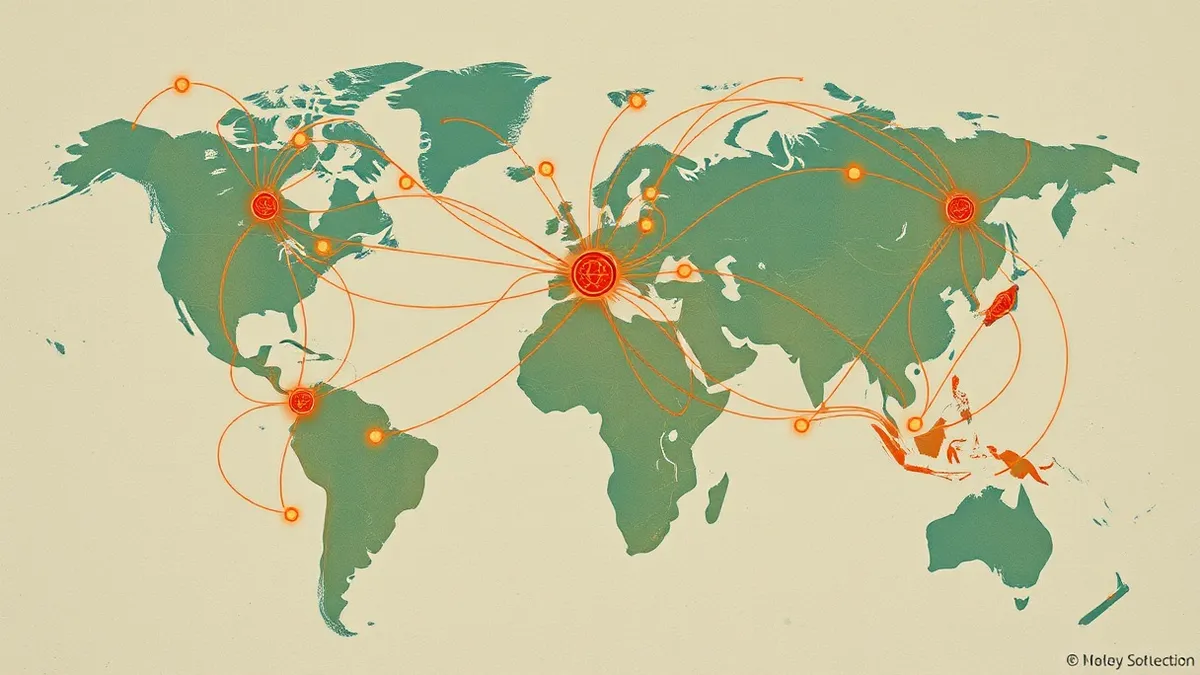
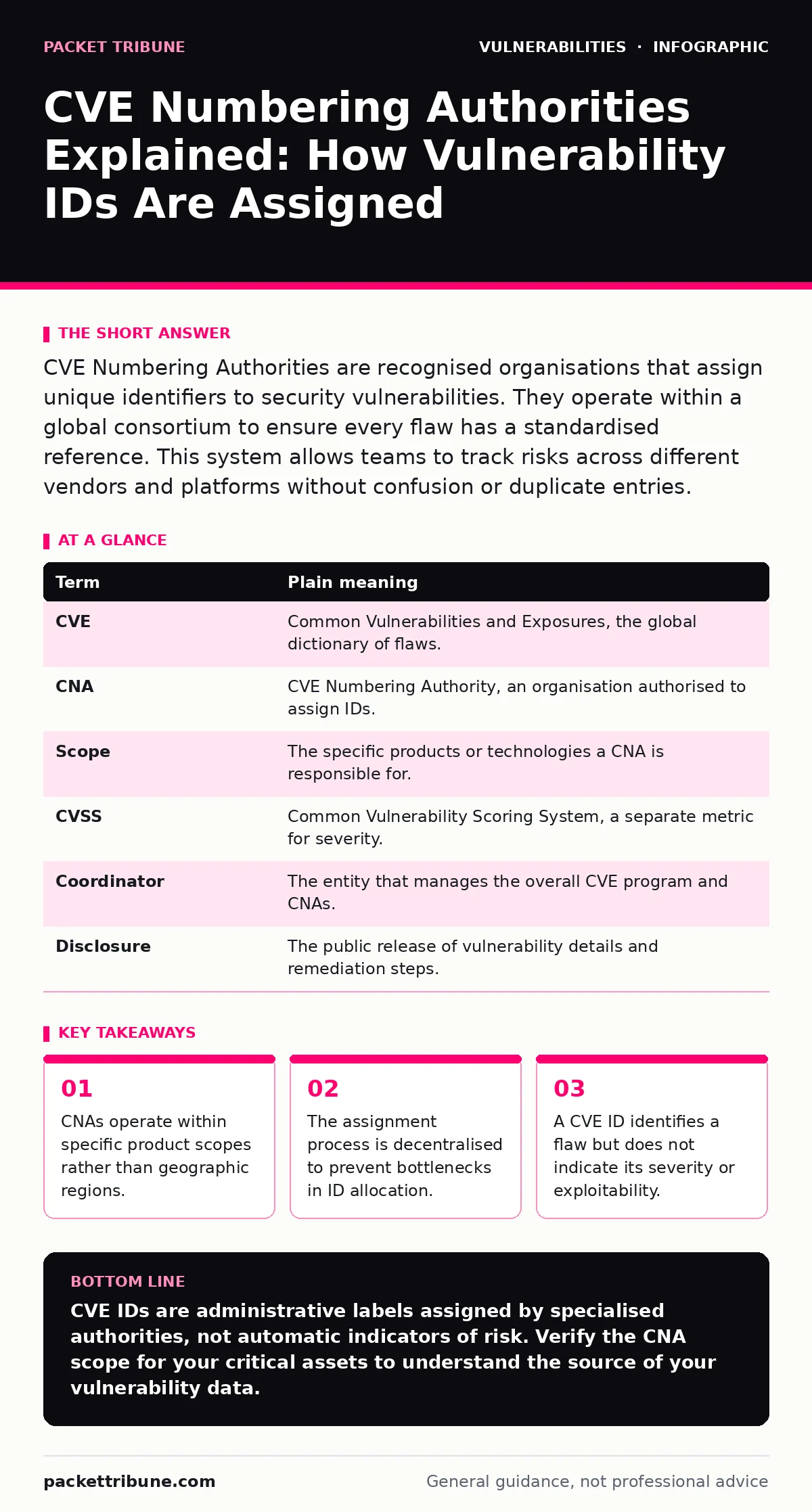
CVE Numbering Authorities are recognised organisations that assign unique identifiers to security vulnerabilities. They operate within a global consortium to ensure every flaw has a standardised reference. This system allows teams to track risks across different vendors and platforms without confusion or duplicate entries.
The Library Catalogue Analogy
Imagine a massive international library where books arrive from every publisher on Earth. If the library relied on a single clerk to stamp every book with a unique barcode, the system would collapse under the volume. Instead, the library appoints trusted specialists for each publisher. These specialists know their own books intimately and can assign barcodes instantly. This is how the Common Vulnerabilities and Exposures system functions.
The global CVE program acts as the library management. It sets the rules for barcodes but does not stamp every book itself. Instead, it delegates authority to specific entities. These entities become the local experts for certain types of content. This structure prevents a single point of failure in the identification process.
Defining the Authority
A CVE Numbering Authority, or CNA, is an organisation recognised by the CVE program to assign CVE IDs. These IDs are the standardised labels for security vulnerabilities. A CNA might be a software vendor, an industry consortium, or a government agency. The key requirement is scope. The CNA must have deep knowledge of the products within its assigned area.
You cannot become a CNA simply by asking. The process requires demonstrating expertise and operational capability. The CVE program reviews applications to ensure the applicant can handle the responsibility. This vetting ensures that IDs are assigned correctly and consistently. It maintains trust in the global database.
Scope Determines Authority
The most common confusion stems from geography. People often assume CNAs cover specific countries. This is incorrect. A CNA covers a specific product or technology scope. For example, one CNA might handle all vulnerabilities for a specific operating system. Another might cover a broad range of web applications.
This scope-based model allows for specialisation. A vendor is the best source of truth for its own code. It can identify flaws faster than an external body. However, this creates edge cases. What if a vulnerability affects two products owned by different CNAs? The CNAs must coordinate. They negotiate who assigns the ID.
Consider a scenario where a library book is co-authored by two publishers. The specialists must agree on which barcode to use. This negotiation ensures a single ID for a single flaw. It prevents duplicate entries that confuse tracking systems.
The Assignment Process
When a vulnerability is discovered, the responsible CNA assigns a CVE ID. This happens before the details are made public. The ID acts as a placeholder. It allows researchers and vendors to discuss the flaw without confusion. The CNA then publishes a brief description.
This description must be factual. It should not include severity scores or remediation advice. Those details belong to other systems. The CVE ID is purely an identifier. It links to a specific technical flaw in a specific product. This separation of concerns keeps the database clean.
Common Points of Confusion
Many teams assume that a CVE ID implies immediate danger. This is a dangerous misconception. The ID is administrative. It tells you that a flaw exists. It does not tell you how easy it is to exploit. You must cross-reference the ID with other sources for risk assessment.
Another confusion involves timing. People expect IDs to appear only after a patch is released. In reality, IDs are often assigned during the research phase. This allows for coordinated disclosure. It gives vendors time to prepare fixes. The ID exists before the solution.
See also: Emergency Patching: How to Fix Critical Flaws Without Breaking Production · Risk-Based Vulnerability Management: Prioritise Exploitability Over CVSS Scores
Mini Glossary of Terms
| Term | Plain meaning |
|---|---|
| CVE | Common Vulnerabilities and Exposures, the global dictionary of flaws. |
| CNA | CVE Numbering Authority, an organisation authorised to assign IDs. |
| Scope | The specific products or technologies a CNA is responsible for. |
| CVSS | Common Vulnerability Scoring System, a separate metric for severity. |
| Coordinator | The entity that manages the overall CVE program and CNAs. |
| Disclosure | The public release of vulnerability details and remediation steps. |
Try This Now
- Identify the vendor of a critical application in your environment. Check if that vendor is listed as a CNA. This tells you who is responsible for assigning IDs for that software.
- Select a recent CVE ID relevant to your stack. Read the raw description from the CVE database. Note what information is missing, such as exploitability or impact.
- Review your internal tracking process. Ensure you are not using CVE IDs as severity indicators. Map them to your own risk framework instead.
Integration with Risk Management
Understanding CNAs helps you navigate the wider security ecosystem. When you see a new CVE, you know it has passed a basic validation step. You can trust the identifier is unique. This reliability supports broader strategies like risk-based vulnerability management.
It also clarifies why some flaws appear quickly while others lag. If a CNA is slow, the ID assignment delays. This does not mean the flaw is unknown. It means the administrative process is pending. Patience is required. Do not assume silence means safety.
For teams dealing with complex stacks, understanding these boundaries is helpful. It prevents frustration when IDs seem missing. It also aids in prioritising dependency updates. You know who to watch for announcements. This clarity reduces noise in your alerting systems.
Key takeaways
- CNAs operate within specific product scopes rather than geographic regions.
- The assignment process is decentralised to prevent bottlenecks in ID allocation.
- A CVE ID identifies a flaw but does not indicate its severity or exploitability.
CVE IDs are administrative labels assigned by specialised authorities, not automatic indicators of risk. Verify the CNA scope for your critical assets to understand the source of your vulnerability data.
Frequently asked questions
Can an individual researcher assign a CVE ID?
No, individuals must work through a recognised CNA or submit findings to the CVE program coordinator for assignment.
Does a CVE ID mean a patch is available?
Not necessarily. IDs are often assigned before patches are developed to facilitate coordinated disclosure.
How do I find the CNA for a specific product?
Consult the official CVE program list of CNAs, which maps organisations to their assigned product scopes.
Can one vulnerability have multiple CVE IDs?
Generally no. If multiple CNAs are involved, they coordinate to assign a single ID to avoid duplication.
How this guide was produced: written by the Packet Tribune editorial team with AI assistance, checked against the public references listed below, and reviewed when the facts change. See our editorial policy or report an error.