Dependency Updates: Mechanism, Risk and Maintenance Strategy
Updating dependencies is not merely a repair task; it is a continuous negotiation between software stability and the shrinking window of exploitability.
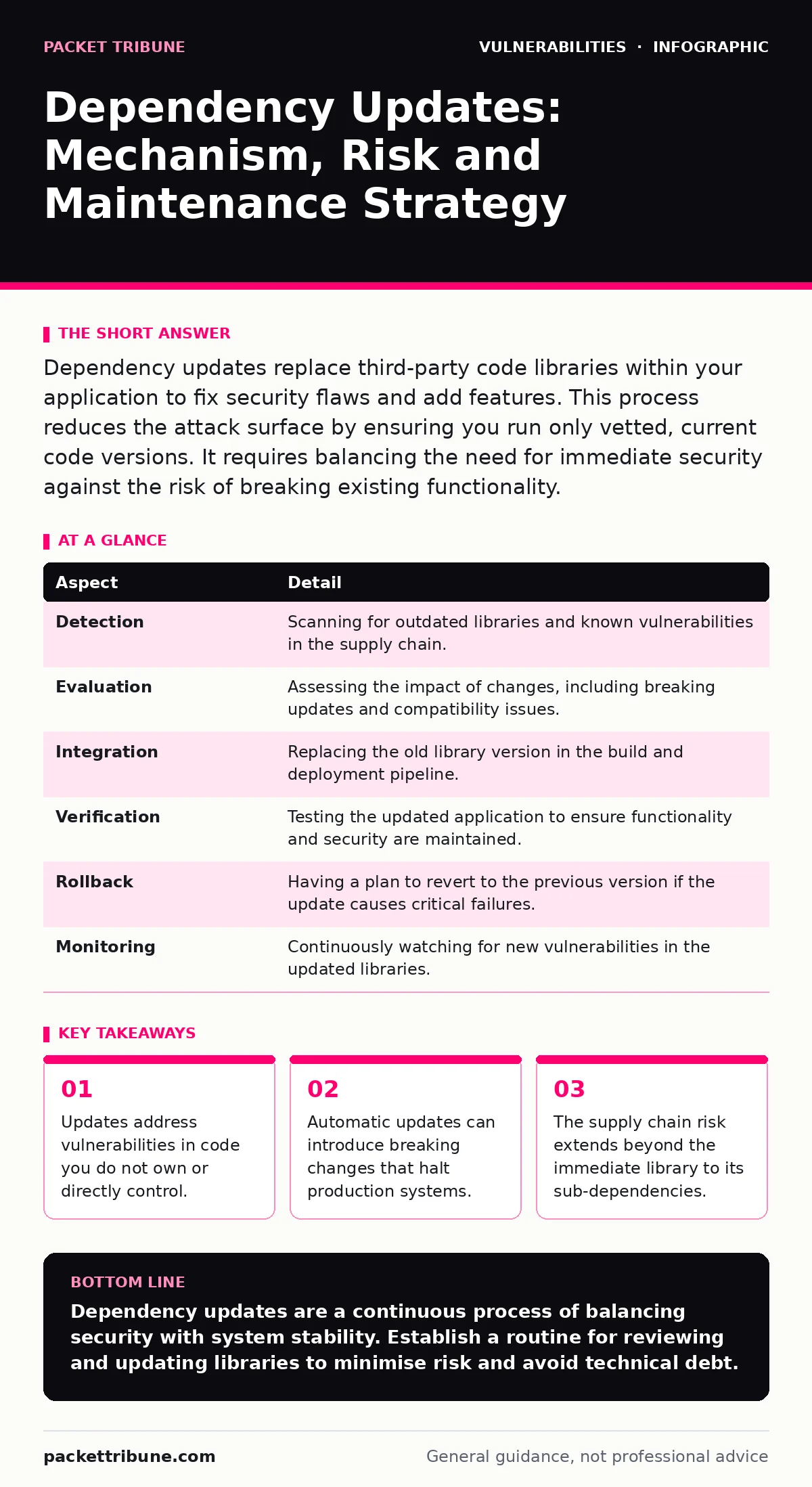
Dependency updates replace third-party code libraries within your application to fix security flaws and add features. This process reduces the attack surface by ensuring you run only vetted, current code versions. It requires balancing the need for immediate security against the risk of breaking existing functionality.
The Library Analogy
Imagine you are building a house using pre-fabricated rooms. You design the layout, but you buy the plumbing, electrical wiring and insulation from specialists. If a flaw is discovered in the wiring standard, you cannot simply rewire the house yourself. You must wait for the specialist to produce a corrected version and then swap out the old component.
In software, your application is the house. The libraries you import are the pre-fabricated rooms. Dependency updates are the process of replacing these imported libraries with newer versions. This ensures that any flaws in the specialist’s work are corrected before they can be exploited.
The purpose is not just to add new features. It is to maintain the integrity of the components you rely on. If you ignore these updates, you are effectively leaving a known broken window in your house, hoping no one notices.
The Problem of Transitive Trust
The core problem dependency updates solve is the illusion of control. When you write code, you can review every line. When you use a library, you trust the author. This trust is transitive. If library A uses library B, and library B has a flaw, your application is vulnerable even if library A is perfect.
This creates a hidden attack surface. Attackers often target popular libraries because compromising one library can give them access to thousands of applications that use it. You are defending not just your code, but the entire chain of libraries beneath it.
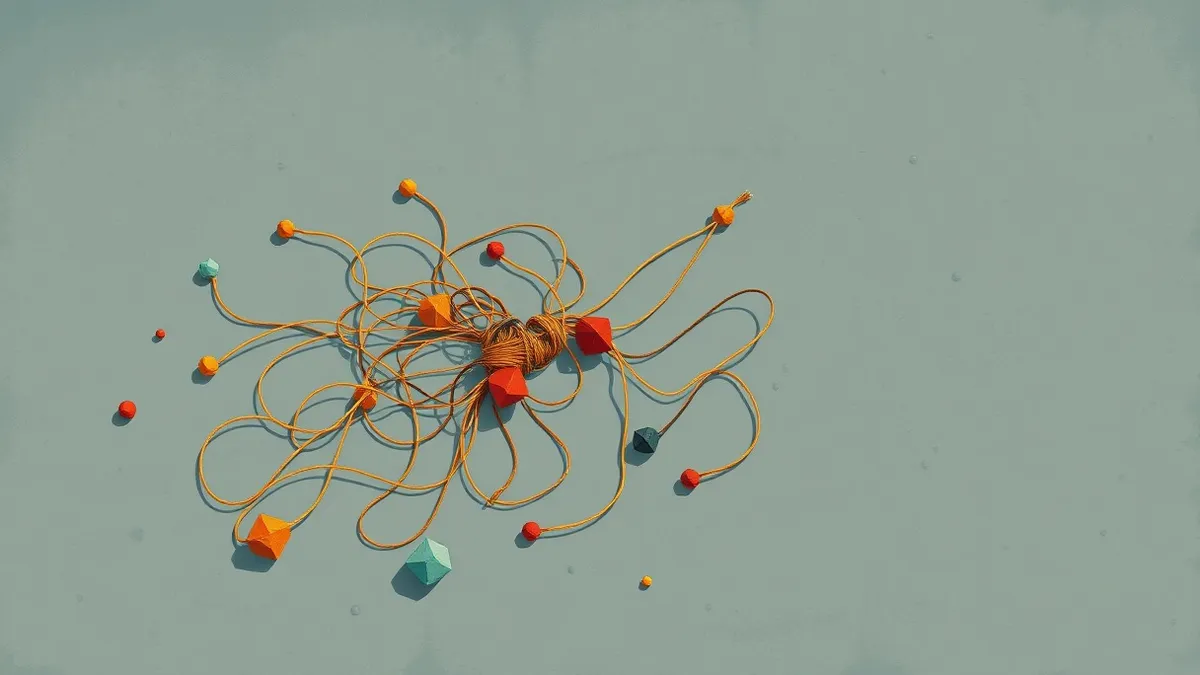
Consider the difference between a direct dependency and a transitive one. A direct dependency is a library you explicitly import. A transitive dependency is a library used by your direct dependency. You often have no visibility into the latter until a vulnerability is disclosed.
Anatomy of an Update Cycle
The update process consists of three distinct phases: detection, evaluation and integration. Detection involves identifying which libraries are outdated and whether new versions exist. This is often automated by tools that scan your project’s manifest files.
Evaluation is the most critical step. You must determine if the new version introduces breaking changes. A breaking change is a modification that causes existing code to fail or behave differently. This phase requires reviewing release notes and testing the update in a non-production environment.
Integration is the final swap. You replace the old library version with the new one in your build pipeline. This must be done carefully to ensure that the application continues to function as expected. Rushing this step can lead to system outages that are more damaging than the original vulnerability.
| Aspect | Detail |
|---|---|
| Detection | Scanning for outdated libraries and known vulnerabilities in the supply chain. |
| Evaluation | Assessing the impact of changes, including breaking updates and compatibility issues. |
| Integration | Replacing the old library version in the build and deployment pipeline. |
| Verification | Testing the updated application to ensure functionality and security are maintained. |
| Rollback | Having a plan to revert to the previous version if the update causes critical failures. |
| Monitoring | Continuously watching for new vulnerabilities in the updated libraries. |
Where Updates Fit in Defence
Dependency updates are a form of mitigations and workarounds. They are not a standalone solution. They work best when combined with other defences. For instance, if a vulnerability is found in a library, an update might not be immediately available. In this case, you might apply a workaround to restrict access to the vulnerable function.
Updates also relate to backported security fixes. Sometimes, vendors release fixes for older versions of a library rather than forcing an upgrade. This allows you to patch a vulnerability without changing the library version, reducing the risk of breaking changes. Understanding when to update and when to apply a backport is a key skill.
However, updates do not replace secure coding practices. If your application has NoSQL injection flaws, updating the database driver will not fix the issue. The flaw lies in how you handle user input, not in the library itself. Updates address the library’s code, not your application’s logic.
The Hidden Cost of Stability
There is a trade-off between security and stability. New library versions often include performance improvements and new features. However, they may also change how data is handled. This can break existing integrations. For example, a library might change how it formats dates, causing errors in reports that relied on the old format.
This is why many teams hesitate to update. They fear the cost of debugging and fixing broken functionality. This hesitation creates a "technical debt" of security. The longer you wait, the more vulnerabilities accumulate, and the harder the update becomes. A large update involves many changes, making it difficult to identify the cause of any new issues.
Common Misconceptions
Many teams believe that automatic updates are the best solution. This is a mistake. Automatic updates remove human oversight. If a malicious actor compromises a library maintainer, an automatic update could install malicious code. Human review provides a checkpoint to verify that the update is legitimate and safe.
Another misconception is that updating one library fixes all related issues. This is rarely true. Libraries have their own dependencies. Updating library A might not update library B, which library A uses. You must update the entire dependency tree to ensure all vulnerabilities are addressed. This is known as a "dependency graph" update.
Finally, some believe that internal tools do not need updates. This is dangerous. If an internal tool has exposed admin panels, it can be used as a foothold to attack the wider network. Even tools that do not face the internet can be compromised if an attacker gains access to the internal network.
Managing the Supply Chain
Effective dependency management requires a strategy. Start by maintaining an inventory of all libraries your applications use. This is called a Software Bill of Materials (SBOM). Without an SBOM, you cannot know what you are vulnerable to.
Next, establish a routine for updates. Do not wait for a crisis. Regular, small updates are easier to manage than large, infrequent ones. This reduces the risk of breaking changes and keeps your security posture strong.
Finally, consider the source. Prefer libraries that are actively maintained and have a clear security policy. Avoid libraries with no recent updates or unclear ownership. These are high-risk components that may never receive security fixes.
Integration with Other Defences
Dependency updates work in tandem with other security measures. For example, if you are dealing with router vulnerabilities, updating the firmware is a form of dependency update. The router’s operating system is a collection of libraries and components. Keeping these updated is critical for network security.
Similarly, integer overflow vulnerabilities are often found in low-level libraries. Updating these libraries can prevent crashes and potential code execution. However, this only works if the application correctly handles the data passed to these libraries.
In cases of emergency patching, speed is critical. You may need to update a library immediately to address a critical vulnerability. This bypasses the normal evaluation process. To mitigate the risk, you should have a rollback plan ready. If the update causes issues, you can revert quickly.
Key takeaways
- Updates address vulnerabilities in code you do not own or directly control.
- Automatic updates can introduce breaking changes that halt production systems.
- The supply chain risk extends beyond the immediate library to its sub-dependencies.
Dependency updates are a continuous process of balancing security with system stability. Establish a routine for reviewing and updating libraries to minimise risk and avoid technical debt.
Frequently asked questions
How often should I update my dependencies?
Update regularly, ideally as part of your normal development cycle. Small, frequent updates are safer than large, infrequent ones.
What is a breaking change?
A breaking change is a modification in a library that causes existing code to fail or behave differently. This requires code changes in your application to fix.
Can I automate dependency updates?
You can automate the detection and testing of updates, but human review is recommended before deployment to ensure safety and compatibility.
What is a Software Bill of Materials?
An SBOM is a list of all the libraries and components used in your application. It helps you track vulnerabilities and manage updates.
How this guide was produced: written by the Packet Tribune editorial team with AI assistance, checked against the public references listed below, and reviewed when the facts change. See our editorial policy or report an error.