Secure Software Development: Benefits, Limits and Real ROI
Secure development reduces breach probability but introduces velocity trade-offs that require careful architectural balancing to maintain delivery speed.

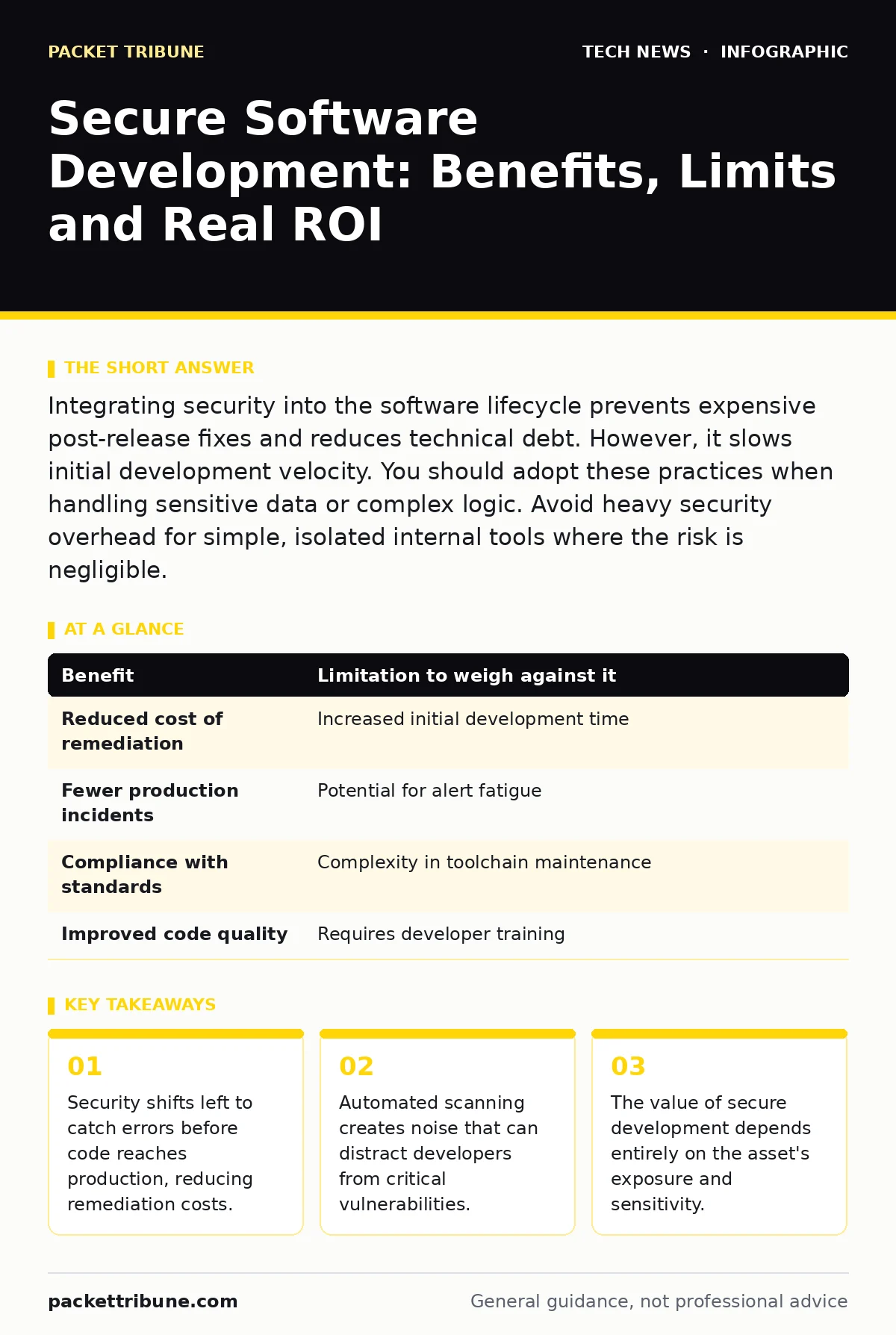
Integrating security into the software lifecycle prevents expensive post-release fixes and reduces technical debt. However, it slows initial development velocity. You should adopt these practices when handling sensitive data or complex logic. Avoid heavy security overhead for simple, isolated internal tools where the risk is negligible.
The Economic Case for Early Security
Fixing a vulnerability after deployment costs significantly more than fixing it during design. This is not merely a matter of developer convenience. It is a structural reality of software engineering. When you find a flaw in production, you must halt updates, notify users, and rebuild trust.
Early detection allows you to correct logic errors while the code is still abstract. You change a line of text rather than a running system. This approach, often called "shift left," moves security checks to the beginning of the pipeline. It treats security as a quality attribute, identical to performance or usability.
The primary benefit is reduced mean time to remediation. You address the issue while the context is fresh in the developer's mind. This prevents the accumulation of technical debt, which is the cost of choosing an easy solution now instead of a better approach that would take longer.
The Velocity Tax of Security Controls
Security controls introduce friction. Every check requires time. Static analysis tools scan code for patterns that resemble vulnerabilities. This process takes computational resources and human attention to review results.
The limitation is that security processes can slow down feature delivery. If your team cannot deploy frequently, business momentum stalls. This creates tension between the development team and the security team. Developers may view security checks as obstacles rather than safeguards.
You must balance the depth of inspection with the speed of delivery. Over-scanning leads to alert fatigue. When developers see hundreds of warnings, they ignore them. This creates a false sense of security because critical issues get buried in noise.
Comparing Security Outcomes
The table below contrasts the tangible benefits of secure development against the operational limitations you must manage.
| Benefit | Limitation to weigh against it |
|---|---|
| Reduced cost of remediation | Increased initial development time |
| Fewer production incidents | Potential for alert fatigue |
| Compliance with standards | Complexity in toolchain maintenance |
| Improved code quality | Requires developer training |
When Integration Is Worth It
You should invest heavily in secure development when the software handles sensitive data. If your application processes financial records, health information, or intellectual property, the cost of a breach outweighs the cost of development friction.
Complex architectures also demand rigorous security. Systems with multiple interacting components have a larger attack surface. Each interface is a potential entry point for an attacker. You need automated checks to ensure that data flows correctly between these components.
Consider the implications for APIs. These interfaces expose your data to external consumers. A single misconfigured endpoint can leak vast amounts of information. Secure development practices ensure that authentication and authorisation are baked into the design, not added as an afterthought.
When Simplicity Suffices
Not every piece of software requires a fortress. If you are building a simple internal tool used by five people, heavy security measures may be overkill. The cost of implementing and maintaining these controls exceeds the potential damage of a breach.
Isolated systems with no external connectivity have a lower risk profile. If the software cannot be reached from the internet, the attack surface is minimal. You can rely on network segmentation and access controls rather than deep code inspection.
However, do not assume isolation is permanent. Systems evolve. An internal tool may eventually need to connect to an external service. You should design with some baseline security hygiene, even for low-risk applications. This prevents future refactoring when requirements change.
See also: OAuth vs API Key: When to Use Tokens and When to Use Secrets · Different Types of Load Balancers: Architecture and Selection
The Hidden Cost of False Positives
One non-obvious consequence of secure development is the distraction caused by false positives. Security tools often flag code that looks suspicious but is actually safe. Investigating these false alarms consumes developer time.
This hidden cost can erode the productivity gains from early detection. If a developer spends ten minutes investigating a false alarm for every one real bug, the net benefit is reduced. You must tune your tools carefully to minimise noise.
Another hidden cost is the skill gap. Secure development requires developers to understand security concepts. Training takes time and resources. If you do not invest in education, the tools will be misused or ignored.
Beyond Code: The Human Factor
Secure development is not just about tools. It is about culture. Developers must feel empowered to raise security concerns without fear of blame. If security is seen as a policing function, cooperation breaks down.
You should encourage peer reviews that include security perspectives. When developers review each other's code, they catch logic errors that automated tools miss. This collaborative approach builds a shared sense of responsibility.
Remember that no process is perfect. Even with rigorous secure development, vulnerabilities can slip through. This is why defence in depth is necessary. You need multiple layers of protection, including runtime protections and network monitoring.
Integrating with Broader Security Practices
Secure development does not exist in a vacuum. It must align with your broader security strategy. For instance, how your software handles domain name resolution can impact its security posture.
If your application interacts with external services, ensure it validates the identity of those services. This relates to DNSSEC, which adds authentication to DNS responses. Without it, your software may connect to a malicious server that mimics a legitimate one.
Similarly, consider how your software manages updates. Just as smartphone security updates protect devices from known vulnerabilities, your software must have a mechanism for patching. Ensure that your secure development process includes a plan for rapid response to new threats.
Key takeaways
- Security shifts left to catch errors before code reaches production, reducing remediation costs.
- Automated scanning creates noise that can distract developers from critical vulnerabilities.
- The value of secure development depends entirely on the asset's exposure and sensitivity.
Frequently asked questions
Does secure development prevent all hacks?
No. Secure development reduces the likelihood of vulnerabilities, but it cannot eliminate all risks. Attackers constantly develop new techniques, and human error remains a factor. You must combine secure development with runtime protections and monitoring.
How do I justify the cost to management?
Focus on the cost of breach versus the cost of prevention. Calculate the potential financial impact of a data breach, including regulatory fines and reputational damage. Compare this to the incremental cost of adding security checks to your development pipeline.
Can small teams implement secure development?
Yes. Small teams can start with basic practices like code reviews and dependency scanning. You do not need expensive tools or a dedicated security team. Focus on high-impact areas first, such as authentication and data handling.
What is the role of threat modelling?
Threat modelling helps you identify potential attacks before writing code. It allows you to design defences into the architecture. This proactive approach is more effective than trying to fix vulnerabilities after the fact.
How this guide was produced: written by the Packet Tribune editorial team with AI assistance, checked against the public references listed below, and reviewed when the facts change. See our editorial policy or report an error.