OAuth vs API Key: When to Use Tokens and When to Use Secrets
OAuth tokens are ephemeral access passes that expire, while API keys are static identities that persist until manually revoked, creating distinct risk profiles for your infrastructure.

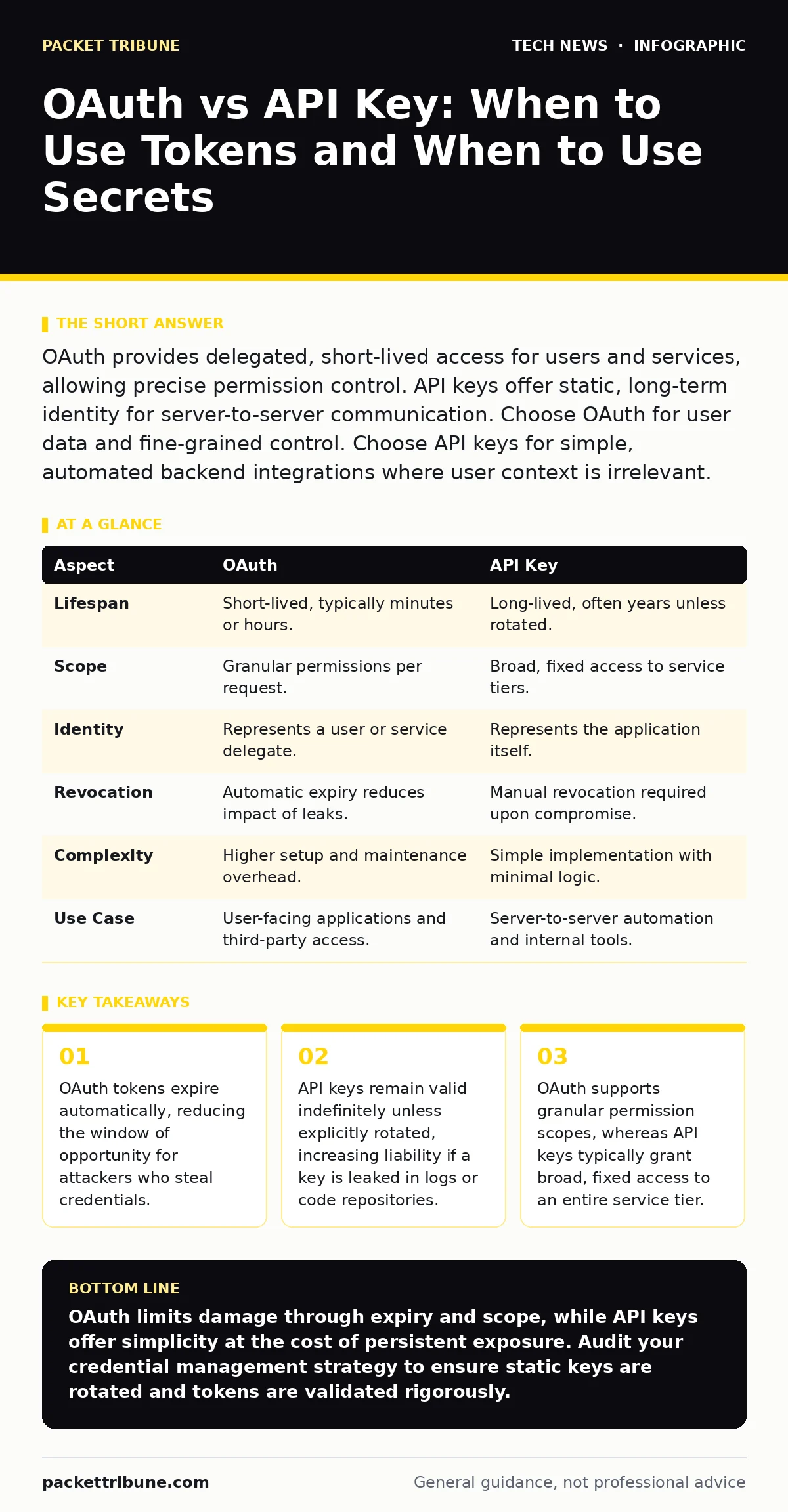
OAuth provides delegated, short-lived access for users and services, allowing precise permission control. API keys offer static, long-term identity for server-to-server communication. Choose OAuth for user data and fine-grained control. Choose API keys for simple, automated backend integrations where user context is irrelevant.
The Core Difference Between OAuth and API Keys
OAuth and API keys solve different identity problems. An API key is a static secret that identifies a specific application or user account. It does not change unless you manually regenerate it. OAuth, or Open Authorization, is a framework for granting limited, temporary access to resources without sharing credentials. The token it issues expires after a short period. This distinction dictates your security posture. Static secrets require rigorous rotation policies. Ephemeral tokens reduce exposure but add complexity to your authentication flow. Understanding this trade-off prevents over-engineering simple integrations or under-protecting sensitive user data.
| Aspect | OAuth | API Key |
|---|---|---|
| Lifespan | Short-lived, typically minutes or hours. | Long-lived, often years unless rotated. |
| Scope | Granular permissions per request. | Broad, fixed access to service tiers. |
| Identity | Represents a user or service delegate. | Represents the application itself. |
| Revocation | Automatic expiry reduces impact of leaks. | Manual revocation required upon compromise. |
| Complexity | Higher setup and maintenance overhead. | Simple implementation with minimal logic. |
| Use Case | User-facing applications and third-party access. | Server-to-server automation and internal tools. |
What Is an OAuth Token?
OAuth issues access tokens that act as temporary passes. The resource owner grants permission to a client application. The authorization server validates this request and issues a token. This token contains metadata about the permitted actions. It does not contain the user’s password. The client presents this token to the resource server. The server verifies the token’s signature and validity period. If valid, it grants access. This mechanism ensures that the client never handles long-term credentials. It also allows the user to revoke access without changing their password. This separation of concerns improves security by limiting the blast radius of a token leak.
What Is an API Key?
An API key is a unique string that identifies your application to an API provider. It is usually embedded in request headers or query parameters. The provider checks this key against its database. If the key matches an active account, the request proceeds. API keys do not verify who the user is. They only verify that the application is authorised to make requests. This makes them ideal for rate limiting and usage tracking. They are not suitable for authenticating individual users. Using an API key for user authentication exposes all users sharing that key to mutual risk. One leaked key compromises access for everyone using it.
When to Choose OAuth
Choose OAuth when you handle sensitive user data. This includes personal information, financial records, or private communications. OAuth allows you to request only the permissions you need. You can ask for read-only access instead of full write privileges. This principle of least privilege limits damage from compromised accounts. OAuth also supports multi-factor authentication at the authorization stage. You gain insight into who accessed data and when. The short lifespan of tokens means stolen credentials become useless quickly. This aligns with modern zero-trust architectures. It forces continuous verification rather than relying on a single initial check.
When to Choose API Keys
Choose API keys for server-to-server communication. These are automated processes that do not involve human users. Examples include synchronising data between databases or triggering webhooks. API keys simplify the development process. You do not need to manage token refresh cycles. You do not need to implement complex consent screens. This reduces latency and operational overhead. API keys are also suitable for public APIs where no user data is exchanged. They provide a simple way to track usage and enforce quotas. Keep these keys secure in environment variables. Never commit them to version control systems. Regular rotation is your primary defence against leakage.
See also: Email Security Protocols: Mechanics, Gaps and Mitigation
Overlapping Use Cases and Risks
Some scenarios blur the lines between these methods. Microservices may use API keys for internal communication while using OAuth for external access. This hybrid approach balances simplicity and security. However, it increases the attack surface. You must manage two types of credentials. Misconfiguration can lead to privilege escalation. An attacker might swap an API key for an OAuth token if validation is weak. This is why consistent validation is critical. You must verify the source and scope of every request. Do not assume internal traffic is safe. Treat all endpoints as public. This mindset reduces the risk of lateral movement within your network.
Implementation Best Practices
Secure your credentials regardless of the method. For OAuth, ensure your authorization server uses strong encryption. This often involves managing TLS certificates correctly to prevent man-in-the-middle attacks. For API keys, rotate them regularly. Automate this process to avoid human error. Monitor usage patterns for anomalies. Sudden spikes in requests may indicate a leaked key. Implement rate limiting to mitigate abuse. Use secure software development practices to prevent injection attacks. Validate all inputs. This reduces the chance of attackers manipulating your authentication logic. Regular audits of your access controls keep your system resilient.
Key takeaways
- OAuth tokens expire automatically, reducing the window of opportunity for attackers who steal credentials.
- API keys remain valid indefinitely unless explicitly rotated, increasing liability if a key is leaked in logs or code repositories.
- OAuth supports granular permission scopes, whereas API keys typically grant broad, fixed access to an entire service tier.
OAuth limits damage through expiry and scope, while API keys offer simplicity at the cost of persistent exposure. Audit your credential management strategy to ensure static keys are rotated and tokens are validated rigorously.
Frequently asked questions
Can I use an API key for user authentication?
No, API keys identify applications, not individual users. Using them for user auth creates a single point of failure and prevents granular permission control.
How long should an OAuth token last?
Access tokens should be short-lived, often minutes. Refresh tokens can be longer but should be rotated and stored securely to limit exposure.
Do I need OAuth for internal microservices?
Not necessarily. API keys or mutual TLS are often simpler and more performant for internal service-to-service communication where user context is irrelevant.
What happens if an OAuth token is stolen?
The attacker gains limited access only until the token expires. If scopes are restricted, the damage is contained. Revoking the token immediately is still recommended.
How this guide was produced: written by the Packet Tribune editorial team with AI assistance, checked against the public references listed below, and reviewed when the facts change. See our editorial policy or report an error.