Replay Attacks Explained: How Recycled Data Breaches Security
Attackers intercept valid data transmissions and resend them later to trick systems into accepting duplicate actions as fresh requests.

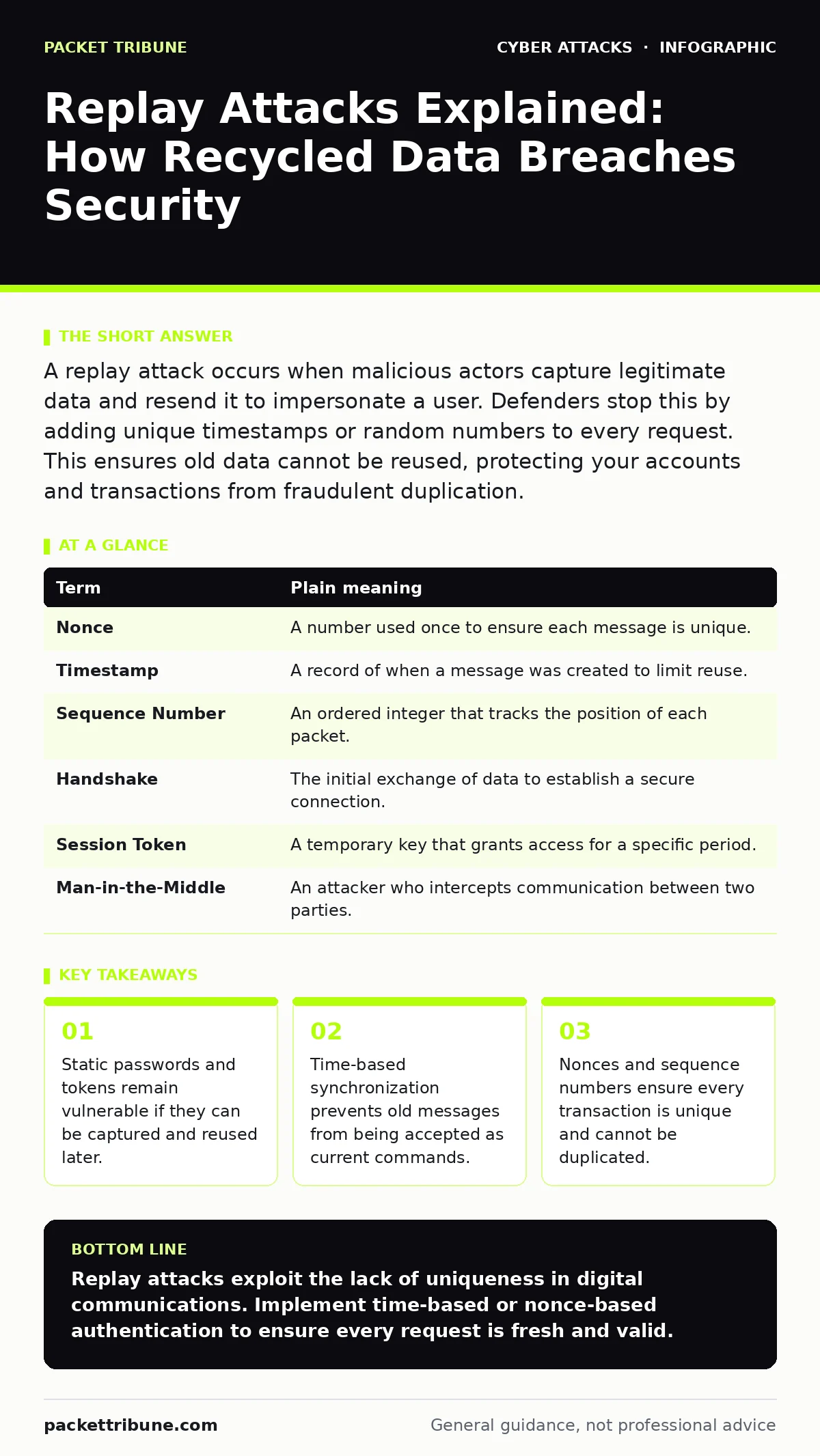
A replay attack occurs when malicious actors capture legitimate data and resend it to impersonate a user. Defenders stop this by adding unique timestamps or random numbers to every request. This ensures old data cannot be reused, protecting your accounts and transactions from fraudulent duplication.
The Stolen Keycard Analogy
Imagine you enter a secure building using a magnetic keycard. The door reader validates the card and opens the lock. An attacker does not need to pick the lock or forge a new card. They simply stand nearby with a small device that captures the radio signal from your card. Later, they press that recorded signal against the reader. The door opens again. The system sees valid credentials, but it does not know the user standing there is not the original cardholder. This is the core mechanic of a replay attack. The attacker reuses valid communication data to gain unauthorized access.
What Is a Replay Attack?
A replay attack involves capturing valid data transmission and maliciously or fraudulently delaying or repeating it. The attacker does not decrypt the message. They do not need to understand the content. They only need to copy the raw data and send it again to the receiver. If the receiver accepts the second transmission as legitimate, the attack succeeds. This usually happens when the protocol lacks a mechanism to distinguish between a fresh request and a recorded one. The system treats the old data as new because it appears valid.
Key Terms for Understanding
Understanding the mechanics requires clarity on specific components. These terms describe how systems verify identity and how attackers bypass those checks. The table below defines the core concepts involved in this type of interception and duplication.
| Term | Plain meaning |
|---|---|
| Nonce | A number used once to ensure each message is unique. |
| Timestamp | A record of when a message was created to limit reuse. |
| Sequence Number | An ordered integer that tracks the position of each packet. |
| Handshake | The initial exchange of data to establish a secure connection. |
| Session Token | A temporary key that grants access for a specific period. |
| Man-in-the-Middle | An attacker who intercepts communication between two parties. |
Why Static Credentials Fail
Many users believe that encryption alone prevents replay attacks. This is a common misconception. Encryption hides the content from eavesdroppers, but it does not prevent them from copying the ciphertext. If the encryption key remains the same and the message structure is static, the attacker can replay the encrypted blob. The receiver decrypts it and sees valid credentials. The system cannot tell that the message is old. This is why protocols must include dynamic elements. Static secrets are vulnerable to simple recording and playback. Defense in depth requires layers beyond just encryption to mitigate this risk.
How Protocols Prevent Duplication
Secure protocols introduce variability into every transaction. This ensures that even if an attacker captures a message, it becomes useless after one use. The most common method is using a nonce. A nonce is a random value included in the request. The server checks if it has seen this nonce before. If it has, the request is rejected. Another method is using timestamps. The server accepts messages only within a narrow time window. Any message outside this window is discarded. Sequence numbers also help by ensuring messages arrive in the correct order.
See also: TLS Certificates: Answers to 10 Persistent Infrastructure Questions · OAuth vs API Key: When to Use Tokens and When to Use Secrets
Impact on Ordinary Users
You are exposed to replay attacks every time you use wireless technology. Wi-Fi networks, Bluetooth devices, and RFID tags all broadcast signals. If these connections lack strong authentication, an attacker can capture your handshake data. They can then impersonate your device to the network. This might allow them to intercept your internet traffic or inject malicious data. For ordinary users, this means your private data could be visible to others on the same network. It also means attackers could perform actions on your behalf, such as making purchases or changing settings. Endpoint protection helps detect unusual network behavior on your device, but it cannot fix a weak network protocol.
Simple Safety Habits
You can reduce your risk by adopting specific habits. First, avoid connecting to open Wi-Fi networks for sensitive tasks. Public networks often lack the encryption standards needed to prevent packet capture. Second, enable multi-factor authentication wherever possible. While this does not stop the replay itself, it adds a layer that a simple recorded token cannot bypass. Third, keep your software updated.
Developers frequently patch vulnerabilities in communication protocols that allow replay attacks. Supply chain attacks often exploit these same weaknesses, so regular updates are critical. Finally, use callback verification for high-value transactions. This adds a human check that automated replay tools cannot pass. Bot protection systems on websites also help filter out automated replay attempts.
- Use a VPN on public Wi-Fi to encrypt traffic before it leaves your device.
- Enable two-factor authentication to add a dynamic layer to static logins.
- Update applications regularly to patch known protocol vulnerabilities.
Verifying the Source
The ultimate defense is verifying that the sender is who they claim to be at the moment of transmission. Mutual authentication ensures both parties prove their identity. Digital signatures can also help, but they must include a nonce or timestamp to be effective. Without these dynamic elements, a signed message can still be replayed. Vendor email compromise often uses similar social engineering tactics, but technical replay attacks rely on protocol flaws. Understanding this distinction helps you prioritize technical controls over just training.
Key takeaways
- Static passwords and tokens remain vulnerable if they can be captured and reused later.
- Time-based synchronization prevents old messages from being accepted as current commands.
- Nonces and sequence numbers ensure every transaction is unique and cannot be duplicated.
Replay attacks exploit the lack of uniqueness in digital communications. Implement time-based or nonce-based authentication to ensure every request is fresh and valid.
Frequently asked questions
Can a VPN stop a replay attack?
A VPN encrypts your traffic, making it harder to capture readable data, but it does not inherently prevent an attacker from recording and replaying the encrypted packets if the underlying protocol is weak.
Are smart cards vulnerable to replay attacks?
Smart cards are generally resistant because they generate unique responses for each challenge. However, if the card or reader implementation is flawed, it may still be possible to replay certain authentication sequences.
How do I know if my app is secure against replay?
Look for features like time-based passwords or dynamic tokens. If the app uses the same password or token for every login without changing it, it may be vulnerable to simple recording and playback.
Does HTTPS prevent replay attacks?
HTTPS provides encryption and authentication, but replay attacks can still occur at the application layer if the web service does not implement proper session management or request uniqueness checks.
How this guide was produced: written by the Packet Tribune editorial team with AI assistance, checked against the public references listed below, and reviewed when the facts change. See our editorial policy or report an error.