Callback Verification: Benefits, Limits and When It Works
Callback verification blocks social engineering by forcing callers to prove identity through a separate channel, yet it fails against advanced impersonation.

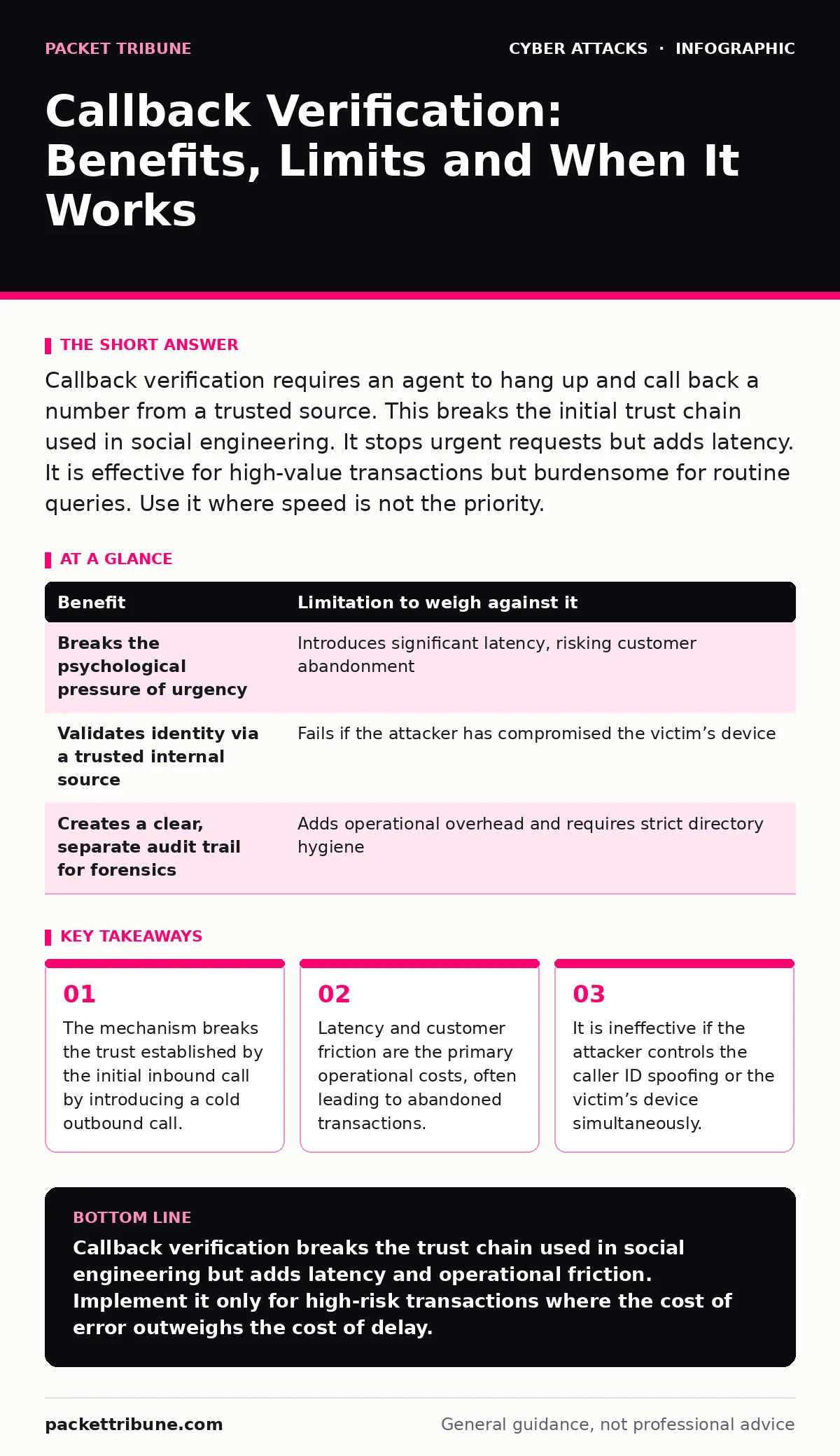
Callback verification requires an agent to hang up and call back a number from a trusted source. This breaks the initial trust chain used in social engineering. It stops urgent requests but adds latency. It is effective for high-value transactions but burdensome for routine queries. Use it where speed is not the priority.
The Mechanics of Trust Disruption
Social engineering relies on the assumption that the person on the line is who they claim to be. This assumption is fragile when the attacker can mimic voice tones, knowledge of internal procedures and caller ID data. Callback verification disrupts this assumption by forcing a reset of the communication channel. The agent must terminate the current session and initiate a new one using a number from a trusted, internal directory.
This process introduces a deliberate friction point. In a normal transaction, the goal is speed and ease. In a security context, the goal is certainty. The callback acts as a gatekeeper. It ensures that the request is not merely a reaction to a phone call but a confirmed action from a verified source. The attacker cannot maintain the psychological pressure of urgency once the line is disconnected.
Imagine an employee receiving a call from someone claiming to be the CEO. The caller demands an immediate wire transfer. Under standard protocol, the employee might hesitate but comply due to authority bias. With callback verification, the employee hangs up. They then dial the CEO’s number from the corporate directory. The attacker, now disconnected, loses the element of surprise and the ability to manipulate the conversation in real time.
Concrete Benefits of the Protocol
The primary benefit is the elimination of reliance on inbound metadata. Caller ID can be spoofed with minimal effort. Voice biometrics can be mimicked by sophisticated models. The callback removes these variables from the equation. It replaces them with a physical or digital address that is harder to forge.
Second, it creates an audit trail that is distinct from the initial interaction. The log shows two separate events: an inbound call from an unknown or suspicious source and an outbound call to a verified destination. This separation aids in forensic analysis. It proves that the agent did not act on the inbound call alone.
Third, it serves as a training mechanism for staff. The requirement to hang up and call back reinforces the habit of verification. Over time, this becomes muscle memory. Employees learn to distrust urgency and prioritize process. This cultural shift reduces the success rate of all types of social engineering, not just phone-based attacks.
| Benefit | Limitation to weigh against it |
|---|---|
| Breaks the psychological pressure of urgency | Introduces significant latency, risking customer abandonment |
| Validates identity via a trusted internal source | Fails if the attacker has compromised the victim’s device |
| Creates a clear, separate audit trail for forensics | Adds operational overhead and requires strict directory hygiene |
Honest Limitations and Hidden Costs
The most obvious limitation is time. Every callback adds minutes to a transaction. In high-volume environments, this slows down operations considerably. Customers may perceive this as poor service. They expect immediate resolution. The friction can lead to lost business or increased complaint volumes.
A more subtle limitation is the assumption of directory accuracy. If the internal directory contains outdated or incorrect numbers, the callback may connect to the wrong person. Worse, it may connect to an attacker who has previously compromised that account. This is where the intersection with SIM swapping becomes relevant. If an attacker has taken over the executive’s mobile line, the callback will reach them. The verification fails.
Another hidden cost is the dependency on process adherence. The security benefit exists only if the agent strictly follows the protocol. If an agent decides to keep the line open and simply checks the directory on another device, the security benefit is nullified. The attacker remains on the line, maintaining control of the narrative. Human error under pressure is a constant variable.
When It Is Worth It
This protocol is worth implementing for high-value, non-routine transactions. Examples include large financial transfers, changes to bank account details or modifications to sensitive access controls. In these cases, the cost of a single breach far outweighs the inconvenience of a delayed transaction.
It is also appropriate for interactions involving senior leadership. Impersonation of executives is a common vector for payroll diversion fraud. The authority bias makes employees more likely to comply with unusual requests from bosses. Adding a mandatory callback step removes the ability for an attacker to exploit that bias effectively.
Furthermore, consider environments where the cost of error is irreversible. If a data deletion request is processed by mistake, the data may be gone forever. The latency of a callback is a small price to pay for certainty. In these scenarios, the protocol acts as a circuit breaker. It prevents catastrophic outcomes.
When It Is Not Worth It
For routine, low-value interactions, callback verification is counterproductive. Consider a customer asking for a password reset or a simple account inquiry. The risk of fraud is low. The effort required to verify is high. Implementing this here will damage customer satisfaction without providing meaningful security gains.
It is also not worth it when alternative, automated verification methods are available. Multi-factor authentication integrated into the portal can verify identity without human intervention. If the system can confirm the user’s identity digitally, a phone callback is redundant. It adds steps without adding security.
Avoid using this for time-sensitive operational requests where delay causes immediate harm. For example, in a crisis management scenario, every second counts. Forcing a callback could hinder response efforts. In these cases, use pre-established code words or secure messaging apps instead. The goal is balance between security and operational continuity.
See also: SIM Swapping: How Number Porting Becomes an Attack Vector · Social Engineering vs Phishing: Which Attack Vector Dominates?
Integration with Broader Defences
Callback verification does not exist in a vacuum. It must be part of a layered defence strategy. Relying on it alone leaves gaps. Attackers will adapt. They may attempt to compromise the directory or the device receiving the callback.
Consider how this interacts with vishing campaigns. Attackers often use robocalls to create a sense of urgency. The callback breaks this chain. However, if the attacker has already compromised the victim’s email, they may monitor the callback attempt. This links to vendor email compromise tactics. The attacker may anticipate the verification and prepare a counter-narrative.
To strengthen this, ensure that the outbound call is made from a different device or network segment if possible. This reduces the risk of the attacker intercepting the callback. Also, train staff to recognise signs of DDoS protection bypasses. If the phone system is under load, attackers may exploit the confusion to push through fraudulent requests.
Operational Best Practices
Implementing this requires clear policies. Define which transactions require a callback. Publish this list widely. Ensure that all staff understand the rationale. Without understanding, compliance will drop.
Maintain the integrity of the directory. Regularly audit the contact numbers for key personnel. Remove old numbers. Ensure that the directory is not publicly accessible. If attackers can see the numbers, they can prepare for the callback.
Use endpoint protection to secure the devices used for callbacks. If the agent’s phone is infected with malware, the attacker may intercept the outbound call. This turns a security measure into a vulnerability. Regular updates and strict access controls are necessary.
Key takeaways
- The mechanism breaks the trust established by the initial inbound call by introducing a cold outbound call.
- Latency and customer friction are the primary operational costs, often leading to abandoned transactions.
- It is ineffective if the attacker controls the caller ID spoofing or the victim’s device simultaneously.
Callback verification breaks the trust chain used in social engineering but adds latency and operational friction. Implement it only for high-risk transactions where the cost of error outweighs the cost of delay.
Frequently asked questions
Does callback verification stop all phone scams?
No, it stops many social engineering attempts but fails if the attacker controls the victim’s device or has compromised the directory numbers.
How long should the callback process take?
It varies, but typically adds two to five minutes. This is acceptable for high-value transactions but detrimental for routine queries.
Can attackers spoof the outbound callback?
It is difficult for an attacker to spoof an outbound call from an internal system, but they can intercept it if the receiving device is compromised.
Is this suitable for customer service centres?
Only for high-risk interactions. For general inquiries, it creates too much friction and damages customer experience without proportional security benefits.
How this guide was produced: written by the Packet Tribune editorial team with AI assistance, checked against the public references listed below, and reviewed when the facts change. See our editorial policy or report an error.