Stop Gift Card Scams: Prevention Tactics That Actually Work
Blocking outbound calls removes more risk from gift card fraud than training staff to recognise social engineering scripts.

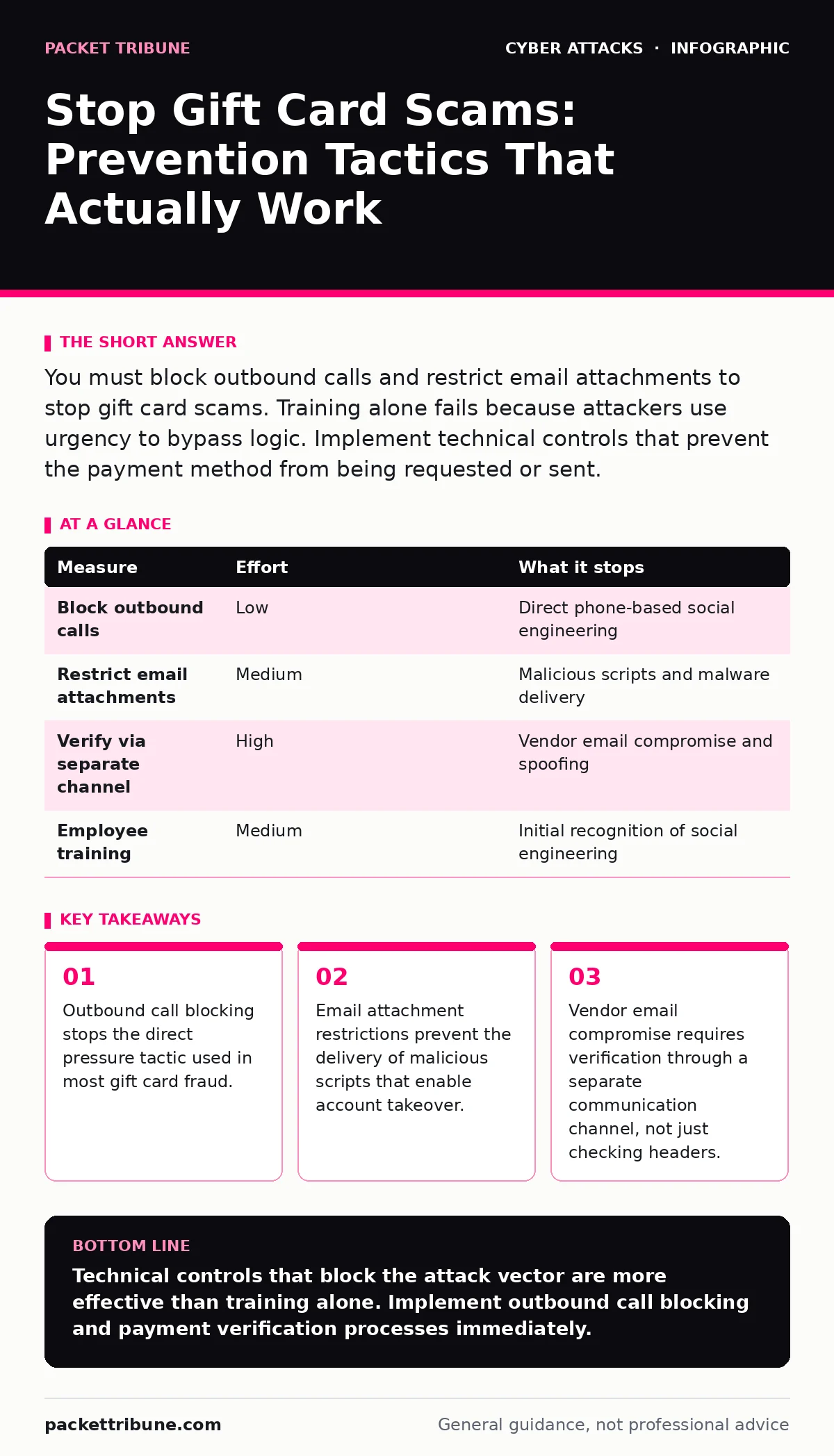
You must block outbound calls and restrict email attachments to stop gift card scams. Training alone fails because attackers use urgency to bypass logic. Implement technical controls that prevent the payment method from being requested or sent.
The Mechanics of Gift Card Fraud
Gift card scams rely on bypassing organisational security policies through social engineering. Attackers do not typically hack your network directly. They manipulate employees into becoming the vector for financial loss. The core mechanism involves creating a sense of urgency. The attacker poses as a superior, a vendor, or a government agency. They demand immediate payment via gift cards because these assets are nearly impossible to trace and cannot be reversed.
The success of these attacks depends on the victim’s willingness to bypass standard procurement procedures. Standard procedures require purchase orders, vendor verification, and approved payment methods. Gift cards sit outside these controls. They are treated as cash equivalents. This creates a blind spot in financial oversight. The attacker exploits the gap between technical security and human behaviour.
Blocking Outbound Calls Removes Primary Risk
The most effective technical control against gift card fraud is blocking outbound calls from corporate phone systems. Many gift card scams begin with a phone call. The attacker establishes authority and then instructs the victim to purchase cards. If the organisation cannot make outbound calls, this attack vector is severed. This is a high-impact, low-effort change. It prevents the initial contact that sets the stage for the fraud.
Blocking outbound calls does not stop all scams. Attackers may use SMS or email to initiate contact. However, phone-based social engineering is the most direct method. Removing the ability to call reduces the surface area for attack. You must configure the telephony system to allow only inbound calls and emergency numbers. This forces any communication to occur through documented channels like email or ticketing systems.
Restricting Email Attachments Prevents Script Execution
Email is the second most common vector for gift card fraud. Attackers send emails that appear to come from trusted sources. These emails often contain attachments or links. The attachment may be a malicious script or a document that exploits a vulnerability in the office suite. Once executed, the script can steal credentials or monitor keystrokes. This enables the attacker to conduct account takeover or vendor email compromise.
Restricting email attachments to safe file types reduces this risk. You should block executable files, scripts, and macros. This prevents the automatic execution of malicious code. You must also enable sandboxing for downloaded files. Sandboxing runs files in an isolated environment. This detects malicious behaviour before the file reaches the user’s desktop. This control protects against the technical component of the attack.
Verifying Payment Requests Through Separate Channels
When a payment request arrives, you must verify it through a separate communication channel. Do not reply to the email. Do not call the number provided in the email. Use a known, trusted contact method. This could be a phone number from the company directory or a previously established vendor relationship. This step breaks the chain of trust that the attacker has forged.
This verification step is critical for vendor email compromise. Attackers often spoof the email address of a legitimate vendor. The email headers may look correct. The domain may be similar. Only by contacting the vendor through a separate channel can you confirm the legitimacy of the request. This process adds friction to the payment workflow. This friction is necessary to prevent fraud.
Training Employees To Recognise Urgency
Employee training is necessary but insufficient on its own. Training must focus on recognising the psychological tactics used by attackers. Attackers create urgency to bypass logical thinking. They threaten consequences for non-compliance. They demand secrecy to prevent verification. Training should teach employees to pause and question these demands.
Training should include simulations of gift card scams. These simulations help employees recognise the patterns. They learn to identify the red flags. However, training does not prevent an employee from making a mistake under pressure. Technical controls provide a safety net. Training builds awareness. Both are required for a layered defence.
See also: SIM Swapping: How Number Porting Becomes an Attack Vector · Social Engineering vs Phishing: Which Attack Vector Dominates?
What Does Not Work
Relying solely on employee vigilance is a failed strategy. Humans are prone to error, especially under stress. Attackers design their scripts to exploit cognitive biases. No amount of training can eliminate this risk. You must assume that an employee will eventually be manipulated. Technical controls must be in place to catch this failure.
Another ineffective measure is using complex password policies for email accounts. While strong passwords are good practice, they do not stop an employee from voluntarily handing over a gift card code. The fraud is not about cracking a password. It is about convincing a person to act. Focusing on password strength ignores the real threat vector.
| Measure | Effort | What it stops |
|---|---|---|
| Block outbound calls | Low | Direct phone-based social engineering |
| Restrict email attachments | Medium | Malicious scripts and malware delivery |
| Verify via separate channel | High | Vendor email compromise and spoofing |
| Employee training | Medium | Initial recognition of social engineering |
Integrating With Broader Security Controls
Gift card scams often overlap with other attack types. For example, an attacker may use vishing to steal credentials. Vishing is voice phishing, where attackers use phone calls to extract sensitive information. Blocking outbound calls mitigates this risk. Similarly, bot protection helps prevent automated attacks that may precede a social engineering attempt.
You should also consider supply chain attacks. Attackers may compromise a vendor’s email account to send fraudulent invoices. This is a form of vendor email compromise. Verifying payment requests through separate channels addresses this risk. These controls work together to create a defence in depth.
Checklist For Immediate Implementation
You can implement these measures today to reduce risk. Start with the technical controls that provide immediate protection. Then move to process changes and training. This prioritisation ensures that you have a safety net in place while you build awareness.
- Configure telephony system to block outbound calls except for emergency numbers.
- Update email gateway to block high-risk file types and enable sandboxing.
- Establish a policy requiring verification of all payment requests through a separate channel.
Key takeaways
- Outbound call blocking stops the direct pressure tactic used in most gift card fraud.
- Email attachment restrictions prevent the delivery of malicious scripts that enable account takeover.
- Vendor email compromise requires verification through a separate communication channel, not just checking headers.
Technical controls that block the attack vector are more effective than training alone. Implement outbound call blocking and payment verification processes immediately.
Frequently asked questions
How do attackers obtain gift card codes?
Attackers trick employees into purchasing the cards and reading out the codes. They do not steal the codes from the retailer. The employee is the source of the value.
Can I block gift card purchases in our accounting software?
You can restrict payment methods in accounting software. This prevents employees from processing gift card payments. This is a strong control if your software supports it.
What if a vendor insists on payment via gift cards?
Legitimate vendors do not accept gift cards as payment. This is a clear sign of fraud. Verify the request through a separate channel. It will be confirmed as fraudulent.
Does multi-factor authentication stop gift card scams?
Multi-factor authentication protects account access. It does not stop an employee from being tricked into purchasing a gift card. The fraud is social, not technical.
How this guide was produced: written by the Packet Tribune editorial team with AI assistance, checked against the public references listed below, and reviewed when the facts change. See our editorial policy or report an error.