Social Engineering vs Phishing: Which Attack Vector Dominates?
Phishing is merely the delivery mechanism, while social engineering is the psychological manipulation that makes the click inevitable and the theft possible.

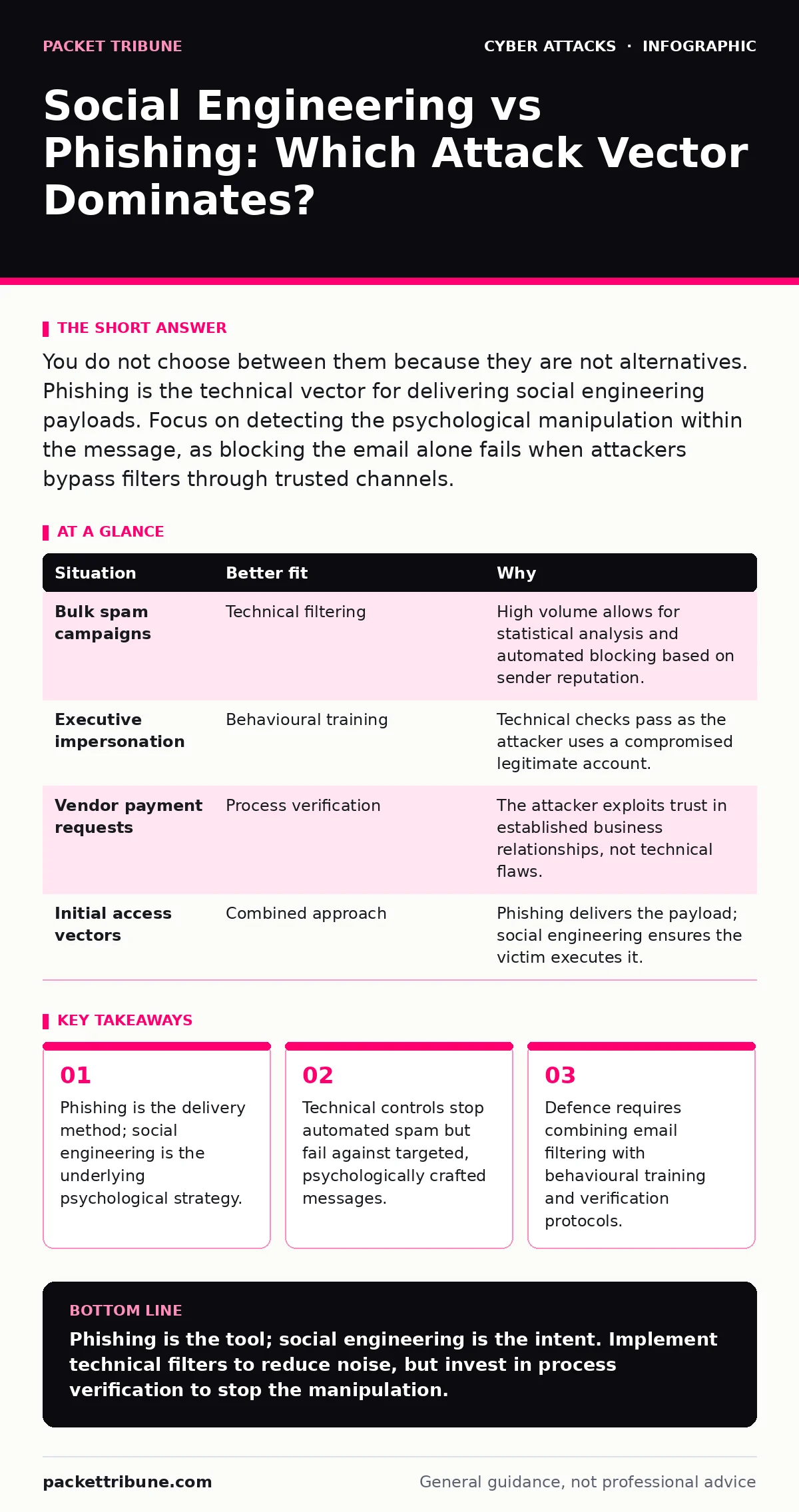
You do not choose between them because they are not alternatives. Phishing is the technical vector for delivering social engineering payloads. Focus on detecting the psychological manipulation within the message, as blocking the email alone fails when attackers bypass filters through trusted channels.
Defining the Technical Boundary
Confusion often arises because people treat phishing and social engineering as competing threats. They are not. Phishing is a specific technique involving the use of deceptive electronic communications, typically email, to trick recipients into revealing sensitive information or installing malware. Social engineering is the broader practice of manipulating people into breaking normal security procedures. One is the vehicle; the other is the driver.
Imagine a letter arriving at your office. The envelope is the phishing component. The story inside that convinces you to open it is the social engineering. If you block the envelope, you stop that specific attack. However, the attacker simply changes the envelope design. If you train staff to question the story, you defeat the manipulation regardless of the delivery method.
The Delivery Mechanism
Phishing relies on volume and technical obscurity. The success rate depends on the recipient failing to notice subtle discrepancies in sender addresses or urgent language. This approach is cheap and scalable.
The technical side of defence involves analysing headers, checking Domain Message Authentication, Reporting, and Conformance (DMARC) records, and inspecting links. These measures are effective against bulk campaigns. They are less effective when an attacker compromises a legitimate account. In that scenario, the email passes all technical checks because it originates from a trusted source. This is where the distinction matters most.
The Psychological Manipulation
Social engineering exploits cognitive biases rather than technical vulnerabilities. It relies on urgency, authority, or reciprocity to bypass critical thinking. An attacker might pose as a senior executive demanding an immediate wire transfer. The message contains no malware. It requires no clever code. It only requires the recipient to act without verifying the request.
This is why email filtering alone is insufficient. The message is technically clean. The sender is a known colleague. The domain is correct. The threat is purely human. You must address the human factor in security to mitigate this risk. Training must focus on recognising emotional manipulation, not just spotting typos in an email address.
Deciding Factors for Defence Strategy
Your defence posture depends on which part of the attack chain you are trying to break. If your primary concern is automated botnets sending malicious links, technical controls are your first line of defence. If your concern is attackers impersonating vendors or executives, behavioural controls are paramount.
You cannot eliminate one without addressing the other. A robust email gateway reduces the noise. It does not remove the signal. The signal is the human desire to be helpful or the fear of retribution. Understanding this dynamic allows you to allocate resources more effectively.
Situations That Favour Each Approach
Different scenarios require different defensive priorities. Some environments face high volumes of low-quality spam. Others face targeted campaigns against specific individuals. The table below outlines which defensive focus is more appropriate for common scenarios.
| Situation | Better fit | Why |
|---|---|---|
| Bulk spam campaigns | Technical filtering | High volume allows for statistical analysis and automated blocking based on sender reputation. |
| Executive impersonation | Behavioural training | Technical checks pass as the attacker uses a compromised legitimate account. |
| Vendor payment requests | Process verification | The attacker exploits trust in established business relationships, not technical flaws. |
| Initial access vectors | Combined approach | Phishing delivers the payload; social engineering ensures the victim executes it. |
See also: Callback Verification: Benefits, Limits and When It Works · SIM Swapping: How Number Porting Becomes an Attack Vector
Integrating Technical and Human Defences
The most effective defence treats phishing and social engineering as a single threat model. You need technical controls to filter out the obvious threats. You need human training to handle the subtle ones. This layered approach reduces the attack surface.
Consider implementing callback verification for any request involving money or sensitive data changes. This simple process breaks the chain of deception. The attacker cannot spoof a phone call to the same degree as an email. It adds friction to the attack, which is often enough to stop it.
When to Use Both Together
You should always use both together. Relying solely on technology leaves you vulnerable to sophisticated impersonation. Relying solely on training leaves you vulnerable to volume-based attacks that overwhelm staff. The integration point is policy.
Define clear procedures for verifying requests. Document the steps for reporting suspicious messages. Conduct tabletop exercises that simulate both technical failures and human error. This prepares your team to respond when the inevitable breach occurs. It shifts the focus from prevention to containment and recovery.
Beyond Email Vectors
While email is the most common vector, it is not the only one. Attackers increasingly use SIM swapping to intercept multi-factor authentication codes. They use supply chain attacks to compromise trusted software updates. These are all forms of social engineering delivered through different channels.
Your defence must extend beyond the inbox. Monitor for unusual login patterns. Verify identity changes through multiple channels. Understand that the attacker is adapting. If email becomes too difficult, they will move to instant messaging or voice calls. The psychology remains the same. The delivery changes.
Key takeaways
- Phishing is the delivery method; social engineering is the underlying psychological strategy.
- Technical controls stop automated spam but fail against targeted, psychologically crafted messages.
- Defence requires combining email filtering with behavioural training and verification protocols.
Phishing is the tool; social engineering is the intent. Implement technical filters to reduce noise, but invest in process verification to stop the manipulation.
Frequently asked questions
Can email filters stop all phishing attempts?
No, filters catch automated and obvious threats. They cannot detect sophisticated social engineering using compromised accounts or legitimate sender addresses.
How do I verify a suspicious request?
Use a pre-established out-of-band channel, such as a phone call to a known number, to confirm the request with the alleged sender.
Is training enough to prevent social engineering?
Training raises awareness but cannot eliminate human error. Combine training with technical controls and strict verification processes.
What is the difference between spear phishing and social engineering?
Spear phishing is a targeted phishing attack. Social engineering is the psychological manipulation used to make that attack successful. One is the method; the other is the motive.
How this guide was produced: written by the Packet Tribune editorial team with AI assistance, checked against the public references listed below, and reviewed when the facts change. See our editorial policy or report an error.