SIM Swapping: How Number Porting Becomes an Attack Vector
Attackers exploit carrier customer service protocols to hijack your phone number, bypassing two-factor authentication without touching your device.
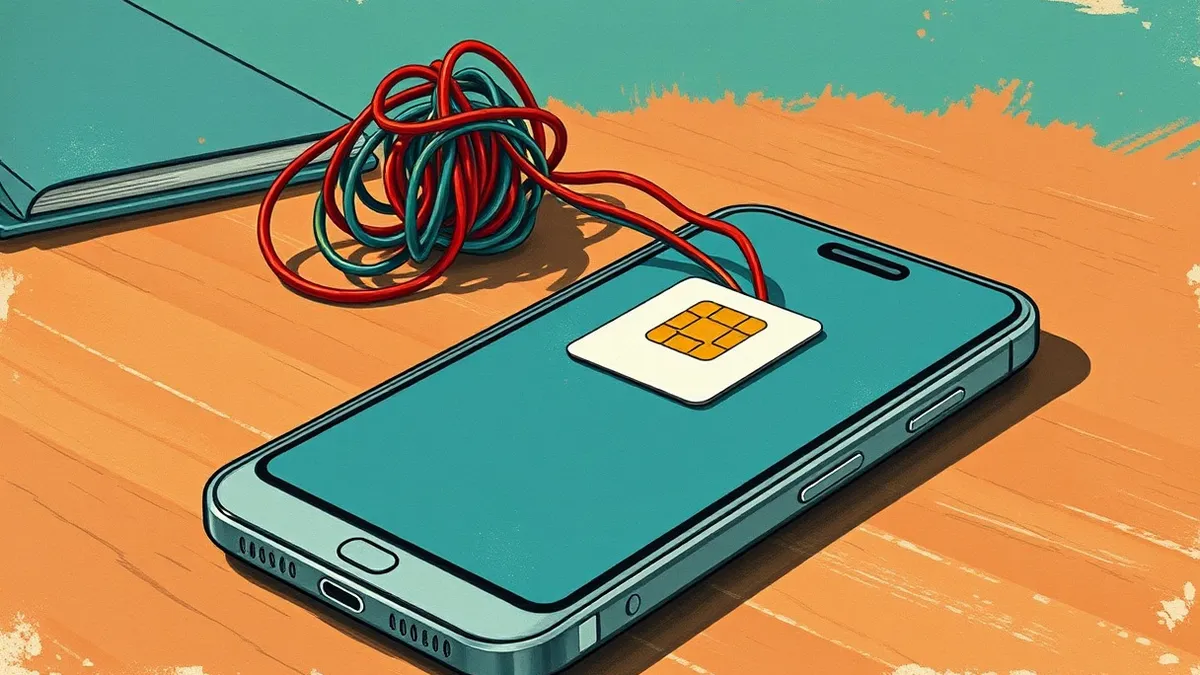
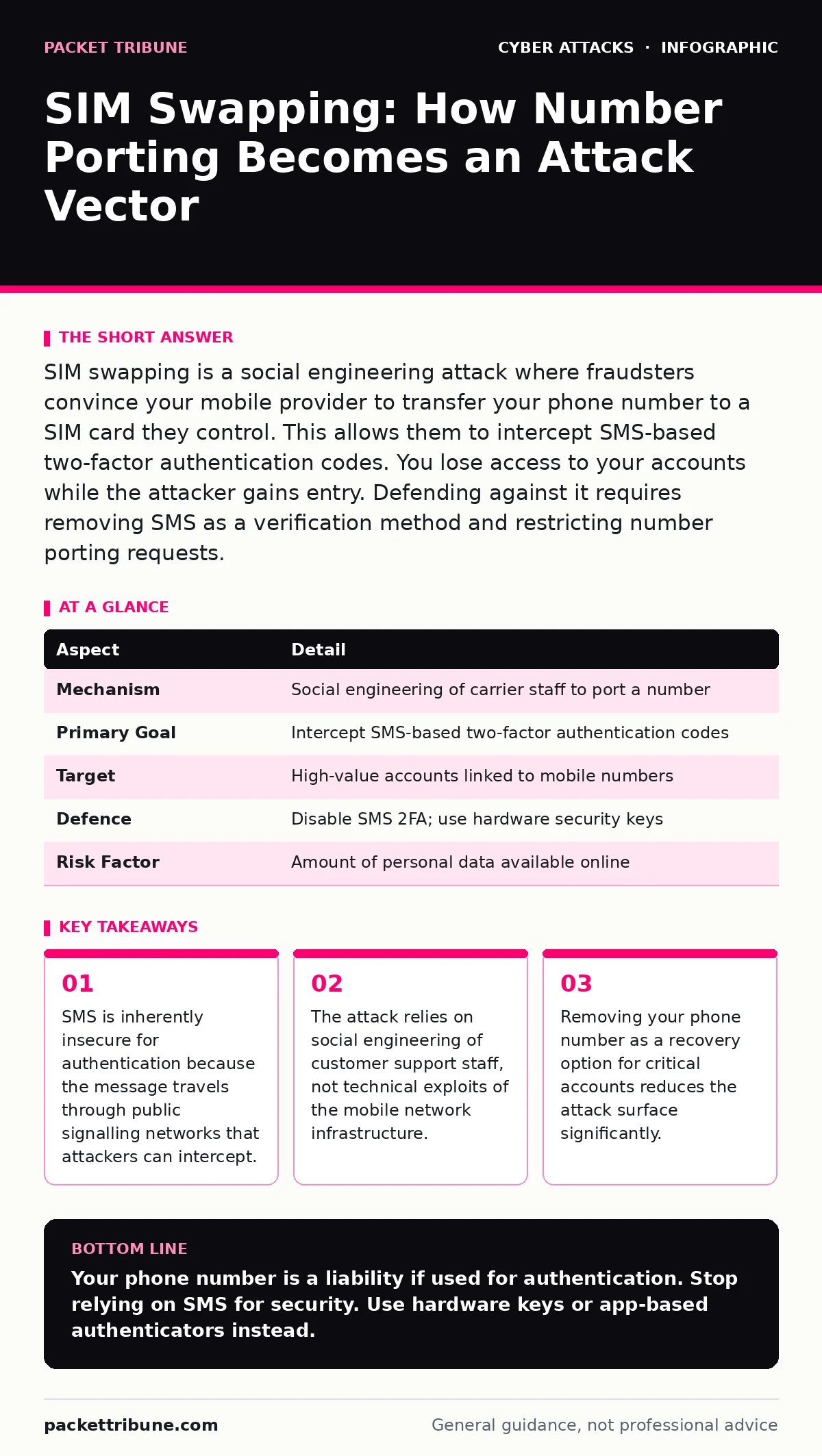
SIM swapping is a social engineering attack where fraudsters convince your mobile provider to transfer your phone number to a SIM card they control. This allows them to intercept SMS-based two-factor authentication codes. You lose access to your accounts while the attacker gains entry. Defending against it requires removing SMS as a verification method and restricting number porting requests.
The Lease on Your Phone Number
Imagine you rent a mailbox. The post office does not own the box; you do. However, if someone convinces the post office that you have moved, they can redirect your mail to their address. You have not lost your keys. You have not been burgled. Yet, your correspondence now goes elsewhere.
Your mobile phone number operates similarly. You lease the number from a carrier. The carrier maintains the relationship. If an attacker can impersonate you to the carrier, they can port that number to a device they control. This is SIM swapping. It is not a hack of your phone. It is a hack of the administrative process.
At a Glance
| Aspect | Detail |
|---|---|
| Mechanism | Social engineering of carrier staff to port a number |
| Primary Goal | Intercept SMS-based two-factor authentication codes |
| Target | High-value accounts linked to mobile numbers |
| Defence | Disable SMS 2FA; use hardware security keys |
| Risk Factor | Amount of personal data available online |
How the Swap Occurs
The attacker begins with reconnaissance. They gather your name, date of birth, address and potentially your PIN or password hints. This data is often sourced from data breaches, social media profiles or public records. The more information they hold, the more convincing they appear to a customer service representative.
Next, the attacker contacts your mobile carrier. They claim to have lost their phone or need an urgent replacement. They provide the stolen personal details. If the carrier’s verification process relies solely on these static facts, the attacker passes. The carrier deactivates your existing SIM card and activates a new one in the attacker’s possession.
You notice the loss of signal. Your phone shows "No Service" or "Emergency Calls Only". The attacker now receives your SMS messages. They use these messages to reset passwords on your email, banking and cryptocurrency accounts. The window of opportunity is short. They act quickly to drain assets or lock you out before you raise an alarm.
Who Is in the Crosshairs
Attackers do not choose targets at random. They look for value. Individuals with significant cryptocurrency holdings are frequent targets because blockchain transactions are irreversible. Once funds are moved, they cannot be recalled.
Business owners and executives are also prime candidates. Their phone numbers are often linked to corporate email accounts, financial systems and supplier portals. Compromising a single number can lead to vendor email compromise or payroll diversion fraud. The attacker does not need to hack the corporate network. They only need the reset code that arrives on your phone.
Even ordinary users are at risk if they use SMS for account recovery. The attacker may not find millions in crypto, but they can steal identity, apply for loans or sell access to your accounts. The cost of the attack is low. The potential reward is high. This asymmetry drives the volume of attempts.
Common Forms and Variations
The classic SIM swap involves porting the number to a new carrier. This is a permanent change until you dispute it. However, attackers use other methods to achieve the same result.
SIM jamming is a technical variant. The attacker uses a device to flood your local area with fake cell tower signals. Your phone connects to the attacker’s tower. They can then intercept traffic. This requires specialised hardware and proximity. It is less common but more dangerous because it does not rely on social engineering.
Another form is the silent port. Some carriers allow number transfers without sending an SMS confirmation to the old device. If you do not monitor your signal status, you may not realise the swap has occurred until you try to log into an account and fail.
See also: How Does Scareware Work: The Psychological and Technical Breakdown · Callback Verification: Benefits, Limits and When It Works
What People Usually Get Wrong
Many users believe that having a strong password is enough. They think the SIM swap is a secondary issue. This is incorrect. If an attacker can intercept your two-factor authentication code, your password strength is irrelevant. They reset the password and set a new one. You are locked out.
Another misconception is that SIM locking prevents the attack. A SIM lock prevents the SIM card from being used in another phone. It does not prevent the carrier from issuing a new SIM card with your number. The attacker does not need your physical SIM. They need the carrier to create a new one.
Some users think that changing their PIN frequently helps. If the attacker obtains your PIN through a data breach or phishing, changing it does not help. They will simply use the new PIN. The vulnerability lies in the single point of failure: the phone number itself.
Reducing the Risk
The most effective defence is to stop using SMS for authentication. Replace it with authenticator apps or hardware security keys. These methods generate codes locally or use cryptographic signatures. They do not rely on the mobile network. An attacker cannot intercept them by swapping your SIM.
If you must use SMS, enable additional protections. Set up a porting freeze or PIN with your carrier. This requires a specific code to transfer your number. Keep this code secure. Do not share it. Not all carriers offer this feature. Check your options.
Limit the personal information you share online. Attackers use this data to pass verification checks. Remove your date of birth, address and family names from public profiles. The less they know, the harder it is for them to impersonate you.
Monitor your phone signal. If you suddenly lose service in an area where you usually have coverage, contact your carrier immediately. Ask them to place a freeze on your account. Do not wait for an email or bank alert. The attacker is acting fast.
The Human Factor in Security
This attack highlights the human factor in security. The technology is not broken. The process is. The carrier’s representative is following their script. The script relies on static data that can be stolen.
To mitigate this, organisations should conduct tabletop exercises that include SIM swapping scenarios. Test how your team responds when a key executive loses access to their phone. Ensure you have out-of-band verification methods. Do not rely on the phone number for critical decisions.
Consider callback verification for sensitive requests. Instead of asking the user to provide a code, the system calls the registered number and asks the user to press a button. This is harder to spoof than SMS. However, it is not foolproof if the number has been ported.
Key takeaways
- SMS is inherently insecure for authentication because the message travels through public signalling networks that attackers can intercept.
- The attack relies on social engineering of customer support staff, not technical exploits of the mobile network infrastructure.
- Removing your phone number as a recovery option for critical accounts reduces the attack surface significantly.
Your phone number is a liability if used for authentication. Stop relying on SMS for security. Use hardware keys or app-based authenticators instead.
Frequently asked questions
Can I trace who swapped my SIM?
Carriers may have logs of the request, including the phone number used. However, attackers often use spoofed numbers or burners. Recovery of the number is possible, but identifying the attacker is difficult.
Is there an app to detect SIM swapping?
No app can detect a porting request at the network level. You will notice the loss of signal. Some apps alert you to new logins, but this happens after the swap.
Should I change my phone number?
Only if you have been a victim. Changing the number does not fix the underlying vulnerability. If you change it, you must update all associated accounts and remove SMS 2FA.
Does 5G make SIM swapping safer?
5G improves encryption for data in transit. It does not change the administrative process for porting numbers. The social engineering vector remains the same.
How this guide was produced: written by the Packet Tribune editorial team with AI assistance, checked against the public references listed below, and reviewed when the facts change. See our editorial policy or report an error.