Bot Protection: Questions Answered for Secure Web Traffic
Bot management systems often block legitimate users by mistake, creating a hidden cost that outweighs the security benefit of simple signature-based detection methods.

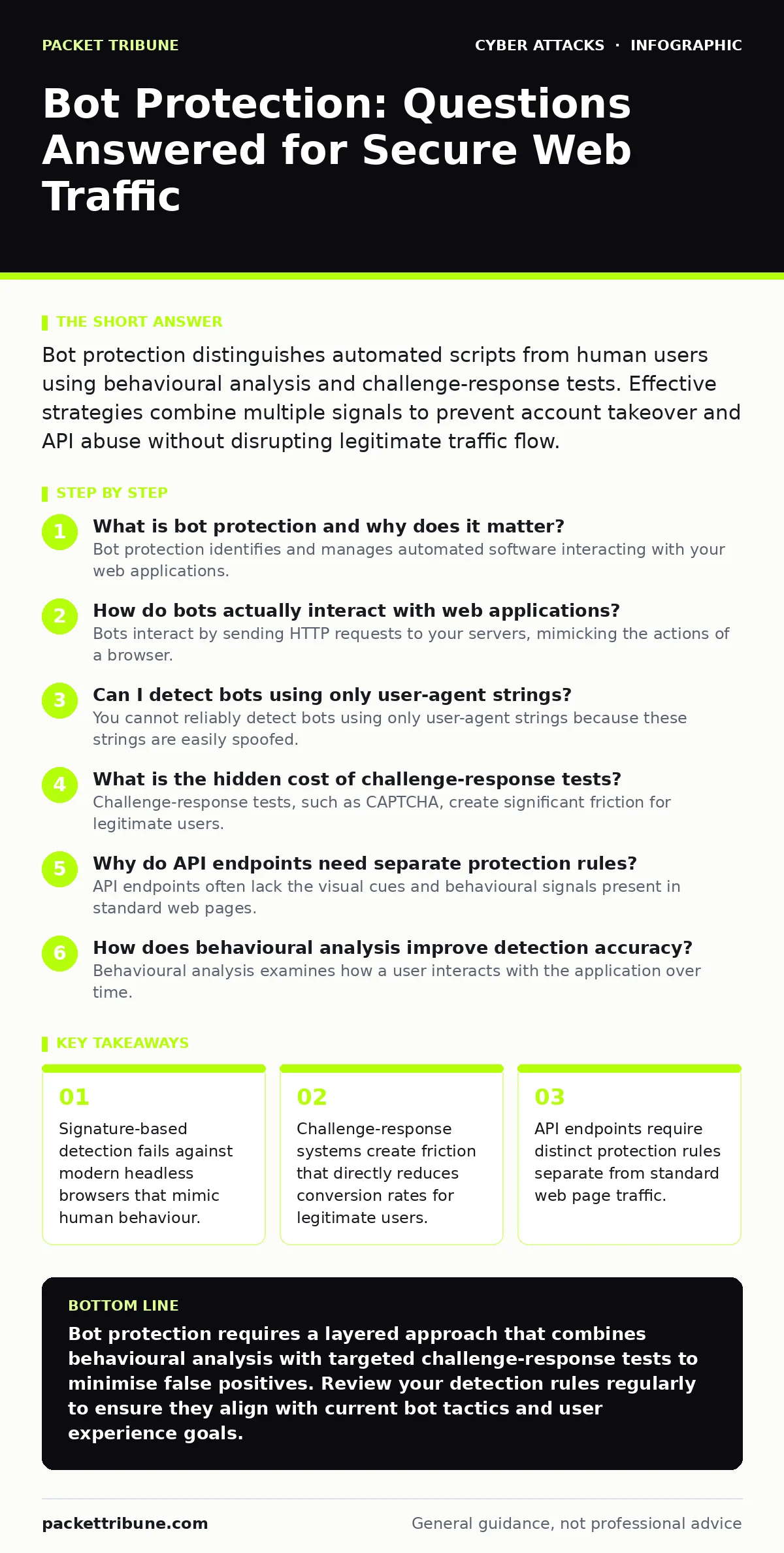
Bot protection distinguishes automated scripts from human users using behavioural analysis and challenge-response tests. Effective strategies combine multiple signals to prevent account takeover and API abuse without disrupting legitimate traffic flow.
What is bot protection and why does it matter?
Bot protection identifies and manages automated software interacting with your web applications. These automated programs, known as bots, can perform beneficial tasks like search indexing or malicious actions like credential stuffing. You need protection because malicious bots operate at scale, overwhelming servers and stealing data faster than any human could. The mechanism relies on distinguishing between human-like interaction patterns and rigid, scripted behaviour. Without these controls, your infrastructure faces constant, high-volume attacks that degrade performance and compromise data integrity.
How do bots actually interact with web applications?
Bots interact by sending HTTP requests to your servers, mimicking the actions of a browser. They can fill forms, click buttons, and scrape content just as a human would, but they do so without rendering the visual page. Modern bots use headless browsers, which are browser engines without a graphical user interface. This allows them to execute JavaScript and bypass simple checks that look for standard browser headers. Understanding this interaction is vital because it means you cannot rely on superficial indicators to identify malicious activity.
Can I detect bots using only user-agent strings?
You cannot reliably detect bots using only user-agent strings because these strings are easily spoofed. A user-agent string is a header sent by the browser to identify itself to the server. Attackers can modify this header to appear as a standard Chrome or Firefox browser. Relying on this single signal creates a false sense of security. You must combine this data with other behavioural signals, such as mouse movement patterns or request timing, to build an accurate picture of the visitor. This layered approach aligns with the principles of defense in depth to ensure no single point of failure exists.
What is the hidden cost of challenge-response tests?
Challenge-response tests, such as CAPTCHA, create significant friction for legitimate users. Every time a user must solve a puzzle to prove they are human, you risk losing their engagement. This friction reduces conversion rates and increases support tickets from confused customers. The hidden cost is not just the time users spend solving puzzles, but the cumulative damage to your brand reputation. Users associate difficult verification processes with poor user experience. You must balance security requirements against the business impact of blocking or annoying genuine visitors.
Why do API endpoints need separate protection rules?
API endpoints often lack the visual cues and behavioural signals present in standard web pages. Bots targeting APIs send direct data requests without rendering a user interface, making traditional browser-based detection ineffective. You need specific rules that monitor request frequency, payload structure, and authentication patterns. Standard web protection tools may miss these attacks because they expect human-like navigation. Treating API traffic as distinct allows you to implement stricter rate limiting and anomaly detection tailored to machine-to-machine communication.
See also: HTTP Security Headers Explained: The Digital Envelope Metaphor · Cross-Site Request Forgery Prevention Checklist for Secure Web Apps
How does behavioural analysis improve detection accuracy?
Behavioural analysis examines how a user interacts with the application over time. It looks at mouse movements, scroll patterns, and typing rhythms to create a baseline for human activity. Bots often exhibit rigid, predictable patterns that deviate from this baseline. This method allows you to identify malicious activity without interrupting the user experience. It works silently in the background, flagging suspicious sessions for further review. This approach reduces false positives compared to static signature matching, which often blocks legitimate automated tools.
What happens when bot protection systems make mistakes?
Bot protection systems frequently generate false positives, blocking legitimate users or services. Search engine crawlers, monitoring tools, and automated internal scripts may be misidentified as malicious bots. This misclassification can lead to lost organic traffic, broken integrations, and internal operational disruptions. You must maintain a allowlist for trusted automated services and provide an easy appeal process for blocked users. Regularly reviewing blocked traffic helps you refine your detection rules and reduce unnecessary friction. This maintenance is critical for keeping your security posture effective over time.
How do I balance security with user experience?
Balancing security with user experience requires continuous tuning of your detection thresholds. You must accept that no system is perfect and will occasionally block legitimate traffic or allow malicious bots through. The goal is to minimise the impact on both sides. Implementing progressive authentication allows you to start with lightweight checks and only escalate to more intrusive measures when risk increases. This approach ensures that low-risk users experience minimal friction while high-risk activity triggers stronger verification. Regularly analysing traffic data helps you adjust these thresholds to match your specific business needs.
| Detection Method | Strengths | Weaknesses | Best Use Case |
|---|---|---|---|
| Signature Matching | Easy to implement | Easily bypassed | Known bot families |
| Behavioural Analysis | High accuracy | Resource intensive | General web traffic |
| Challenge-Response | High certainty | User friction | High-risk transactions |
| Rate Limiting | Simple to configure | Blocks legitimate bursts | API endpoints |
Can I protect against account takeover attacks?
Account takeover attacks often use bots to test stolen credentials at high speed. You can protect against this by monitoring for rapid login attempts from multiple geographic locations. Implementing step-up authentication for unusual login patterns adds a layer of security without annoying regular users. Combining bot detection with anomaly detection in user behaviour helps you spot these attacks early. This strategy prevents attackers from gaining access even if they possess valid credentials. It is a critical component of your overall identity security strategy.
How do I handle headless browser attacks?
Headless browsers mimic standard browser environments, making them difficult to detect using traditional methods. You must look for subtle inconsistencies in how the browser renders pages or handles JavaScript execution. Timing analysis can reveal the rigid patterns of automated scripts. Additionally, challenging the browser to perform tasks that require complex visual interpretation can help distinguish humans from bots. This requires advanced detection capabilities that go beyond simple header inspection. Staying ahead of these sophisticated tools demands continuous adaptation of your detection rules.
What is the role of device fingerprinting?
Device fingerprinting creates a unique identifier for each device based on its configuration and characteristics. It looks at factors like screen resolution, installed fonts, and hardware capabilities. This allows you to track devices across sessions, even if cookies are cleared. It helps identify patterns of abuse associated with specific devices or emulators. However, privacy regulations may restrict the collection of this data. You must ensure your fingerprinting methods comply with local laws and do not collect personally identifiable information unnecessarily. This balance is crucial for maintaining user trust while enhancing security.
Key takeaways
- Signature-based detection fails against modern headless browsers that mimic human behaviour.
- Challenge-response systems create friction that directly reduces conversion rates for legitimate users.
- API endpoints require distinct protection rules separate from standard web page traffic.
Bot protection requires a layered approach that combines behavioural analysis with targeted challenge-response tests to minimise false positives. Review your detection rules regularly to ensure they align with current bot tactics and user experience goals.
Frequently asked questions
How do I distinguish between good bots and bad bots?
Good bots, like search engine crawlers, usually identify themselves and follow standard protocols. Bad bots often hide their identity and exhibit aggressive or repetitive behaviour patterns.
Is CAPTCHA still effective against modern bots?
Standard CAPTCHA is less effective as bots can use AI to solve visual puzzles. More advanced, invisible challenges that analyse behaviour are becoming the standard for effective protection.
Can bot protection prevent DDoS attacks?
Bot protection can mitigate application-layer DDoS attacks by blocking malicious requests. It does not replace network-level DDoS mitigation services for volumetric attacks.
How often should I update my bot protection rules?
You should review and update your rules regularly, ideally weekly, to adapt to new bot tactics and reduce false positives from legitimate traffic changes.
How this guide was produced: written by the Packet Tribune editorial team with AI assistance, checked against the public references listed below, and reviewed when the facts change. See our editorial policy or report an error.