Vishing Attack Mechanics: How Voice Phishing Bypasses Modern Defences
Voice biometrics and caller ID spoofing allow attackers to replicate trusted identities with precision that text-based filters cannot detect.

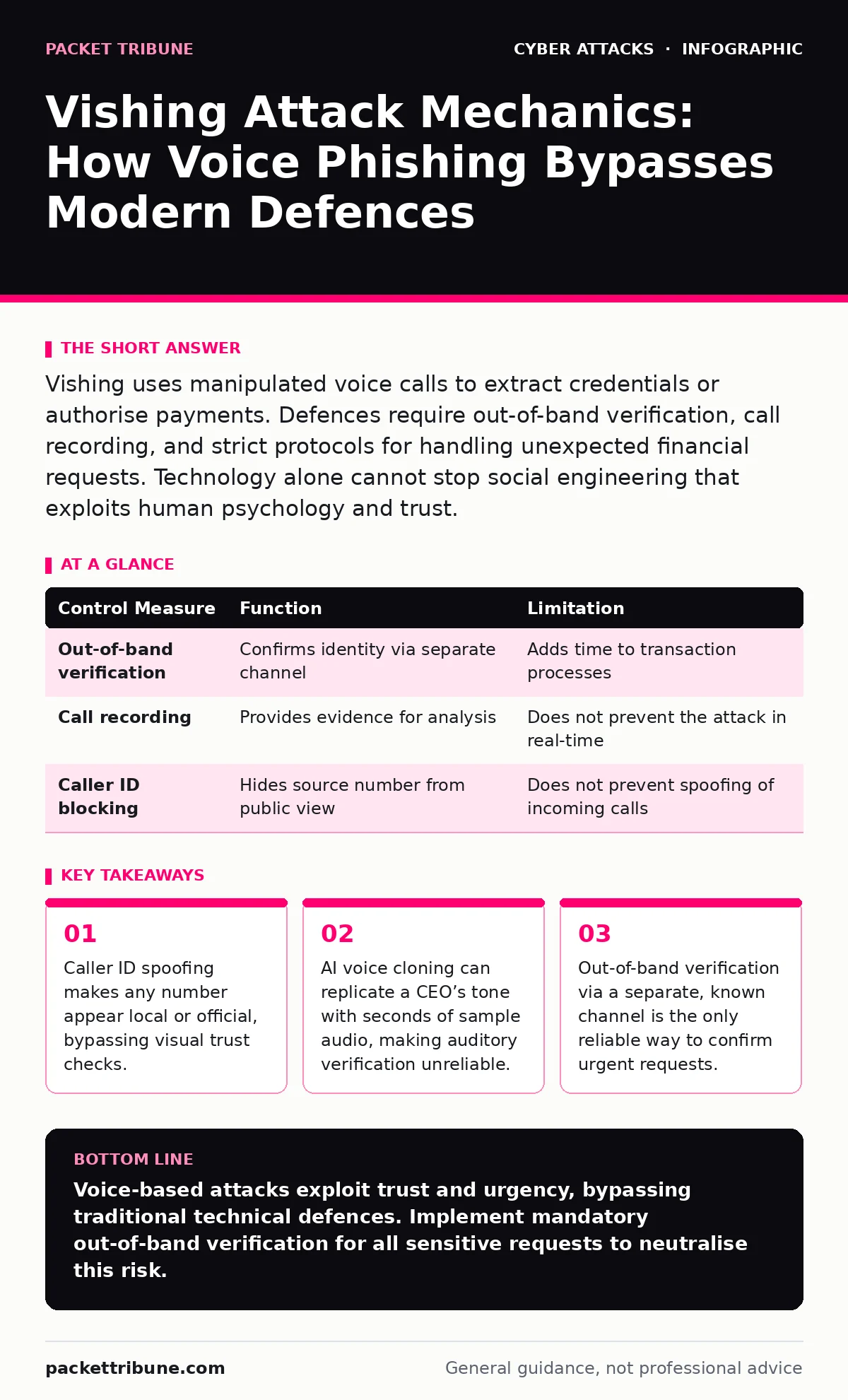
Vishing uses manipulated voice calls to extract credentials or authorise payments. Defences require out-of-band verification, call recording, and strict protocols for handling unexpected financial requests. Technology alone cannot stop social engineering that exploits human psychology and trust.
What is vishing and how does it differ from phishing?
Vishing is voice-based phishing, where attackers use telephone systems to deceive recipients into revealing sensitive data or performing actions. Unlike email phishing, which relies on written text and links, vishing exploits the immediacy and perceived authority of a live voice conversation. The real-time nature of the call creates pressure, reducing the victim’s ability to verify claims or think critically. This medium bypasses traditional email filters and spam blockers entirely.
How do attackers forge caller ID information?
Attackers use caller ID spoofing to manipulate the number displayed on your screen to match a trusted organisation or local area code. This technique exploits the trust you place in the visual confirmation of a familiar number. Modern VoIP (Voice over IP) services allow criminals to alter header data, making the call appear to originate from a legitimate source. You cannot trust the displayed number as proof of identity, regardless of how accurate it seems.
Can artificial intelligence replicate specific voices?
Yes, generative AI can create convincing synthetic voices using only short audio samples from public sources. These models analyse pitch, tone, cadence and accent to produce audio that mimics a specific individual. Attackers use this to impersonate executives or colleagues, a technique known as voice cloning. The audio quality is often sufficient to pass casual auditory verification, making voice recognition an unreliable security control.
What are the most common vishing attack scenarios?
Attackers often pose as IT support staff claiming your device is infected, or as bank officials warning of fraudulent activity. Another common scenario involves impersonating a senior executive requesting an urgent wire transfer or gift card purchase. These scripts are designed to trigger fear or urgency, forcing you to bypass standard procedures. The goal is to secure compliance before you have time to question the legitimacy of the request.
How do you verify a caller’s true identity?
You must use out-of-band verification, which means confirming the request through a different communication channel than the one used for the initial contact. If someone calls requesting a payment, hang up and contact them using a phone number you already have on file. Do not use numbers provided by the caller, as these may be monitored by the attacker. This step breaks the chain of deception and ensures you are speaking to the actual authorised person.
What technical controls reduce vishing effectiveness?
Implementing call recording for all inbound and outbound business calls creates an audit trail for later analysis. Advanced telephony systems can flag calls originating from known spoofing centres or unusual geographic locations. While these tools do not block all attacks, they provide data for forensic investigation and deter casual criminals. Combining technical filters with human verification procedures offers the highest level of protection.
| Control Measure | Function | Limitation |
|---|---|---|
| Out-of-band verification | Confirms identity via separate channel | Adds time to transaction processes |
| Call recording | Provides evidence for analysis | Does not prevent the attack in real-time |
| Caller ID blocking | Hides source number from public view | Does not prevent spoofing of incoming calls |
How does vishing relate to SIM swapping?
Vishing is often the initial step in a SIM swapping attack, where an attacker tricks mobile carriers into transferring a victim’s phone number to a new SIM card. By convincing customer service representatives to authorise the switch, attackers gain access to two-factor authentication codes sent via SMS. This allows them to bypass login security on email and banking accounts. The voice call is the mechanism used to steal the identity that protects the digital credentials.
Why do standard security tools miss these attacks?
Traditional security solutions focus on network traffic, malware signatures and email content analysis. They are not designed to analyse the semantic content of voice conversations or detect social engineering cues in real-time. Even advanced endpoint protection cannot stop a user from voluntarily disclosing a password to a convincing caller. The human element remains the primary vector, making technical controls insufficient without behavioural training.
How do you build resilience against voice phishing?
Resilience comes from assuming that voice communications can never be fully trusted without verification. Establish clear policies for handling urgent requests, requiring multiple forms of confirmation for high-value actions. Regular tabletop exercises help staff practice responding to these scenarios without real-world consequences. These drills reveal gaps in communication protocols and improve collective response times.
Key takeaways
- Caller ID spoofing makes any number appear local or official, bypassing visual trust checks.
- AI voice cloning can replicate a CEO’s tone with seconds of sample audio, making auditory verification unreliable.
- Out-of-band verification via a separate, known channel is the only reliable way to confirm urgent requests.
Voice-based attacks exploit trust and urgency, bypassing traditional technical defences. Implement mandatory out-of-band verification for all sensitive requests to neutralise this risk.
Frequently asked questions
Can blocking unknown numbers stop vishing?
No, because attackers frequently spoof legitimate numbers that you would normally allow, making blanket blocking ineffective and disruptive.
Is call recording a legal requirement?
Legal requirements vary by jurisdiction, but recording business calls for security purposes is widely accepted if parties are notified.
How do I report a suspected vishing attempt?
Document the call details and report it to your internal security team for analysis and potential blocking of the source.
Does two-factor authentication prevent vishing?
It helps, but attackers can attempt to intercept 2FA codes via SIM swapping or trick users into revealing them during the call.
How this guide was produced: written by the Packet Tribune editorial team with AI assistance, checked against the public references listed below, and reviewed when the facts change. See our editorial policy or report an error.