How to Run Tabletop Exercises: A Practical Implementation Framework
Most exercises fail because participants rehearse procedures rather than confronting ambiguous decisions under pressure.

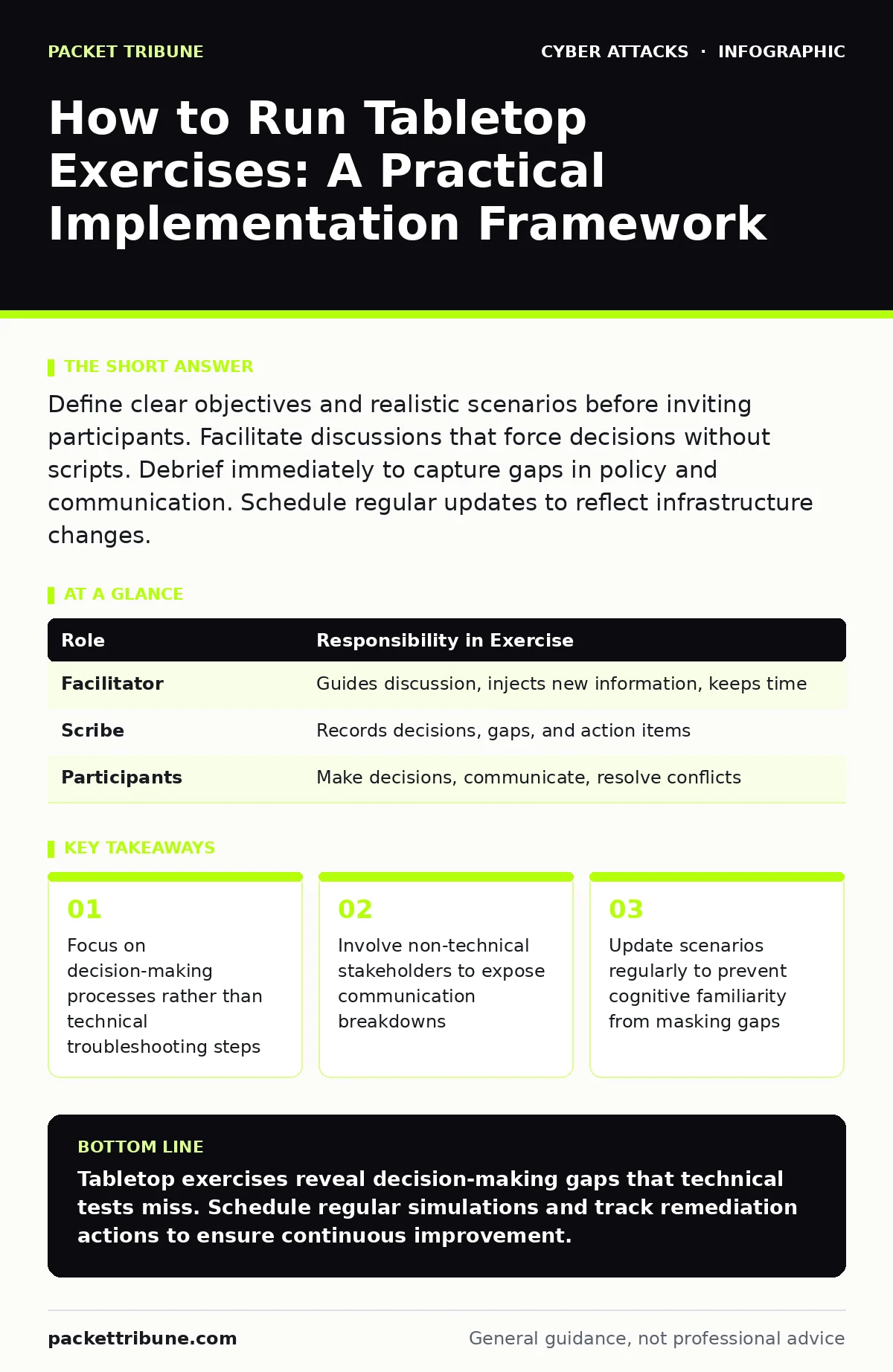
Define clear objectives and realistic scenarios before inviting participants. Facilitate discussions that force decisions without scripts. Debrief immediately to capture gaps in policy and communication. Schedule regular updates to reflect infrastructure changes.
Defining the Scope and Objectives
Tabletop exercises are discussion-based simulations where stakeholders walk through hypothetical incidents to evaluate response capabilities. They differ from technical drills, which test specific tools or configurations. The primary value lies in exposing gaps in coordination, authority, and communication rather than verifying software functionality. You must define what you intend to test before writing any scenario details.
Choosing the right scope prevents the exercise from becoming a generic overview of your security posture. Narrowing the focus allows for deeper analysis of specific failure modes. For instance, testing how you handle a ransomware event differs significantly from testing your response to a data privacy breach. Each scenario demands different legal, public relations, and technical responses.
Preparing the Scenario Narrative
The scenario must be plausible but not predictable. If participants can guess the next plot twist, they will rehearse their expected answers rather than thinking critically. The narrative should introduce ambiguity, forcing participants to make decisions with incomplete information. This mirrors real-world incidents where initial data is often contradictory or scarce.
Consider the human factor in security when designing the narrative. Human error or intentional malice often triggers incidents, and the response must account for internal investigations alongside technical containment. The scenario should include elements that challenge standard operating procedures, such as conflicting advice from legal and technical teams.
Avoid using recent, high-profile breaches as direct templates. Participants will likely recall media reports and apply those solutions to your context, which may be inappropriate. Instead, create a unique combination of threats that requires tailored decisions.
Step 1: Selecting the Participants
Identify individuals who hold decision-making authority during an incident. This includes technical staff, but also legal counsel, public relations officers, and executive leadership. Their presence ensures that the exercise tests the entire chain of command, not just the technical response team.
Do not invite observers unless they have a defined role. Passive attendees dilute the focus and can create a performance atmosphere rather than a learning environment. The group size should remain manageable, typically between five and ten people, to allow for meaningful discussion.
| Role | Responsibility in Exercise |
|---|---|
| Facilitator | Guides discussion, injects new information, keeps time |
| Scribe | Records decisions, gaps, and action items |
| Participants | Make decisions, communicate, resolve conflicts |
Step 2: Establishing the Rules of Engagement
Clarify how the exercise will proceed before it begins. Participants need to know that the goal is learning, not blame. Establish that decisions made during the exercise do not constitute official policy changes until reviewed and approved. This psychological safety encourages honest admission of uncertainty.
Define the communication channels to be used. Will participants use email, chat, or phone? Simulating the actual tools used in an incident reveals friction points in daily operations. If your incident response plan specifies a particular communication platform, use it during the exercise.
Step 3: Executing the Simulation
Begin by presenting the initial incident details. Allow participants to react naturally before injecting new complications. The facilitator should pause the discussion periodically to ask probing questions. Questions like "Who needs to be notified?" or "What is the business impact?" drive deeper analysis than technical queries.
Introduce time pressure by imposing decision deadlines. Real incidents do not wait for consensus. This constraint reveals whether your delegation of authority is clear. If participants struggle to decide who has the final say, you have identified a critical governance gap.
See also: Data Breaches: The Hidden Costs and Real Mechanics of Exfiltration
Step 4: Debriefing and Documentation
The debrief is where the most significant learning occurs. Immediately after the exercise, while memories are fresh, review the decisions made. Identify where the response succeeded and where it stalled. Document these findings in a structured format that links observations to specific policy or process gaps.
Avoid summarising the event. Focus on the process. Ask why certain decisions were delayed or why communication failed. These insights are more valuable than noting that a server was compromised. Share the debrief report with all participants and relevant stakeholders within a week.
Verifying Effectiveness
An exercise is only effective if it leads to change. Track the action items generated during the debrief. Assign owners and deadlines to each item. If no policies are updated, no tools are adjusted, and no training is scheduled, the exercise was merely a discussion, not an improvement mechanism.
Check if the documented gaps have been addressed in subsequent audits or reviews. The verification checklist below helps ensure that the exercise translates into tangible security improvements.
- Action items assigned to specific owners
- Policy updates drafted and reviewed
- Communication protocols tested in follow-up drills
- Training materials updated based on identified knowledge gaps
Maintaining Long-Term Relevance
Threats and infrastructure evolve, so your exercises must too. Schedule regular reviews of your scenario library. Update them to reflect new technologies, organisational changes, and emerging threat tactics. An exercise based on outdated infrastructure tests irrelevant procedures.
Rotate participants to ensure that new team members understand their roles. This prevents knowledge silos and ensures business continuity. Consider integrating lessons from supply chain attacks or vendor email compromise into your scenarios to broaden the perspective beyond internal systems.
Integrating with Broader Security Strategies
Tabletop exercises complement other security measures but do not replace them. They test the human and procedural elements that technical controls cannot address. For example, endpoint protection may detect a threat, but the exercise reveals how quickly the team can isolate affected systems.
Similarly, DDoS protection mitigates traffic floods, but the exercise tests how you communicate with customers and law enforcement during the attack. By linking tabletop findings to technical controls, you create a cohesive security posture.
Key takeaways
- Focus on decision-making processes rather than technical troubleshooting steps
- Involve non-technical stakeholders to expose communication breakdowns
- Update scenarios regularly to prevent cognitive familiarity from masking gaps
Tabletop exercises reveal decision-making gaps that technical tests miss. Schedule regular simulations and track remediation actions to ensure continuous improvement.
Frequently asked questions
How often should we run tabletop exercises?
Run them at least twice a year, or whenever significant infrastructure or policy changes occur.
Can remote teams participate effectively?
Yes, provided the communication tools used in the exercise match those used in real incidents.
How do we measure the success of an exercise?
Success is measured by the number of actionable improvements implemented, not by the smoothness of the discussion.
What if participants resist participating?
Emphasise that the exercise identifies systemic issues, not individual failures, and highlight the organisational benefits.
How this guide was produced: written by the Packet Tribune editorial team with AI assistance, checked against the public references listed below, and reviewed when the facts change. See our editorial policy or report an error.