Detecting Cyber Attacks on Railways: Early Signs and Response
Operational technology failures often precede network alerts, meaning physical symptoms reveal intrusion before digital sensors trigger alarms.

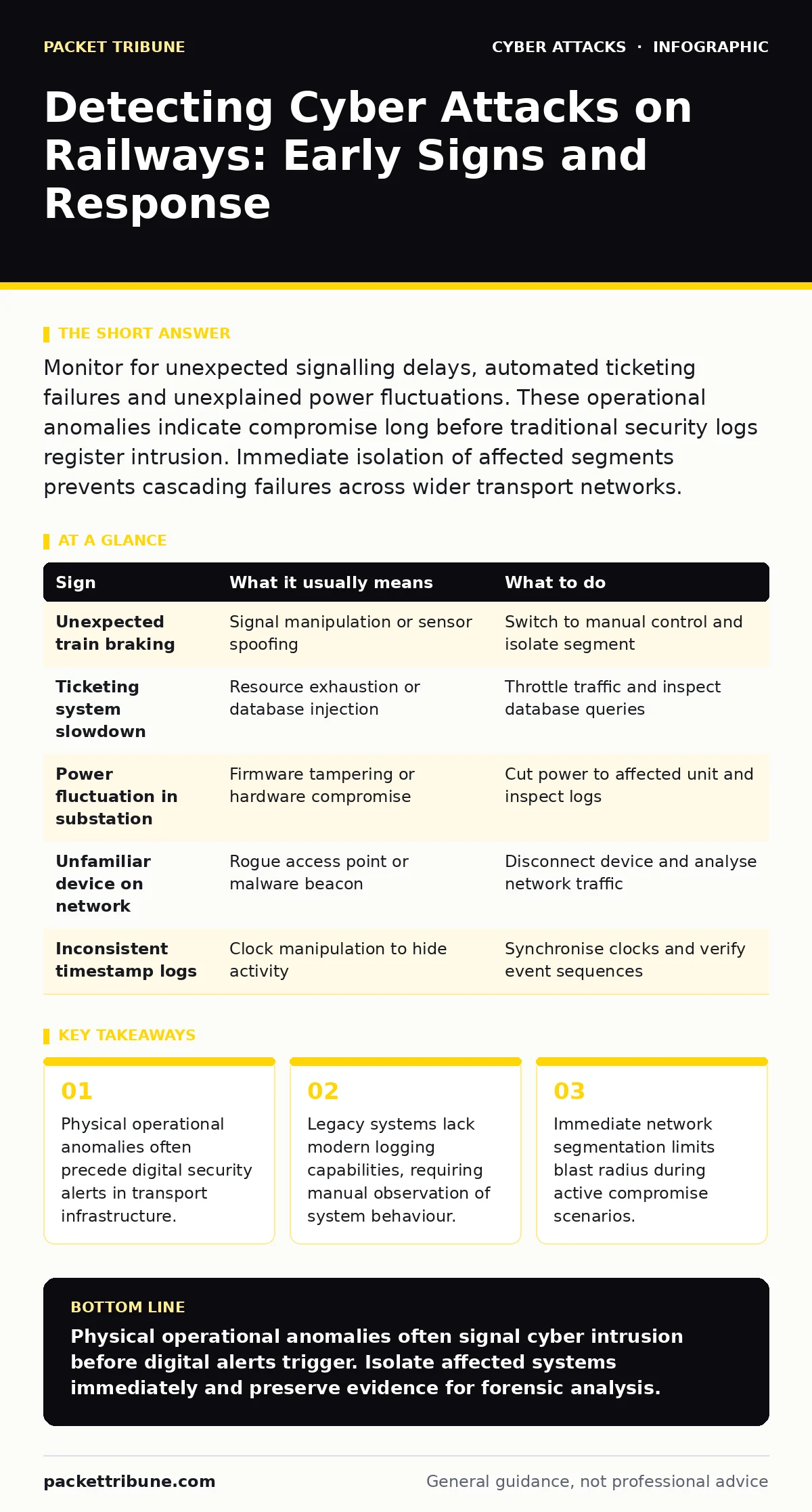
Monitor for unexpected signalling delays, automated ticketing failures and unexplained power fluctuations. These operational anomalies indicate compromise long before traditional security logs register intrusion. Immediate isolation of affected segments prevents cascading failures across wider transport networks.
Recognising Immediate Operational Anomalies
Transport operators notice signalling irregularities first. Train dispatch systems may display incorrect track occupancy statuses. Automatic train protection systems could trigger unexpected brakes. These events disrupt service immediately. Staff report inconsistent data between control centres and field equipment. Network latency spikes appear without corresponding traffic increases. These symptoms suggest active manipulation of operational technology.
Imagine a scenario where a central dispatch system suddenly reports clear tracks while sensors indicate occupation. This contradiction forces manual intervention. The delay creates backlog. Such inconsistencies are rarely accidental. They indicate external influence on data feeds. Operators must treat these discrepancies as potential security incidents. Standard operational procedures do not account for malicious data injection.
Identifying Hidden Indicators in Legacy Systems
Legacy signalling equipment lacks modern logging features. Attackers exploit this silence. They manipulate inputs without generating audit trails. Power consumption patterns change subtly. Motors draw different currents during tampering. These physical metrics remain invisible to standard network monitoring. Environmental sensors in server rooms may show temperature drift. This drift indicates hardware working harder than normal.
Suppose a ticketing machine processes transactions slower than usual. The delay is minimal. Passengers barely notice. The backend database receives malformed queries. These queries strain the system. Over time, performance degrades. This degradation is not a software bug. It is a symptom of resource exhaustion attacks. Such slow-burn attacks evade traditional threshold-based alerts.
Connecting Digital and Physical Layers
Operational technology and information technology share resources. Compromise spreads across boundaries. A phishing email on an administrative laptop can pivot to control systems. This pivot exploits trust relationships. The initial entry point appears benign. The destination is critical infrastructure. Monitoring must cover both domains. Correlation between email logs and train movement data reveals the link.
Network segmentation fails when protocols are misconfigured. Legacy systems often allow unrestricted broadcast traffic. Attackers use this openness to map networks. They scan for vulnerable endpoints. They exploit known weaknesses in industrial protocols. These protocols prioritise reliability over security. This design choice creates persistent vulnerabilities.
| Sign | What it usually means | What to do |
|---|---|---|
| Unexpected train braking | Signal manipulation or sensor spoofing | Switch to manual control and isolate segment |
| Ticketing system slowdown | Resource exhaustion or database injection | Throttle traffic and inspect database queries |
| Power fluctuation in substation | Firmware tampering or hardware compromise | Cut power to affected unit and inspect logs |
| Unfamiliar device on network | Rogue access point or malware beacon | Disconnect device and analyse network traffic |
| Inconsistent timestamp logs | Clock manipulation to hide activity | Synchronise clocks and verify event sequences |
Responding to Detected Anomalies
Isolate the affected segment immediately. Disconnect compromised systems from the main network. This action prevents lateral movement. Do not reboot devices yet. Rebooting destroys volatile memory evidence. Capture memory dumps if possible. Engage incident response teams. Document every step taken. This documentation supports forensic analysis.
Communication protocols must be pre-defined. Staff need clear instructions. Ambiguity causes delay. Delay increases damage. Use out-of-band communication channels. Do not rely on compromised networks for coordination. Verify the integrity of backup systems. Ensure backups are not infected. Restore services only after verification.
The Cost of Over-Automation
Automated response systems can exacerbate attacks. They react to false positives. They shut down critical services unnecessarily. This creates operational paralysis. Attackers anticipate this reaction. They craft attacks to trigger automated shutdowns. This tactic achieves disruption without direct damage. Human oversight is required. Humans can distinguish between malfunction and malice.
Manual verification adds time. It also adds safety. Automated systems lack context. They see data points. Humans see patterns. This pattern recognition identifies nuanced threats. Over-reliance on automation reduces resilience. It creates single points of failure. Diversifying response methods improves stability.
See also: Router Vulnerabilities: Response and Recovery Steps
Integrating Security into Operations
Security must be part of daily operations. Staff need training. They must recognise anomalies. They must report them promptly. Culture changes are required. Security is not just an IT function. It is an operational necessity. Regular drills improve readiness. Tabletop exercises simulate real scenarios. They reveal gaps in procedures.
Endpoint protection alone is insufficient. It misses network-level attacks. Defense in depth requires multiple layers. Each layer adds friction. Friction slows attackers. It also slows legitimate operations. Balance is key. Too much friction hinders service. Too little allows intrusion. Finding the balance requires continuous adjustment.
Long-Term Resilience Strategies
Resilience requires diversity. Use different vendors for critical systems. This prevents single-vendor exploits. Keep air-gapped backups. Verify their integrity regularly. Test restoration procedures. Ensure they work under pressure. Maintain spare hardware. Replace failed components quickly.
Monitor emerging threats. Adapt defences accordingly. Threat actors evolve tactics. Static defences become obsolete. Continuous improvement is mandatory. Engage with industry groups. Share threat intelligence. Collaborative defence strengthens all participants. Isolation weakens collective security.
Key takeaways
- Physical operational anomalies often precede digital security alerts in transport infrastructure.
- Legacy systems lack modern logging capabilities, requiring manual observation of system behaviour.
- Immediate network segmentation limits blast radius during active compromise scenarios.
Physical operational anomalies often signal cyber intrusion before digital alerts trigger. Isolate affected systems immediately and preserve evidence for forensic analysis.
Frequently asked questions
How do I distinguish between a hardware fault and a cyber attack?
Hardware faults are usually isolated and repeatable. Cyber attacks often show patterns of manipulation or occur simultaneously across multiple systems. Check for unauthorized configuration changes.
Can legacy systems be secured without replacement?
Yes, through network segmentation and strict access controls. Monitor traffic at the perimeter. Use proxies to inspect commands. Regular audits detect misconfigurations.
What is the first step in an incident response plan?
Containment. Isolate the affected segment to prevent spread. Do not attempt to fix the issue immediately. Preserve the state for investigation.
How often should tabletop exercises be conducted?
At least annually. More frequent drills improve muscle memory. Include diverse scenarios. Test communication protocols. Evaluate response times.
How this guide was produced: written by the Packet Tribune editorial team with AI assistance, checked against the public references listed below, and reviewed when the facts change. See our editorial policy or report an error.