Defense in Depth Strategy: Layered Security That Actually Stops Breaches
Layered controls fail when they share the same underlying vulnerability, turning multiple barriers into a single point of failure that attackers exploit with ease.

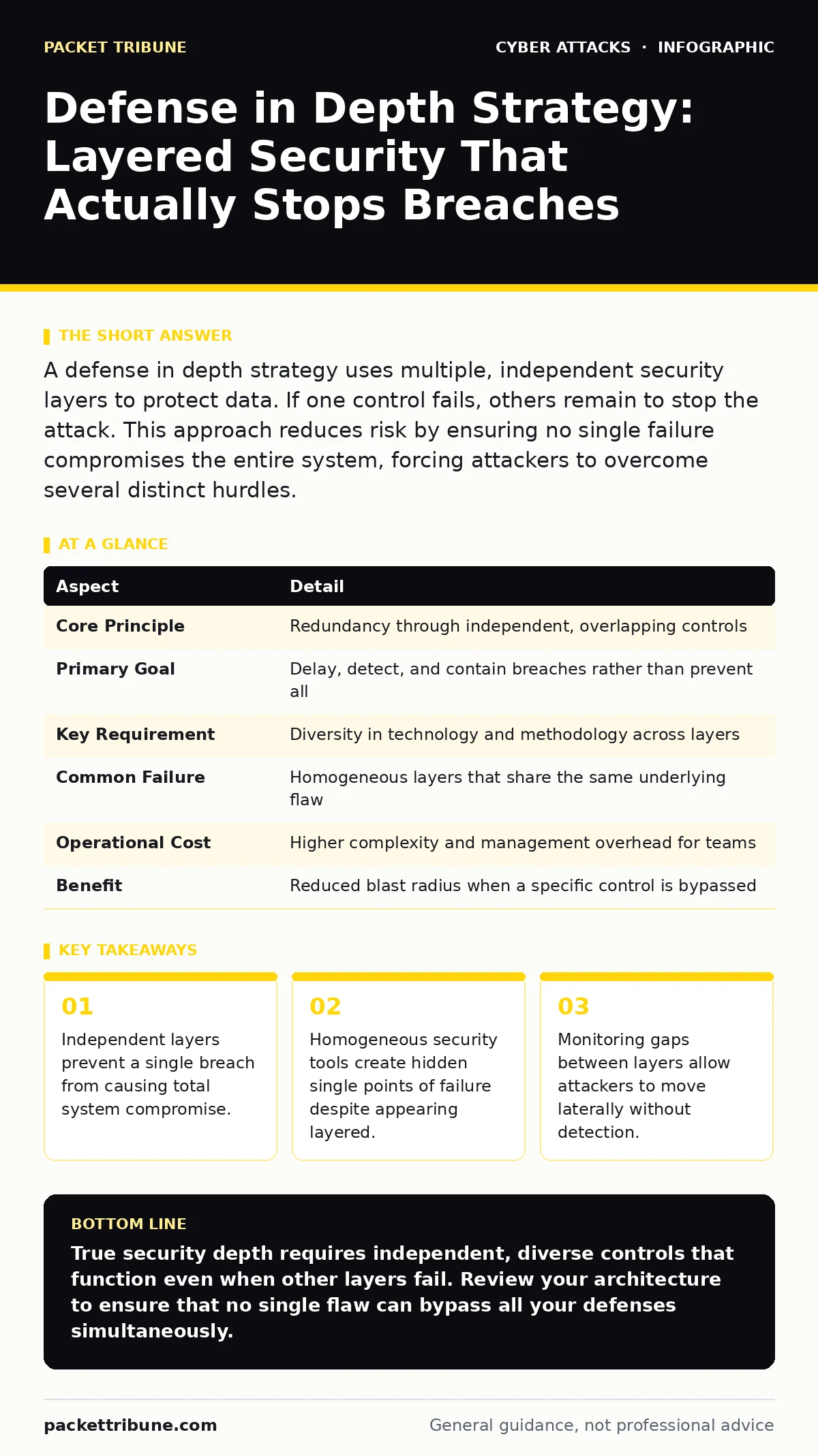
A defense in depth strategy uses multiple, independent security layers to protect data. If one control fails, others remain to stop the attack. This approach reduces risk by ensuring no single failure compromises the entire system, forcing attackers to overcome several distinct hurdles.
The castle wall analogy
Imagine a medieval castle. The outer wall stops casual raiders. The moat slows down determined attackers. The gatehouse checks identities. The inner keep holds the treasure. If raiders breach the wall, the moat still protects the gate. If they cross the moat, the gatehouse still stops them. This physical separation of barriers is the core concept behind a defense in depth strategy.
Digital systems rarely have physical walls. They rely on logical barriers. These barriers must function independently. If the firewall fails, the intrusion detection system must still catch the intruder. If the intrusion detection system misses the pattern, the endpoint protection must block the malicious payload. Each layer adds friction for the attacker. Friction increases the time and effort required to succeed. Most attackers seek the path of least resistance. High friction drives them toward easier targets.
What is a defense in depth strategy
A defense in depth strategy is a security model that employs multiple, overlapping protective measures. It assumes that any single control will eventually fail. The goal is not to create an impenetrable barrier. The goal is to contain damage and detect intrusion early. This approach recognises that attackers adapt. They find ways around firewalls. They exploit software bugs. They trick users into revealing credentials. No single tool stops all threats.
This model affects every part of an organisation. It applies to network architecture. It applies to application code. It applies to physical server rooms. It applies to human behaviour. Every entry point is a potential weakness. Every process is a potential vector. A cohesive strategy ties these elements together. It ensures that a failure in one area does not cascade into total collapse.
| Aspect | Detail |
|---|---|
| Core Principle | Redundancy through independent, overlapping controls |
| Primary Goal | Delay, detect, and contain breaches rather than prevent all |
| Key Requirement | Diversity in technology and methodology across layers |
| Common Failure | Homogeneous layers that share the same underlying flaw |
| Operational Cost | Higher complexity and management overhead for teams |
| Benefit | Reduced blast radius when a specific control is bypassed |
How layered controls work in practice
Layered controls operate on different domains. Network security filters traffic based on rules. Endpoint security monitors device behaviour. Identity management verifies user claims. Data encryption protects information at rest and in transit. These domains do not overlap perfectly. An attacker might bypass network filters using a legitimate user account. The identity layer catches this. The attacker might steal credentials. The endpoint layer detects the unusual process execution.
The power lies in the independence. If the network firewall uses a specific vendor’s rule engine, the endpoint should use a different detection method. If both rely on the same signature database, a new threat bypasses both. Independence means that a flaw in one component does not invalidate the others. This diversity is hard to achieve. It requires purchasing different tools. It requires configuring them differently. It requires training staff on multiple systems.
The hidden cost of homogeneous layers
Many organisations mistake quantity for diversity. They deploy five different security tools. All five use the same underlying engine. All five rely on the same threat intelligence feed. This is not a defense in depth strategy. This is a single layer painted in five colours. If the engine misses a technique, all five tools miss it.
This homogeneity creates a false sense of security. Dashboards display green lights. But the underlying logic is identical. An attacker who understands the engine’s limitations can craft payloads that bypass all five tools simultaneously. This is a critical insight for technical managers. Review the architecture, not just the vendor list. Ensure that detection methods differ fundamentally. Combine signature-based detection with behavioural analysis. Combine network monitoring with host-based logging.
This diversity increases operational complexity. Teams must manage more systems. They must correlate alerts from different sources. This requires skilled analysts. It requires integrated platforms. The cost is higher. But the security posture is genuinely stronger. A homogeneous stack is cheaper to manage. It is also cheaper to break.
What people usually get wrong
People often confuse depth with breadth. They focus on external perimeter defenses. They neglect internal segmentation. Once an attacker is inside the network, they move freely. Internal segmentation limits this movement. It creates zones. If one zone is compromised, the attacker cannot easily reach the sensitive data in another zone. This is a fundamental part of effective depth.
Another common error is ignoring the human element. Technical controls are only as strong as the people operating them. If staff bypass security procedures for convenience, the layers crumble. Training must reinforce the technical controls. It must explain why the layers exist. It must show how failures occur. Without this understanding, users become the weakest link.
Finally, many organisations fail to monitor the gaps between layers. Alerts from the firewall do not automatically correlate with alerts from the endpoint. This creates blind spots. Attackers exploit these gaps. They move laterally between systems without triggering a unified alert. Integration is key. Security information and event management systems help correlate these signals. But they require careful tuning.
Integrating identity and data protection
Identity is the new perimeter. Traditional networks relied on IP addresses for trust. Modern environments rely on user identities. Multi-factor authentication adds a layer to identity verification. It ensures that stolen passwords are insufficient for access. This is a critical component of a modern defense in depth strategy.
Data protection must also be layered. Encryption at rest protects data if storage devices are stolen. Encryption in transit protects data as it moves across networks. Access controls limit who can view the data. These controls operate at different stages. They provide protection even if earlier layers fail. For instance, if an attacker compromises a database server, encrypted data remains unreadable without the keys.
This approach aligns with the principle of least privilege. Users and systems should only have the access they need. Excessive privileges increase the risk. If an account is compromised, the attacker inherits all its privileges. Limiting privileges limits the damage. Regular reviews of access rights are necessary. Permissions accumulate over time. They must be pruned.
Managing the operational burden
Layered security creates more alerts. More alerts create noise. Noise leads to alert fatigue. Analysts ignore warnings. Real threats are missed. Managing this burden is a significant challenge. It requires automation. It requires prioritisation. Not all alerts are equal. Some indicate critical breaches. Others indicate benign anomalies.
Automated response plays a key role. Routine alerts can be handled by scripts. This frees analysts for complex investigations. Integration between tools is essential. Alerts should flow seamlessly from detection to response. This reduces manual effort. It improves speed. But it requires careful configuration. Incorrect automation can cause disruption. It must be tested thoroughly.
This complexity impacts related areas. For example, effective bot protection requires coordination between network layers and application firewalls. Similarly, preventing account takeover demands tight integration between identity providers and endpoint monitoring. Ignoring these connections creates gaps. A holistic view is necessary.
Building a resilient architecture
Resilience is the ultimate goal. Systems must withstand attacks. They must recover quickly. Redundancy is part of this. Not just security redundancy, but operational redundancy. Backups must be secure. They must be tested. Recovery procedures must be documented. They must be practiced.
A defense in depth strategy is not a one-time project. It is a continuous process. Threats evolve. Technologies change. Controls must be updated. Regular assessments are needed. Penetration testing identifies weaknesses. Vulnerability scanning finds known flaws. These activities keep the layers sharp. They ensure that the strategy remains effective.
Consider the broader threat environment. Supply chain attacks target trusted vendors. If a vendor is compromised, the attacker enters your network through a legitimate channel. Your internal layers must detect this. They must not trust external inputs blindly. This extends the depth concept outward. It recognises that trust is limited.
Key takeaways
- Independent layers prevent a single breach from causing total system compromise.
- Homogeneous security tools create hidden single points of failure despite appearing layered.
- Monitoring gaps between layers allow attackers to move laterally without detection.
True security depth requires independent, diverse controls that function even when other layers fail. Review your architecture to ensure that no single flaw can bypass all your defenses simultaneously.
Frequently asked questions
How many layers do I need for effective defense?
There is no fixed number. Focus on covering distinct domains: network, endpoint, identity, and data. Ensure each layer uses a different detection method to avoid homogeneous failure.
Does cloud computing change defense in depth?
Yes. The perimeter disappears. Identity and workload protection become primary layers. Network segmentation must be virtual. Controls must be applied at the API level.
How this guide was produced: written by the Packet Tribune editorial team with AI assistance, checked against the public references listed below, and reviewed when the facts change. See our editorial policy or report an error.