TLS Certificates: Answers to 10 Persistent Infrastructure Questions
Certificate transparency logs create a public audit trail that forces issuers to reveal every issued certificate, preventing stealthy impersonation attacks.

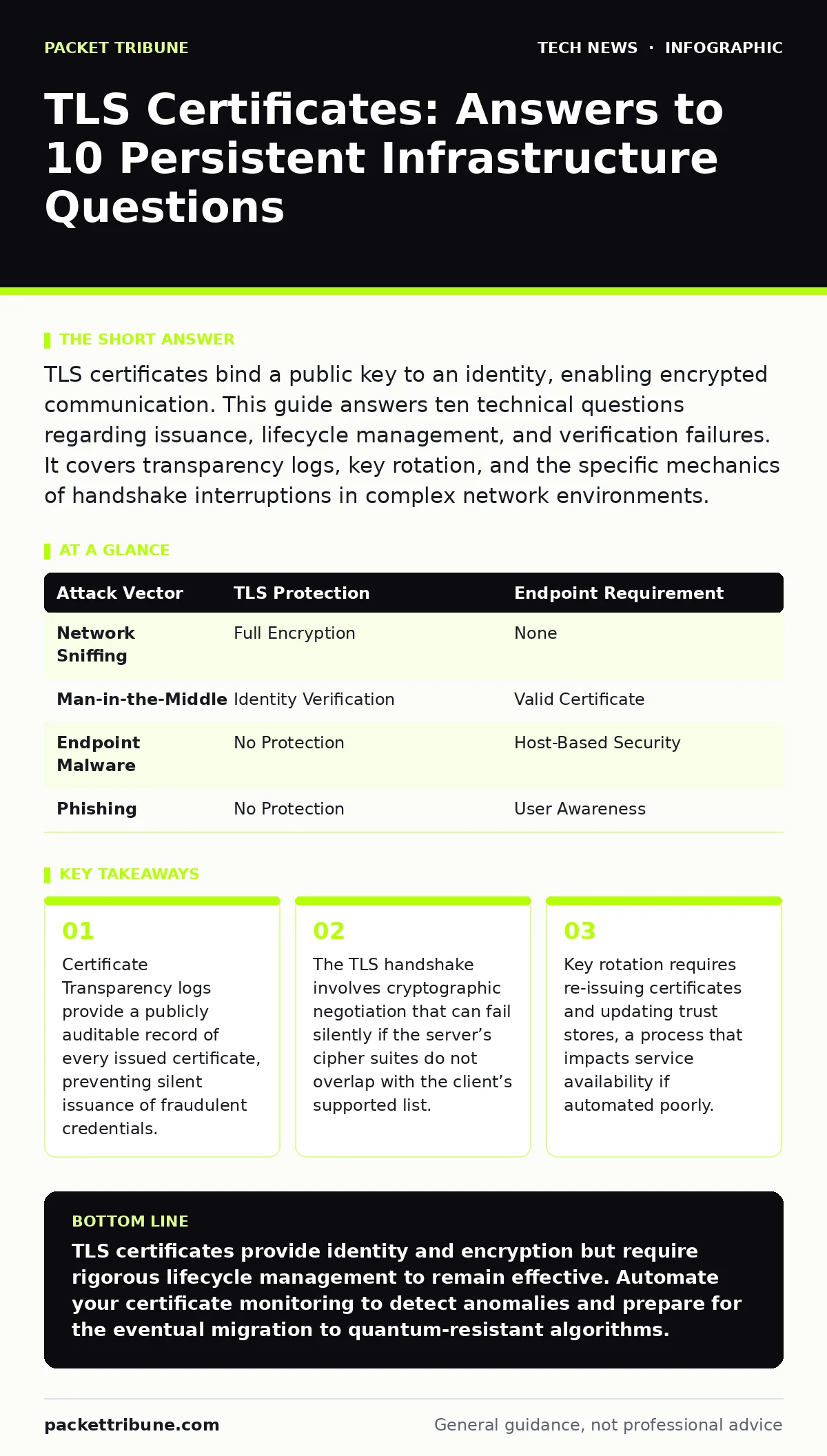
TLS certificates bind a public key to an identity, enabling encrypted communication. This guide answers ten technical questions regarding issuance, lifecycle management, and verification failures. It covers transparency logs, key rotation, and the specific mechanics of handshake interruptions in complex network environments.
What is the primary function of a TLS certificate?
A TLS certificate binds a public key to a specific identity, such as a domain name, allowing systems to verify they are communicating with the intended server. This binding prevents man-in-the-middle attacks, where an adversary intercepts traffic by impersonating the destination. The certificate does not encrypt the data itself; rather, it facilitates the exchange of symmetric keys used for the actual encryption. Without this identity verification, encryption alone cannot guarantee that you are speaking to the correct endpoint.
How does the certificate chain of trust work?
The trust model relies on a hierarchy where a root certificate authority signs intermediate certificates, which in turn sign your leaf certificate. Your device ships with a pre-installed store of trusted root certificates, forming the anchor of this trust. When you connect to a server, it presents its leaf certificate along with the intermediate certificates needed to trace the lineage back to a trusted root. If any link in this chain is missing or untrusted, the connection fails immediately.
Why do Certificate Transparency logs exist?
Certificate Transparency logs are public append-only databases that record every certificate issued by a participating authority. This mechanism prevents the secret issuance of fraudulent certificates for your domain by an rogue or compromised authority. You can monitor these logs to detect if an unknown entity has obtained a valid certificate for your infrastructure. This visibility forces certificate authorities to maintain higher standards of validation, as any error becomes publicly visible.
What happens during the TLS handshake?
The handshake is a multi-step process where the client and server agree on the cryptographic protocol version and cipher suite. The server presents its certificate, and the client verifies its validity and signature against its trust store. Once verified, they perform a key exchange to generate a shared secret that only they possess. This shared secret becomes the symmetric key for encrypting the subsequent session data.
Why does a certificate expire after a set period?
Expiration limits the window of opportunity for an attacker who might compromise a private key. If a key is stolen, the damage is confined to the period between the theft and the certificate’s expiry, after which it becomes useless. Shorter lifespans also encourage automation of the issuance and renewal process, reducing reliance on manual administrative tasks. This reduces the risk of human error during critical maintenance windows.
See also: Network Access Control Mistakes That Compromise Your Infrastructure · How the TLS Handshake Works: Mechanics, Weaknesses and Audit Points
How does key rotation differ from certificate renewal?
Renewal typically involves generating a new certificate for the same private key, while key rotation involves generating a brand new key pair. Key rotation is more secure because it ensures that even if a past key is compromised, future communications remain safe. However, key rotation is more disruptive as it requires updating the private key on the server and ensuring the new certificate is trusted by all clients. Many organisations prefer simple renewal to avoid the operational complexity of frequent key changes.
What causes "SSL handshake failure" errors?
This error usually indicates that the client and server could not agree on a common set of security parameters. This often occurs when the server supports only outdated protocols that modern clients have disabled for security reasons. It can also happen if the server’s certificate is missing an intermediate certificate, breaking the chain of trust. Misconfigured cipher suites, where the server rejects the client’s preferred encryption method, are another common cause.
Can TLS protect against all types of attacks?
TLS protects the integrity and confidentiality of data in transit, but it does not secure the endpoints themselves. If malware resides on the client device, it can capture data before encryption or after decryption. TLS also does not protect against social engineering attacks where a user voluntarily sends sensitive information to a fraudulent site. Furthermore, if the server’s private key is compromised, an attacker can decrypt intercepted traffic recorded before the compromise.
| Attack Vector | TLS Protection | Endpoint Requirement |
|---|---|---|
| Network Sniffing | Full Encryption | None |
| Man-in-the-Middle | Identity Verification | Valid Certificate |
| Endpoint Malware | No Protection | Host-Based Security |
| Phishing | No Protection | User Awareness |
How does certificate pinning improve security?
Certificate pinning restricts a client application to accept only specific certificates or public keys, rather than any certificate signed by a trusted authority. This prevents attackers from using a legitimately issued certificate from a compromised authority to intercept traffic. It is commonly used in mobile applications to ensure that the app only communicates with the intended backend server. However, pinning introduces operational risk; if you rotate keys without updating the app, users will be unable to connect.
What impact will quantum computing have on TLS?
Quantum computers threaten the asymmetric cryptography used in key exchange and certificate signatures, such as RSA and ECC. They do not directly threaten the symmetric encryption used for the data stream, such as AES encryption, though they halve its effective key length. The industry is transitioning towards post-quantum cryptography, which uses mathematical problems believed to be hard for quantum computers to solve. This transition requires updating hardware, software, and certificate authorities to support new algorithmic standards.
Suppose a quantum computer becomes capable of breaking current RSA keys. Your existing archived traffic, if captured and stored, could be decrypted retroactively. This highlights the need for forward secrecy, where each session uses a unique key that cannot be derived from the server’s long-term private key. Implementing forward secrecy ensures that compromising the server later does not reveal past communications.
Key takeaways
- Certificate Transparency logs provide a publicly auditable record of every issued certificate, preventing silent issuance of fraudulent credentials.
- The TLS handshake involves cryptographic negotiation that can fail silently if the server’s cipher suites do not overlap with the client’s supported list.
- Key rotation requires re-issuing certificates and updating trust stores, a process that impacts service availability if automated poorly.
TLS certificates provide identity and encryption but require rigorous lifecycle management to remain effective. Automate your certificate monitoring to detect anomalies and prepare for the eventual migration to quantum-resistant algorithms.
Frequently asked questions
Do I need a separate certificate for every subdomain?
Not necessarily. A wildcard certificate covers a domain and all its first-level subdomains, such as *.example.com. However, wildcard certificates do not cover deeper levels, like sub.sub.example.com, and pose a higher risk if the private key is compromised.
What is the difference between TLS 1.2 and TLS 1.3?
TLS 1.3 removes support for outdated and insecure cryptographic algorithms, reducing the attack surface. It also simplifies the handshake process, making it faster and more secure by eliminating renegotiation features that were prone to abuse.
Can I self-sign a certificate for production?
Technically yes, but it is strongly discouraged. Self-signed certificates are not trusted by default in browsers or operating systems, causing warnings for every user. This undermines trust and makes it difficult to distinguish between a legitimate server and a malicious impersonator.
How often should I check my certificate status?
You should automate continuous monitoring rather than checking manually. Automated systems can alert you days before expiration or if a certificate appears in transparency logs unexpectedly. This ensures you address issues before they cause service outages.
How this guide was produced: written by the Packet Tribune editorial team with AI assistance, checked against the public references listed below, and reviewed when the facts change. See our editorial policy or report an error.