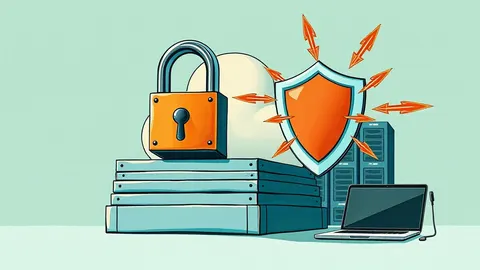
Tenant Isolation Explained: How Cloud Boundaries Prevent Data Bleed
Multi-tenancy shares hardware resources while enforcing strict logical separation, meaning your data never touches another customer’s storage despite the shared infrastructure.

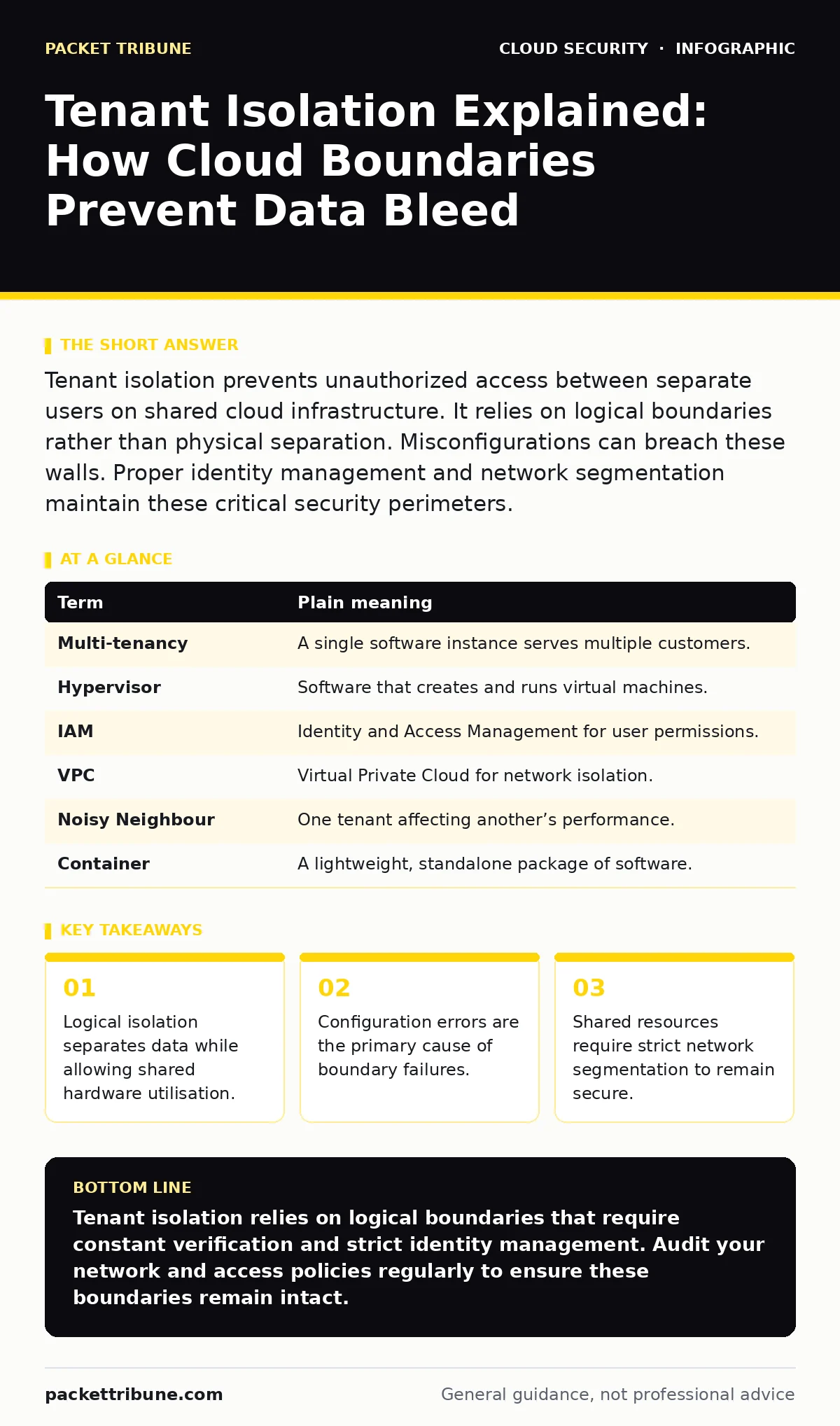
Tenant isolation prevents unauthorized access between separate users on shared cloud infrastructure. It relies on logical boundaries rather than physical separation. Misconfigurations can breach these walls. Proper identity management and network segmentation maintain these critical security perimeters.
The Apartment Building Analogy
Imagine a high-rise apartment building. The structure is a single physical entity with shared foundations, plumbing, and electrical systems. This represents the shared hardware in a cloud environment. Each apartment is a tenant. The walls between units are the isolation mechanisms.
You share the building with neighbours, but you do not share their living space. If a pipe bursts in unit four, water should not flood unit five. If someone steals the keys to unit four, they cannot enter unit five. The building manager ensures the walls remain intact and the locks function correctly.
Defining the Security Boundary
In cloud computing, tenant isolation is the mechanism that keeps one customer’s data and compute resources separate from another’s. This separation is logical, not physical. The cloud provider runs the infrastructure, but the software ensures your data never mixes with someone else’s.
This differs from single-tenancy, where one customer gets dedicated hardware. Multi-tenancy is more efficient but requires rigorous software controls. The boundary is defined by code and configuration, not by concrete or steel. If the code fails, the boundary fails.
Common Points of Confusion
Many assume that because the hardware is shared, the data is inherently mixed. This is incorrect. Data resides in isolated containers or virtual machines. The confusion often stems from not understanding the difference between physical proximity and logical separation.
Another misconception is that isolation is automatic. While the cloud provider builds the walls, you must lock the doors. Misconfiguring your network settings can create a hole in the wall. This is similar to leaving your apartment door unlocked in a secure building.
The Hidden Cost of Shared Resources
Sharing resources offers cost efficiency but introduces the risk of a noisy neighbour. If one tenant consumes excessive CPU or memory, it can degrade performance for others. This is a resource contention issue, not a security breach, but it highlights the interdependence of tenants.
More critically, a vulnerability in the hypervisor or container runtime can bypass isolation entirely. If the software managing the virtual machines has a flaw, an attacker in one tenant space might escape into another. This is why patching the underlying infrastructure is vital.
Identity as the Primary Lock
Isolation fails when identity controls are weak. If your access rules are too broad, an employee in one department might access data belonging to another. This is an internal breach of tenant isolation.
Integrating with federated identity systems helps manage these permissions centrally. It ensures that access rights are consistent and revocable. Without strict identity governance, the logical walls of the cloud become porous.
See also: Prevent Public File Share Exposure With This Technical Checklist · DevSecOps vs SecDevOps: Why the Syntax Defines Your Security Posture
Network Segmentation Strategies
Network segmentation reinforces tenant isolation by dividing your cloud environment into smaller zones. Each zone has its own security policies. Traffic between zones is filtered and monitored.
Imagine the apartment building having separate corridors for each floor. To move from floor one to floor two, you must pass through a secure lobby. In the cloud, this is achieved using virtual private clouds and security groups. Misconfiguring these rules can allow unwanted traffic flow.
Practical Verification Steps
You cannot rely solely on the cloud provider’s promises. You must verify that your configurations enforce isolation. Here is how to start:
- Audit your network security groups to ensure no public inbound traffic reaches sensitive databases.
- Review IAM policies to confirm that users only have the permissions required for their specific role.
- Implement cloud logging gaps monitoring to detect unusual access patterns across tenant boundaries.
Maintaining Isolation Over Time
Isolation is not a one-time setup. It requires continuous monitoring. Changes in your application or infrastructure can inadvertently open new pathways.
Using least privilege in the cloud principles reduces the blast radius of any potential breach. If an account is compromised, the attacker’s reach is limited. This approach complements technical isolation controls.
| Term | Plain meaning |
|---|---|
| Multi-tenancy | A single software instance serves multiple customers. |
| Hypervisor | Software that creates and runs virtual machines. |
| IAM | Identity and Access Management for user permissions. |
| VPC | Virtual Private Cloud for network isolation. |
| Noisy Neighbour | One tenant affecting another’s performance. |
| Container | A lightweight, standalone package of software. |
Key takeaways
- Logical isolation separates data while allowing shared hardware utilisation.
- Configuration errors are the primary cause of boundary failures.
- Shared resources require strict network segmentation to remain secure.
- Identity controls must enforce boundaries at every access layer.
Tenant isolation relies on logical boundaries that require constant verification and strict identity management. Audit your network and access policies regularly to ensure these boundaries remain intact.
Frequently asked questions
Can tenant isolation be broken?
Yes, through software vulnerabilities in the cloud provider’s infrastructure or misconfigurations by the customer. Proper patching and configuration management mitigate these risks.
Is multi-tenancy less secure than single-tenancy?
Not necessarily. Multi-tenancy relies on software isolation which can be very strong. However, it has a larger attack surface if the underlying platform is compromised.
How do I know if my tenant isolation is effective?
Implement **cloud detection and response** solutions to monitor for anomalous access. Regular audits of network rules and IAM policies also help verify effectiveness.
Does encryption replace tenant isolation?
No. Encryption protects data at rest and in transit, but isolation prevents unauthorized access in the first place. They are complementary security measures.
How this guide was produced: written by the Packet Tribune editorial team with AI assistance, checked against the public references listed below, and reviewed when the facts change. See our editorial policy or report an error.