DevSecOps vs SecDevOps: Why the Syntax Defines Your Security Posture
The letter order dictates whether security acts as a gatekeeper reviewing code or as an embedded constraint shaping how that code is written and deployed.

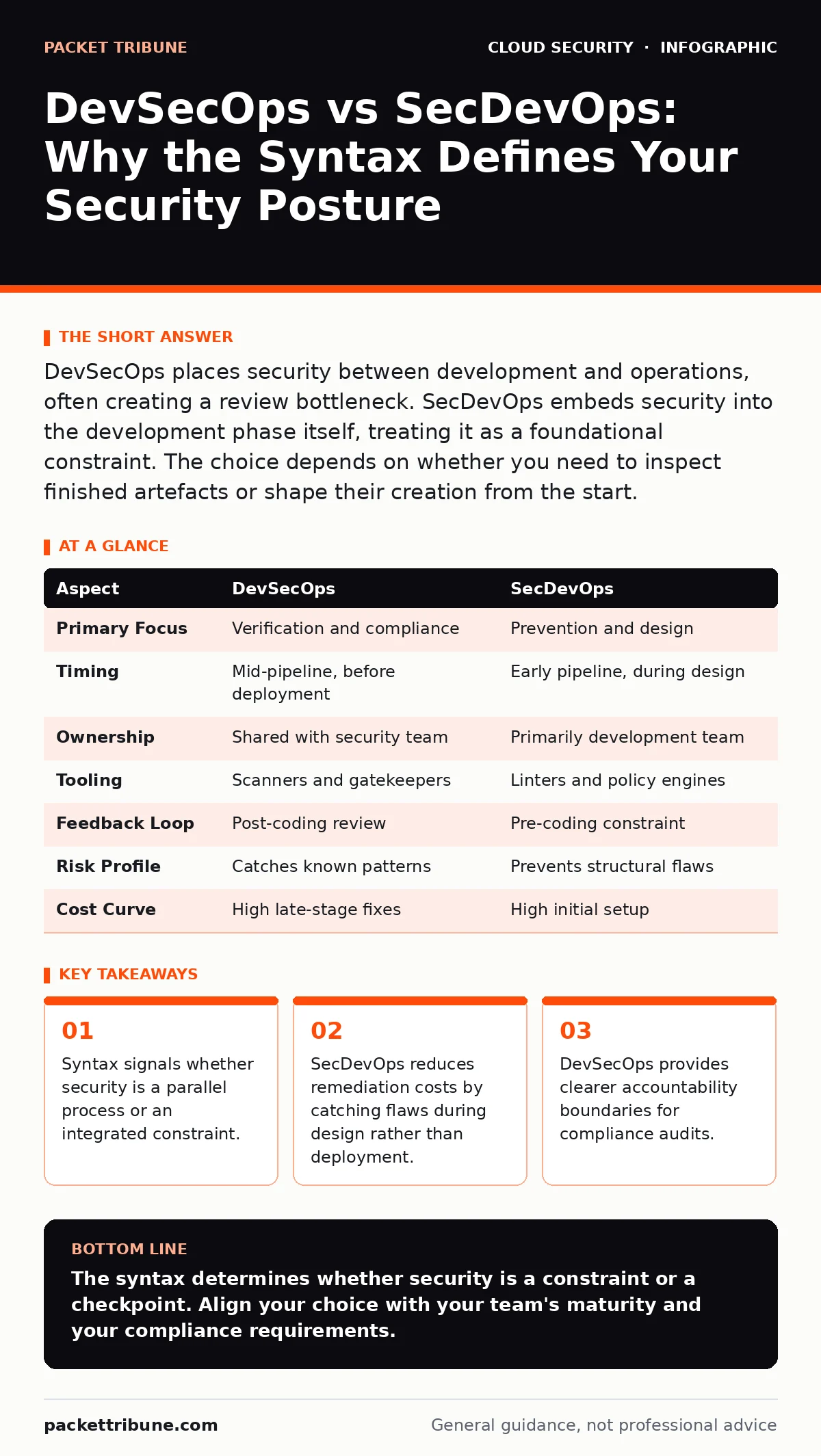
DevSecOps places security between development and operations, often creating a review bottleneck. SecDevOps embeds security into the development phase itself, treating it as a foundational constraint. The choice depends on whether you need to inspect finished artefacts or shape their creation from the start.
The Core Distinction in Syntax and Strategy
The difference between DevSecOps and SecDevOps lies in where security resides within the workflow sequence. DevSecOps positions security as a distinct phase between development and operations. This structure implies that code is written, then secured, then deployed. SecDevOps places security at the very beginning, alongside development. This implies that security requirements shape the code from its inception. The placement determines whether security is a validator of finished work or a constraint on the creative process.
What DevSecOps Actually Does
DevSecOps treats security as a specialized function that intersects with development and operations. You write code, run it through security scans, and then deploy it. This model relies on dedicated security engineers to review artefacts. It creates a clear hand-off point where security ownership transfers. This structure works well for organisations with mature compliance requirements. It allows for deep, manual review of complex systems. However, it often introduces latency into the release cycle. Security becomes a gate that code must pass through, rather than a lens through which code is viewed.
What SecDevOps Actually Does
SecDevOps integrates security practices into the initial design and coding phases. Security constraints are defined before any code is written. Developers use secure libraries and follow predefined patterns from day one. This approach prevents vulnerabilities from entering the codebase in the first place. It shifts the burden from detection to prevention. You configure your environment to make insecure choices difficult or impossible. This requires significant upfront effort in tooling and training. The payoff is a reduction in late-stage remediation costs.
Point-by-Point Comparison
| Aspect | DevSecOps | SecDevOps |
|---|---|---|
| Primary Focus | Verification and compliance | Prevention and design |
| Timing | Mid-pipeline, before deployment | Early pipeline, during design |
| Ownership | Shared with security team | Primarily development team |
| Tooling | Scanners and gatekeepers | Linters and policy engines |
| Feedback Loop | Post-coding review | Pre-coding constraint |
| Risk Profile | Catches known patterns | Prevents structural flaws |
| Cost Curve | High late-stage fixes | High initial setup |
When to Choose DevSecOps
Choose DevSecOps when your organisation requires clear audit trails. This model provides distinct evidence of security review. It suits environments where external compliance standards mandate separate verification steps. You benefit from this approach when handling legacy systems that cannot be redesigned. It allows you to apply modern security checks to older codebases without rewriting them. This method also works well when you lack the internal expertise to embed security deeply into every team.
See also: Prevent Public File Share Exposure With This Technical Checklist · Cloud migration security strategy: secure data in transit and at rest
When to Choose SecDevOps
Choose SecDevOps when speed and scalability are your primary drivers. This model reduces the friction of late-stage security failures. It suits greenfield projects where you can define standards from scratch. You benefit from this approach when your development teams are already agile. It requires a culture where developers accept security as a peer, not a police force. This model is ideal for cloud-native applications that change frequently. It aligns with the principles of infrastructure-as-code scanning, ensuring your environment is secure by design.
Where the Two Models Overlap
Both approaches require automation to be effective. Manual checks do not scale in modern environments. You need continuous integration pipelines that run security tests automatically. Both models benefit from cloud-native application protection platforms (CNAPP) to provide visibility across the stack. The overlap exists in the need for consistent policy enforcement. Whether you check before or after, the rules must be machine-readable. This convergence means you often use tools from both camps. You might design with SecDevOps principles but verify with DevSecOps gates.
Implementing a Hybrid Approach
Most mature organisations use a hybrid model. You embed security principles in the design phase. You then enforce those principles with automated gates. This requires careful coordination to avoid duplicate efforts. You must ensure that early-stage constraints do not conflict with late-stage verification. This approach addresses common cloud logging gaps by ensuring logs are structured correctly from the start. It also helps prevent misconfigured IAM roles by defining permissions during the design phase. The key is to view security as a continuous loop, not a linear path.
Key takeaways
- Syntax signals whether security is a parallel process or an integrated constraint.
- SecDevOps reduces remediation costs by catching flaws during design rather than deployment.
- DevSecOps provides clearer accountability boundaries for compliance audits.
- Hybrid approaches often fail without distinct ownership of security tooling.
The syntax determines whether security is a constraint or a checkpoint. Align your choice with your team's maturity and your compliance requirements.
Frequently asked questions
Does SecDevOps eliminate the need for penetration testing?
No, SecDevOps reduces the number of obvious vulnerabilities. Penetration testing remains necessary to find complex logic flaws and interaction issues that static analysis misses.
Can small teams afford both DevSecOps and SecDevOps?
Small teams should prioritise SecDevOps principles to avoid late-stage rework. Automate the basic DevSecOps checks to maintain compliance without adding manual overhead.
How does this relate to Kubernetes security?
SecDevOps defines the secure configuration for your clusters. DevSecOps uses Kubernetes admission controllers to enforce those configurations at runtime, preventing non-compliant pods from launching.
Is one approach better for remote teams?
SecDevOps is often better for distributed teams because it relies on defined constraints and automated feedback, reducing the need for synchronous security reviews.
How this guide was produced: written by the Packet Tribune editorial team with AI assistance, checked against the public references listed below, and reviewed when the facts change. See our editorial policy or report an error.