Cloud migration security strategy: secure data in transit and at rest
Most breaches occur because legacy access controls fail to map correctly to cloud identity models, leaving migrated assets exposed.

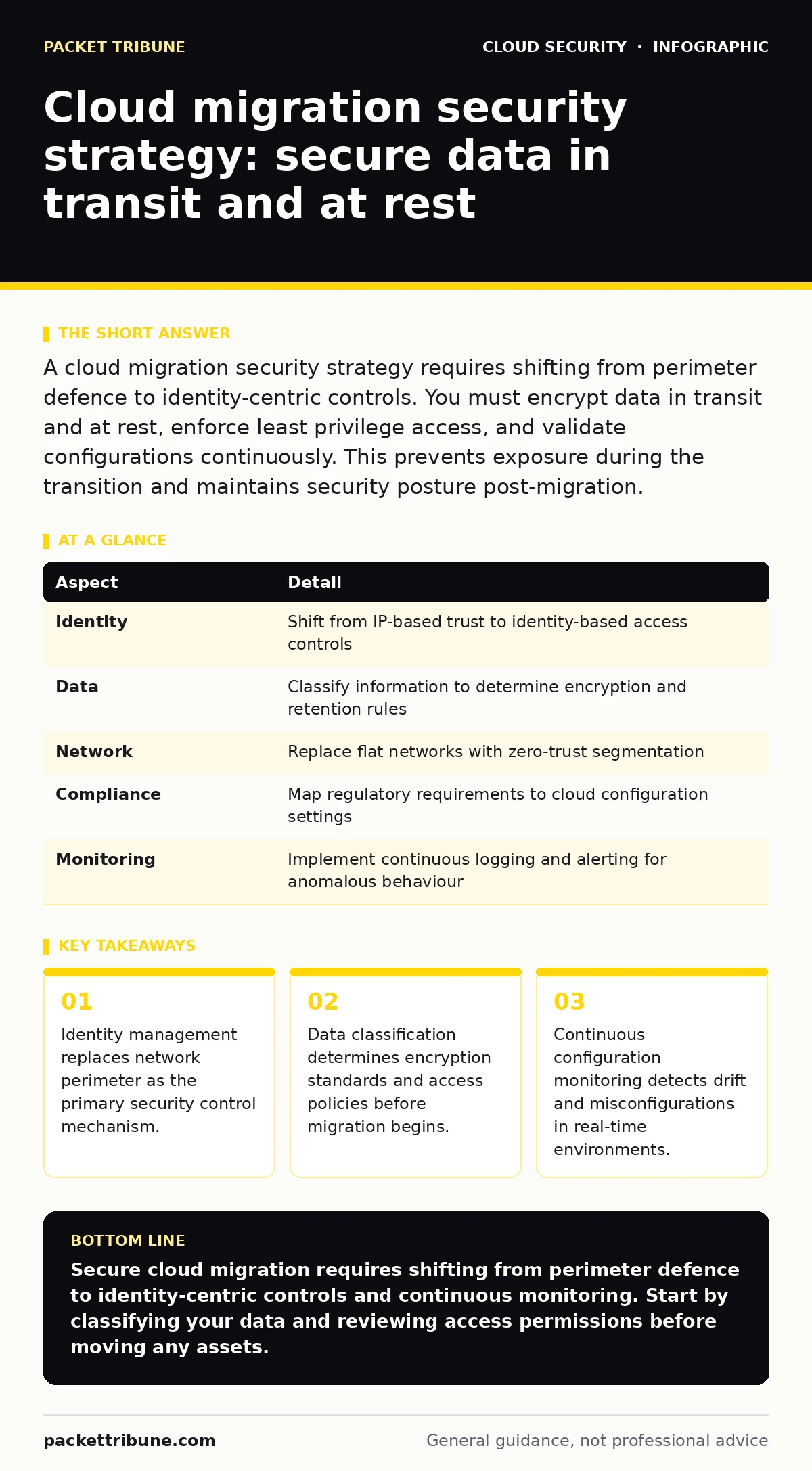
A cloud migration security strategy requires shifting from perimeter defence to identity-centric controls. You must encrypt data in transit and at rest, enforce least privilege access, and validate configurations continuously. This prevents exposure during the transition and maintains security posture post-migration.
Moving assets without exposing them
Imagine moving a bank vault across a city. You do not simply open the doors and walk out. You seal the contents, track the transport vehicle, and verify the new location’s locks before opening the old ones. Cloud migration security strategy follows this same logic. It is the process of transferring applications and data to cloud environments while maintaining confidentiality, integrity and availability. This approach affects every organisation that stores sensitive information, processes transactions or hosts user identities.
You must treat the migration window as a period of heightened vulnerability. The cloud provider secures the infrastructure, but you secure what you put inside it. This shared responsibility model means you cannot assume the cloud is automatically secure. You must define security requirements before writing any migration plan. Failure to do so results in exposed data stores and unauthorised access paths.
| Aspect | Detail |
|---|---|
| Identity | Shift from IP-based trust to identity-based access controls |
| Data | Classify information to determine encryption and retention rules |
| Network | Replace flat networks with zero-trust segmentation |
| Compliance | Map regulatory requirements to cloud configuration settings |
| Monitoring | Implement continuous logging and alerting for anomalous behaviour |
How identity replaces the perimeter
Traditional security relies on firewalls and network boundaries. The cloud dissolves these physical boundaries. Your security strategy must pivot to identity as the new perimeter. This means every user, service and application must authenticate and authorise before accessing resources. You need to implement multi-factor authentication for all administrative accounts. Service accounts require managed identities rather than static credentials.
This reduces the risk of credential theft and replay attacks. You must also review existing access lists. Many organisations migrate permissions directly from on-premises systems. This carries forward outdated access rights and excessive privileges. You should conduct an access review before migration. Remove unused accounts and restrict permissions to the minimum necessary. This principle of least privilege limits the damage if an account is compromised.
Classifying data before movement
You cannot protect what you do not understand. Data classification is the foundation of a secure migration. You must identify sensitive data, such as personal identifiers, financial records and intellectual property. This classification drives your encryption strategy. Data in transit requires transport layer security protocols. Data at rest needs server-side encryption with customer-managed keys. You should avoid using provider-managed keys for highly sensitive data.
Customer-managed keys give you control over key rotation and deletion. This ensures you can revoke access immediately if needed. You must also define data retention policies. Cloud storage is often cheaper than on-premises storage, leading to data hoarding. This increases the attack surface and compliance risk. Automate the deletion of obsolete data. This reduces cost and limits the impact of a potential breach. For detailed guidance on managing keys, see secrets managers.
Configuring the environment correctly
Misconfiguration is the leading cause of cloud security incidents. You must validate your cloud environment against security benchmarks. This includes checking for publicly accessible storage buckets, open database ports and unencrypted volumes. You should use infrastructure as code to define your environment. This allows you to version control and review security settings. It also enables consistent deployment across multiple environments.
You must scan your code for security issues before deployment. This prevents vulnerabilities from entering the production environment. You should also implement automated compliance checks. These checks run continuously and alert you to any drift from the desired state. This ensures your environment remains secure over time. For related infrastructure practices, see immutable infrastructure.
Monitoring and responding to threats
Static security controls are insufficient in dynamic cloud environments. You must implement continuous monitoring and detection capabilities. This involves collecting logs from all cloud services and applications. You should centralise these logs in a secure location. This allows you to correlate events and detect complex attacks.
You must define alerts for suspicious activities, such as unusual login locations or large data exports. You should also test your incident response plans regularly. This ensures your team can react quickly to a breach. You must have a clear process for isolating compromised resources. This limits the spread of the attack. For advanced detection techniques, see cloud detection and response.
See also: Prevent Public File Share Exposure With This Technical Checklist · DevSecOps vs SecDevOps: Why the Syntax Defines Your Security Posture
What people usually get wrong
Many organisations treat security as a final step in migration. This is a critical error. Security must be integrated into every phase of the migration process. Another common mistake is assuming that cloud providers handle all security. The shared responsibility model clearly defines your obligations. You are responsible for data, identity and application security. You must also avoid migrating legacy applications without modification. These applications often contain hardcoded credentials and insecure protocols. You should refactor or replace these applications before migration. For guidance on integrating security into development, see DevSecOps.
Addressing specific platform risks
Different cloud platforms have unique security challenges. You must understand the specific risks of your chosen environment. For containerised applications, you must secure the container runtime and orchestration layer. This includes managing image vulnerabilities and network policies. You must also protect the underlying infrastructure from misconfigurations.
For related container security issues, see Kubernetes misconfigurations. You must also consider tenant isolation in multi-tenant environments. This ensures your data is separated from other customers. You should verify the provider’s isolation mechanisms and compliance certifications. For further details on isolation, see tenant isolation.
Building a sustainable strategy
A cloud migration security strategy is not a one-time project. It requires ongoing maintenance and improvement. You must regularly review and update your security controls. This includes testing access controls, scanning for vulnerabilities and reviewing logs. You should also train your staff on cloud security best practices. This ensures everyone understands their role in maintaining security.
You must also keep up with changes in cloud services and regulations. This requires continuous learning and adaptation. For insights on logging challenges, see cloud logging gaps. You should also monitor for secrets in source code repositories. This prevents accidental exposure of credentials. By following these steps, you build a resilient security posture.
Key takeaways
- Identity management replaces network perimeter as the primary security control mechanism.
- Data classification determines encryption standards and access policies before migration begins.
- Continuous configuration monitoring detects drift and misconfigurations in real-time environments.
Secure cloud migration requires shifting from perimeter defence to identity-centric controls and continuous monitoring. Start by classifying your data and reviewing access permissions before moving any assets.
Frequently asked questions
How do I secure data during cloud migration?
Encrypt data in transit using TLS and at rest using customer-managed keys. Verify encryption settings before and after migration.
What is the shared responsibility model?
The provider secures the infrastructure, while you secure data, identity and applications. You are responsible for configuration and access management.
How do I prevent misconfigurations?
Use infrastructure as code and automated compliance checks. Scan configurations against security benchmarks before deployment.
Should I migrate legacy applications directly?
No. Refactor or replace legacy applications to remove hardcoded credentials and insecure protocols before migration.
How this guide was produced: written by the Packet Tribune editorial team with AI assistance, checked against the public references listed below, and reviewed when the facts change. See our editorial policy or report an error.