CSPM vs CWPP: How to Choose Cloud Security Tools
Cloud Security Posture Management secures the configuration baseline while Cloud Workload Protection Platform defends running processes from active exploitation.
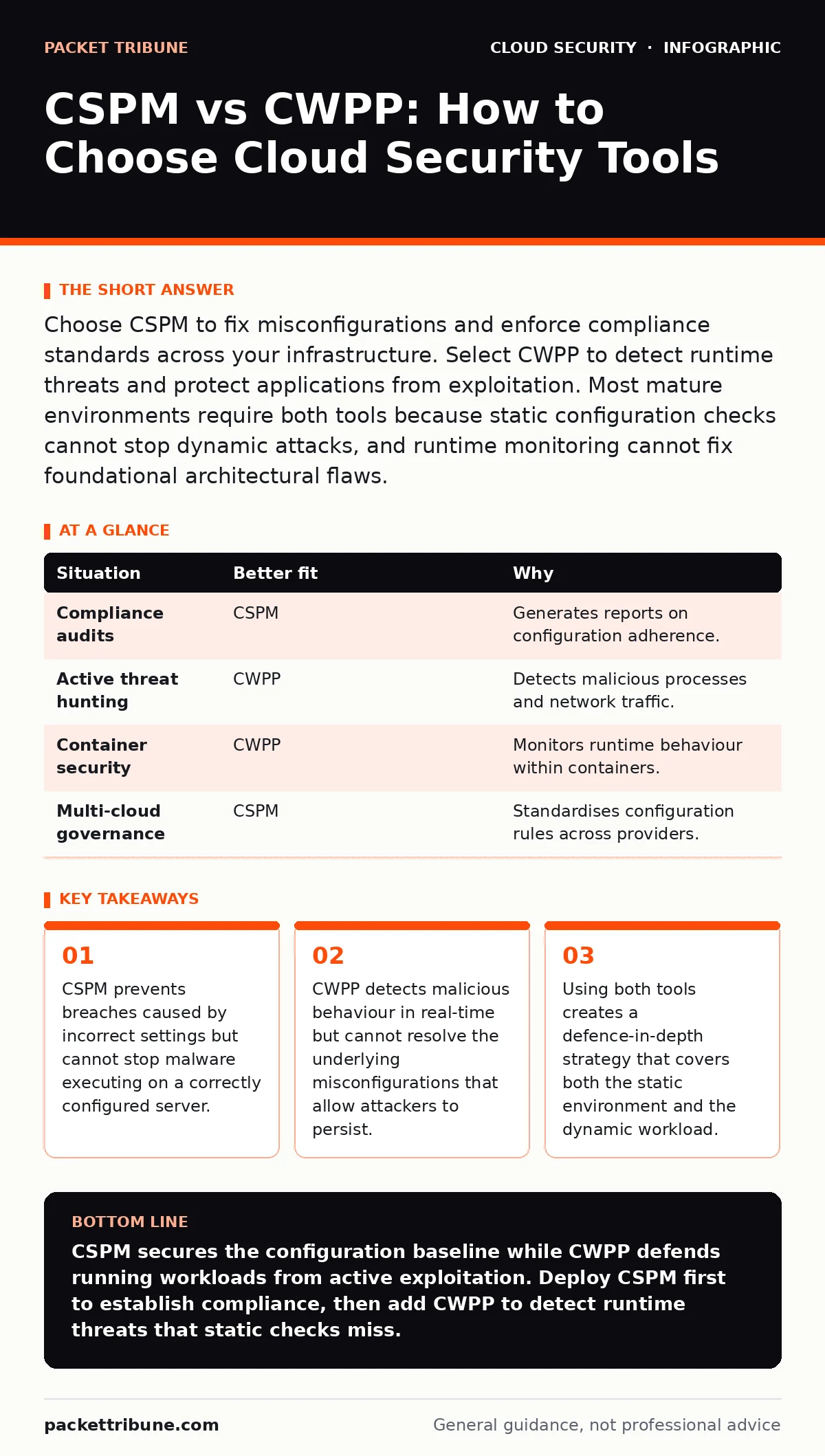
Choose CSPM to fix misconfigurations and enforce compliance standards across your infrastructure. Select CWPP to detect runtime threats and protect applications from exploitation. Most mature environments require both tools because static configuration checks cannot stop dynamic attacks, and runtime monitoring cannot fix foundational architectural flaws.
What is the primary security objective?
CSPM and CWPP address fundamentally different layers of cloud risk. Cloud Security Posture Management focuses on the configuration state of your cloud resources. It scans for deviations from security best practices, such as open storage buckets or overly permissive network rules. Cloud Workload Protection Platform focuses on the runtime behaviour of the workloads themselves. It monitors processes, system calls, and network connections for signs of active exploitation.
If your goal is compliance and architectural hygiene, CSPM is the correct starting point. It ensures your infrastructure adheres to established standards. If your goal is threat detection and incident response, CWPP is necessary. It provides visibility into what is happening inside the virtual machines and containers while they are running.
Who owns the workload lifecycle?
The ownership model of your workloads dictates which tool provides greater value. Infrastructure teams typically manage the underlying cloud resources. They are responsible for ensuring that virtual networks, databases, and storage accounts are configured securely. CSPM integrates well into their workflows by providing continuous compliance checks and remediation guidance.
Application teams manage the code and the runtime environment. They are responsible for the behaviour of the application itself. CWPP integrates into their pipelines by monitoring the application’s execution environment. If you adopt a DevSecOps approach, embedding CWPP into the deployment process allows you to catch runtime anomalies before they reach production.
Suppose an application team deploys a service that behaves unusually due to a bug. CSPM will not flag this because the underlying infrastructure is correctly configured. CWPP will detect the anomalous process behaviour. Understanding which team owns the risk helps you assign the right tool to the right workflow.
| Situation | Better fit | Why |
|---|---|---|
| Compliance audits | CSPM | Generates reports on configuration adherence. |
| Active threat hunting | CWPP | Detects malicious processes and network traffic. |
| Container security | CWPP | Monitors runtime behaviour within containers. |
| Multi-cloud governance | CSPM | Standardises configuration rules across providers. |
How complex is the deployment environment?
Simple, static infrastructure benefits most from CSPM. If your environment consists of traditional virtual machines with fixed configurations, the risk profile is relatively predictable. Misconfigurations are the primary vector for compromise. CSPM excels at identifying these static errors.
Complex, dynamic environments require CWPP. Kubernetes clusters and serverless functions change state rapidly. The ephemeral nature of these workloads makes static scanning insufficient. A container may be correctly configured at deployment but compromised seconds later. CWPP provides the continuous monitoring needed to detect these transient threats.
Consider the risk of container escape. This occurs when an attacker breaks out of the container sandbox to access the host system. CSPM can ensure the container runtime is hardened, but it cannot detect the escape attempt. CWPP monitors the system calls and can alert when a process attempts to access host resources it should not.
Can you integrate with existing tools?
Integration capability determines the operational overhead of each tool. CSPM often integrates with infrastructure-as-code scanning tools. This allows you to catch misconfigurations before they are deployed. This shift-left approach reduces the number of issues that reach the production environment.
CWPP integrates with cloud detection and response platforms. This enables automated incident response when a threat is detected. If your team already uses a centralised logging and monitoring stack, ensure the tool can export data in a compatible format.
When should you use both tools?
Using both CSPM and CWPP provides a complete security posture. CSPM reduces the attack surface by ensuring configurations are secure. CWPP provides a second layer of defence for threats that bypass the configuration controls. This defence-in-depth strategy is critical for high-value assets.
Imagine a scenario where an attacker exploits a zero-day vulnerability in an application. The infrastructure is correctly configured, so CSPM reports no issues. The attacker gains access and begins moving laterally. CWPP detects the unusual network traffic and process behaviour, triggering an alert. Without CWPP, the breach would go unnoticed until data was exfiltrated.
Conversely, consider a scenario where an administrator accidentally opens a management port to the internet. CWPP may not detect this because no malicious activity is occurring. CSPM identifies the misconfiguration and alerts the team to close the port. Without CSPM, the open port remains a persistent risk.
See also: DevSecOps vs SecDevOps: Why the Syntax Defines Your Security Posture · Cloud migration security strategy: secure data in transit and at rest
How do you prioritise remediation?
Prioritisation depends on the severity of the findings. CSPM findings are often high-volume but low-risk. Many misconfigurations do not lead to immediate compromise. CWPP findings are lower-volume but high-risk. Runtime threats indicate active exploitation.
You should automate the remediation of low-risk CSPM findings. This reduces noise and allows the team to focus on critical issues. For CWPP alerts, establish a clear incident response procedure. Not every anomaly is a threat, but every threat requires immediate investigation.
What is the long-term strategy?
Your long-term strategy should evolve from compliance to resilience. Start with CSPM to establish a secure baseline. Once configurations are stable, introduce CWPP to monitor runtime behaviour. As your environment matures, integrate both tools into your continuous integration and continuous deployment pipelines.
This approach ensures that security is built into the development process. It also provides continuous monitoring of the production environment. By combining static configuration checks with dynamic runtime protection, you create a resilient security posture that adapts to changing threats.
Consider the role of immutable infrastructure. If you replace compromised instances rather than patching them, CWPP helps verify the integrity of the new instances. CSPM ensures the new instances are deployed with the correct configurations. This combination supports a modern, resilient cloud architecture.
How do you measure success?
Success metrics differ for each tool. For CSPM, measure the reduction in misconfigurations over time. Track the mean time to remediate configuration issues. For CWPP, measure the mean time to detect and respond to threats. Track the number of false positives to refine detection rules.
Regularly review both metrics to ensure your security posture is improving. If misconfigurations are decreasing but runtime threats are increasing, you may need to enhance your CWPP rules. If runtime threats are stable but misconfigurations are rising, you may need to improve your infrastructure-as-code scanning processes.
Key takeaways
- CSPM prevents breaches caused by incorrect settings but cannot stop malware executing on a correctly configured server.
- CWPP detects malicious behaviour in real-time but cannot resolve the underlying misconfigurations that allow attackers to persist.
- Using both tools creates a defence-in-depth strategy that covers both the static environment and the dynamic workload.
CSPM secures the configuration baseline while CWPP defends running workloads from active exploitation. Deploy CSPM first to establish compliance, then add CWPP to detect runtime threats that static checks miss.
Frequently asked questions
Can CSPM replace CWPP in a containerised environment?
No. CSPM checks static configurations but cannot detect runtime exploits or container escapes that occur after deployment.
Does CWPP fix misconfigurations automatically?
CWPP focuses on detection and response. It does not typically remediate configuration errors, which is the primary function of CSPM.
How do these tools handle cloud logging gaps?
CSPM identifies missing logging configurations. CWPP can detect if logs are being tampered with or deleted during an active attack.
Is it necessary to use both tools for small teams?
Small teams should prioritise CSPM for basic compliance. However, as workloads become more dynamic, adding CWPP becomes necessary for runtime protection.
How this guide was produced: written by the Packet Tribune editorial team with AI assistance, checked against the public references listed below, and reviewed when the facts change. See our editorial policy or report an error.