Cloud Detection and Response: Real Benefits vs Operational Limits
Cloud detection and response shifts focus from network perimeters to identity and configuration, but generates noise without strict baseline governance.

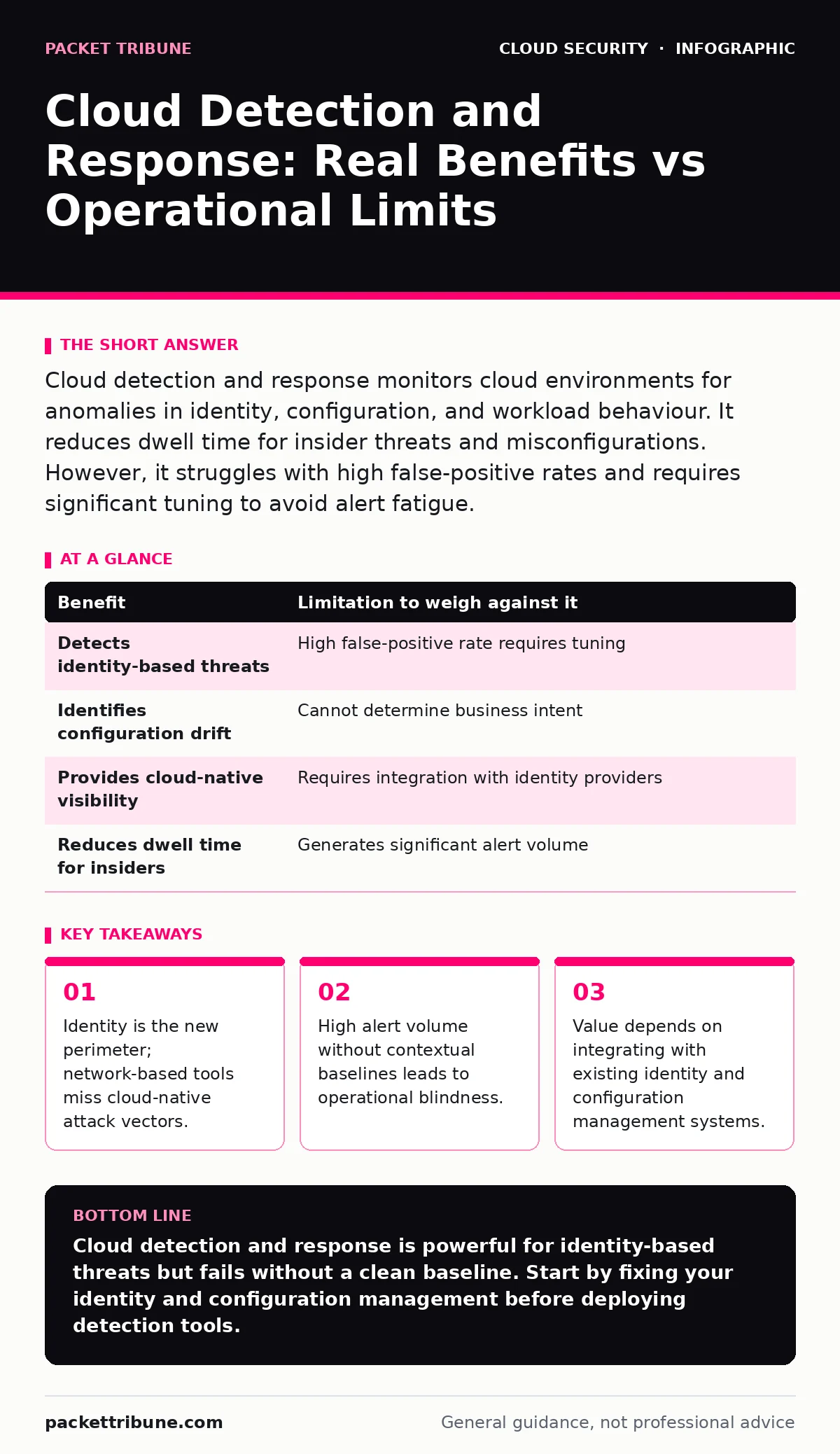
Cloud detection and response monitors cloud environments for anomalies in identity, configuration, and workload behaviour. It reduces dwell time for insider threats and misconfigurations. However, it struggles with high false-positive rates and requires significant tuning to avoid alert fatigue.
The Shift from Network to Identity
Traditional security tools rely on network traffic analysis. They inspect packets moving between on-premises servers and external endpoints. This approach fails in cloud environments where applications communicate via APIs rather than traditional TCP/IP flows. Cloud detection and response monitors these API calls and identity actions. It looks for anomalies in who is doing what, rather than where data is moving.
This shift requires a different mindset. You are no longer defending a boundary. You are monitoring a set of permissions and configurations. The cloud provider manages the underlying infrastructure. You manage the access controls and the workloads. Detection tools must bridge this gap by correlating identity events with configuration changes.
Concrete Benefits of Cloud-Native Monitoring
The primary benefit is visibility into identity-based attacks. A compromised service account can exfiltrate data without triggering network intrusion detection systems. Cloud detection and response flags unusual API calls from that account. It detects lateral movement that occurs entirely within the cloud control plane.
Another benefit is the detection of configuration drift. Developers often modify security groups or storage bucket policies to fix immediate issues. These changes can persist and create vulnerabilities. Continuous monitoring identifies deviations from the desired state. It allows you to remediate misconfigurations before they are exploited.
Honest Limitations of the Technology
Cloud detection and response tools generate significant noise. Cloud environments are dynamic. Legitimate automation and deployment pipelines create thousands of events per minute. Distinguishing between a normal deployment and a malicious action is difficult. Without careful tuning, analysts face alert fatigue.
The tools also struggle with context. They can tell you that a bucket was made public. They cannot always tell you if that was intentional for a specific campaign. This lack of business context leads to false positives. You must invest time in defining what "normal" looks for your specific workloads.
Weighing Benefits Against Limitations
Every benefit comes with a corresponding operational cost. Understanding these trade-offs helps you plan your implementation. The table below outlines the key benefits and the limitations you must manage.
| Benefit | Limitation to weigh against it |
|---|---|
| Detects identity-based threats | High false-positive rate requires tuning |
| Identifies configuration drift | Cannot determine business intent |
| Provides cloud-native visibility | Requires integration with identity providers |
| Reduces dwell time for insiders | Generates significant alert volume |
When It Is Worth It
Cloud detection and response is worth it when you have complex, multi-account environments. If you manage hundreds of microservices, manual monitoring is impossible. The tool provides the scale needed to spot anomalies. It is also valuable when you rely heavily on third-party integrations. External vendors often have broad access. Monitoring their actions is critical.
It is also worth it when you have mature identity management. If you use federated identity correctly, the detection tool has a clear baseline. It can spot deviations from standard authentication patterns. Without good identity hygiene, the tool has nothing to compare against.
See also: Prevent Public File Share Exposure With This Technical Checklist · DevSecOps vs SecDevOps: Why the Syntax Defines Your Security Posture
When It Is Not Worth It
It is not worth it if you lack basic cloud governance. If you have not defined cloud landing zones, the tool will flag everything as suspicious. You will waste resources chasing false alarms. Fix your foundational security first. Ensure you have least privilege in the cloud before adding detection layers.
It is also not worth it if you cannot staff the alerts. If your team is already overwhelmed, adding another stream of alerts will cause burnout. You need dedicated analysts who understand cloud architecture. Without them, the tool becomes an expensive paperweight.
Integrating with Existing Controls
Cloud detection and response does not replace other security controls. It works best when integrated with cloud-native application protection platforms (CNAPP). These platforms provide broader coverage of the application lifecycle. They combine detection with prevention and remediation.
You should also integrate with identity sprawl management tools. If you have orphaned accounts or excessive permissions, the detection tool will struggle. Clean up your identity graph first. This reduces noise and improves accuracy.
Building a Baseline of Normal Behaviour
The most critical step is defining normal behaviour. You must log all administrative actions and API calls. Use these logs to build a baseline. This baseline defines what legitimate activity looks like. Deviations from this baseline trigger alerts.
Regularly review and update this baseline. Your environment will change. New services will be added. Old ones will be decommissioned. If the baseline is stale, the detection tool will become useless.
The Role of Human Analysis
Automated detection is only part of the solution. Human analysts must investigate alerts. They need to understand the context of the alert. Is the change part of a planned deployment? Is the identity belonging to a known service account?
Analysts must also tune the rules. If an alert is a false positive, adjust the rule. If it is a true positive, investigate the root cause. This feedback loop improves the accuracy of the system over time.
Summary of Operational Requirements
Implementing cloud detection and response requires more than just installing a tool. It requires a mature security posture. You need clean identity management. You need defined cloud landing zones. You need skilled analysts.
Without these foundations, the tool will generate more problems than it solves. Start with the basics. Build your identity and configuration management first. Then add detection to monitor for deviations.
Key takeaways
- Identity is the new perimeter; network-based tools miss cloud-native attack vectors.
- High alert volume without contextual baselines leads to operational blindness.
- Value depends on integrating with existing identity and configuration management systems.
Cloud detection and response is powerful for identity-based threats but fails without a clean baseline. Start by fixing your identity and configuration management before deploying detection tools.
Frequently asked questions
How does cloud detection and response differ from traditional SIEM?
Traditional SIEM focuses on log aggregation and correlation. Cloud detection and response focuses on cloud-native APIs and identity actions. It understands the context of cloud resources.
Can cloud detection and response prevent attacks?
No, it primarily detects and alerts. Prevention requires integration with identity providers or configuration management tools. It can trigger automated responses, but this requires careful setup.
What is the biggest challenge in implementing cloud detection and response?
The biggest challenge is tuning. Reducing false positives requires a deep understanding of your environment. It takes time to build an accurate baseline of normal behaviour.
Do I need cloud detection and response if I have a CNAPP?
CNAPP platforms often include detection capabilities. However, dedicated cloud detection and response tools may offer deeper identity analysis. Evaluate your specific needs before choosing.
How this guide was produced: written by the Packet Tribune editorial team with AI assistance, checked against the public references listed below, and reviewed when the facts change. See our editorial policy or report an error.