CNAPP Benefits and Limitations: A Realistic Assessment for Cloud Security
Cloud-native application protection platforms unify disparate tools but often obscure the root cause of misconfigurations behind layers of automated remediation.

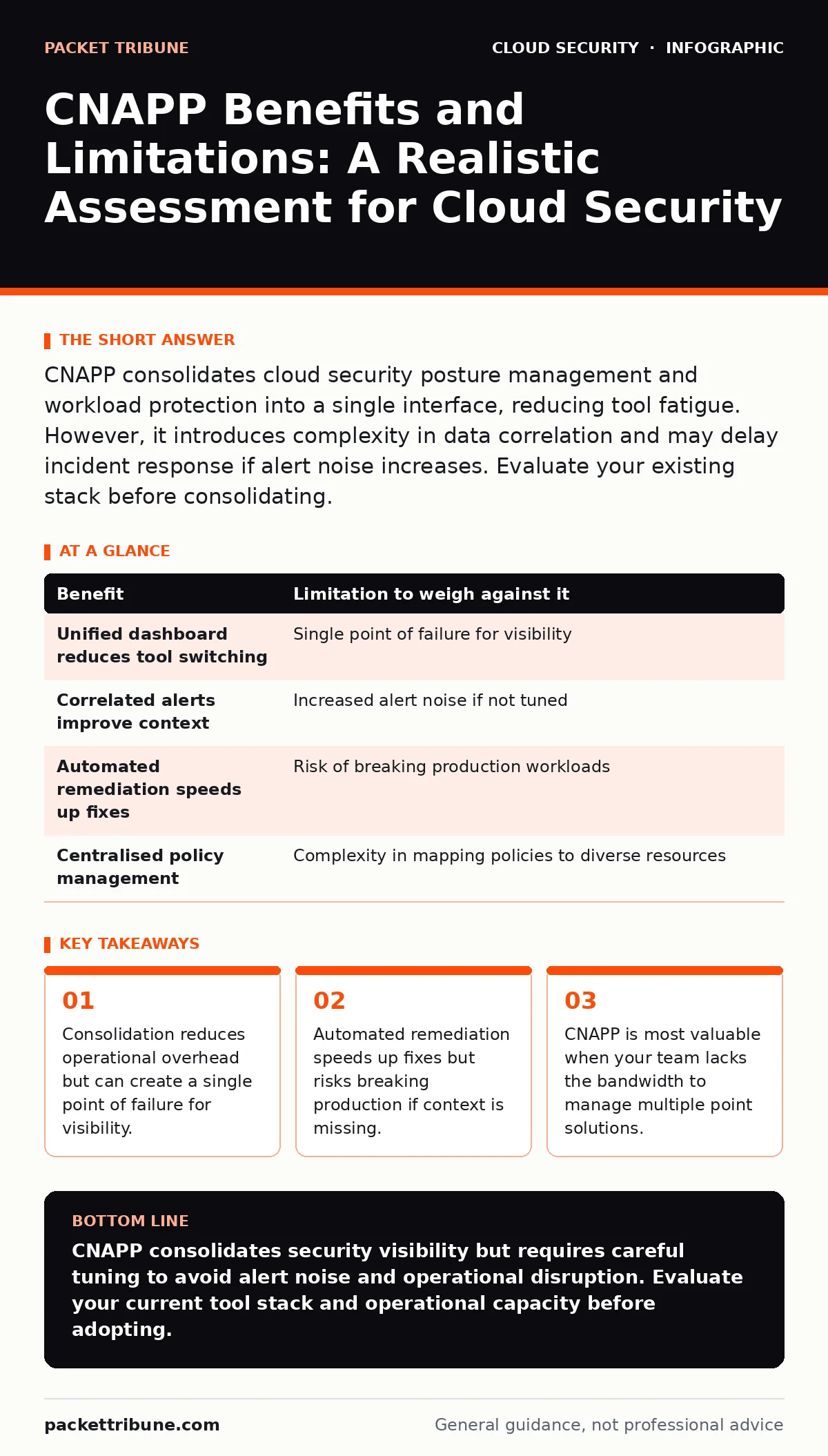
CNAPP consolidates cloud security posture management and workload protection into a single interface, reducing tool fatigue. However, it introduces complexity in data correlation and may delay incident response if alert noise increases. Evaluate your existing stack before consolidating.
The Consolidation Imperative in Cloud Security
Cloud environments generate vast amounts of telemetry data from infrastructure, containers, and serverless functions. Managing this data with separate tools for each layer creates silos that security teams struggle to correlate. A cloud-native application protection platform (CNAPP) attempts to solve this by aggregating data from cloud security posture management (CSPM), cloud workload protection platforms (CWPP), and software composition analysis (SCA) into one dashboard.
This aggregation promises a unified view of your attack surface. You see the relationship between a vulnerable container image and the misconfigured storage bucket it accesses. The theoretical benefit is efficiency. You pay for one platform instead of five, and your analysts spend less time switching contexts.
However, consolidation is not merely a technical upgrade. It is an operational shift that changes how you detect and respond to threats. The platform becomes the lens through which you view your entire cloud estate. If the lens is distorted, your understanding of risk is equally distorted.
Unified Visibility and Contextual Correlation
The primary advantage of CNAPP is contextual correlation. In a fragmented stack, a vulnerability in a library might sit in a developer tool, while a network misconfiguration sits in an infrastructure tool. The analyst must manually link these events to understand the attack path.
CNAPP ingests data from both sources and links them automatically. You can see that a specific Kubernetes pod is using an image with a known vulnerability and is exposed to the public internet. This reduces the time to understand the severity of an issue. It transforms isolated findings into a narrative of risk.
This correlation is particularly useful for identifying complex attack chains. An attacker might exploit a weak identity permission to access a database, then pivot to a container. Without correlation, these appear as two separate, low-severity events. With correlation, they appear as a high-severity lateral movement attempt.
The Hidden Cost of Alert Noise
The downside of aggregation is the potential for alert fatigue. When you combine multiple data sources, you increase the volume of events presented to the analyst. If the platform lacks sophisticated noise reduction, you face a firehose of alerts.
Many CNAPP solutions struggle to distinguish between a genuine threat and a benign anomaly. A development environment might generate hundreds of misconfigurations that are acceptable for testing but flagged as critical by the platform. Your team must triage these false positives, wasting time and eroding trust in the tool.
This noise can lead to alert blindness. When analysts are overwhelmed by low-value alerts, they may miss the rare, high-impact event. The platform becomes a liability rather than an asset. You must invest significant effort in tuning the rules and exceptions to make the data useful.
Automated Remediation and Operational Risk
Many CNAPP solutions offer automated remediation. The platform detects a misconfiguration, such as an open S3 bucket, and automatically closes it. This sounds ideal for reducing response time. In practice, it introduces operational risk.
Automated actions lack business context. The platform does not know if that bucket is used for a critical production workload or a temporary test. Closing it automatically might break an application, causing downtime. The cost of remediation shifts from security to operations, creating friction between teams.
You must implement guardrails for automation. Allow automated fixes only for low-risk, non-production environments. For production, use automated recommendations rather than actions. This preserves the speed of detection while maintaining human oversight for critical changes.
| Benefit | Limitation to weigh against it |
|---|---|
| Unified dashboard reduces tool switching | Single point of failure for visibility |
| Correlated alerts improve context | Increased alert noise if not tuned |
| Automated remediation speeds up fixes | Risk of breaking production workloads |
| Centralised policy management | Complexity in mapping policies to diverse resources |
Integration Challenges and Legacy Gaps
CNAPP platforms rely on APIs to collect data from cloud providers and applications. If your environment includes legacy systems or custom-built infrastructure, these APIs may not provide complete visibility. You might have blind spots where the platform cannot see or act.
Integrating a CNAPP with existing tools can also be difficult. If you already use a specific SIEM or SOAR platform, the CNAPP must feed data into it effectively. Poor integration leads to duplicate efforts and data inconsistencies. You end up managing two parallel workflows instead of one streamlined process.
See also: Prevent Public File Share Exposure With This Technical Checklist · DevSecOps vs SecDevOps: Why the Syntax Defines Your Security Posture
When It Is Worth It
A CNAPP is worth the investment when your organisation struggles with tool sprawl. If your security team spends more time managing tools than analysing threats, consolidation will free up capacity. The unified view allows you to prioritise risks based on actual exposure rather than isolated vulnerabilities.
It is also valuable when you lack deep expertise in every layer of the cloud stack. The platform provides a baseline of security coverage that a small team might not achieve with point solutions. The automated scanning and reporting features ensure you maintain a minimum standard of hygiene across your environment.
For organisations with complex, multi-cloud environments, CNAPP simplifies policy management. You can define security rules once and apply them across AWS, Azure, and Google Cloud. This consistency reduces the chance of misconfiguration due to provider-specific nuances.
When It Is Not Worth It
If your existing tools integrate well and your team is proficient, a CNAPP may add unnecessary complexity. You might already have a robust SIEM that correlates logs effectively. Adding a CNAPP could duplicate this effort without adding significant value.
Small organisations with simple cloud footprints may find CNAPP overkill. The cost and complexity of managing a large platform outweigh the benefits for a few virtual machines and storage buckets. Basic CSPM tools might suffice for their needs.
Complementary Security Strategies
CNAPP is not a silver bullet. It works best when combined with other security practices. For instance, implementing least privilege in the cloud reduces the blast radius of any breach. Even if a container is compromised, limited permissions prevent the attacker from moving laterally.
Addressing cloud logging gaps ensures that the CNAPP has high-quality data to analyse. If logs are incomplete or delayed, the platform’s correlation capabilities are diminished. You must ensure that logging is comprehensive and real-time.
Consider immutable infrastructure to reduce the attack surface. If servers cannot be changed after deployment, the risk of runtime misconfiguration decreases. This complements the CNAPP’s focus on pre-deployment and configuration security.
Review tenant isolation policies to ensure that multi-tenant environments are properly segmented. CNAPP can help monitor these boundaries, but the underlying architecture must support strict isolation.
Address identity sprawl to reduce the number of credentials that could be compromised. CNAPP can identify unused identities, but you must have a process for removing them.
Monitor for Kubernetes misconfigurations specifically, as these are a common entry point. CNAPP provides visibility, but you must have the expertise to interpret the findings.
Ensure cloud encryption is enabled for data at rest and in transit. CNAPP can detect missing encryption, but it cannot apply it automatically in all cases.
Explore cloud detection and response capabilities to complement the preventive measures of CNAPP. While CNAPP focuses on prevention and posture, detection and response tools handle active threats.
Key takeaways
- Consolidation reduces operational overhead but can create a single point of failure for visibility.
- Automated remediation speeds up fixes but risks breaking production if context is missing.
- CNAPP is most valuable when your team lacks the bandwidth to manage multiple point solutions.
CNAPP consolidates security visibility but requires careful tuning to avoid alert noise and operational disruption. Evaluate your current tool stack and operational capacity before adopting.
Frequently asked questions
Does CNAPP replace the need for a SIEM?
No, CNAPP focuses on cloud-specific posture and workload protection, while SIEM aggregates logs from all sources for broader incident response. They complement each other.
Can CNAPP automatically fix all security issues?
No, automated remediation is risky for production environments. Most organisations use automated fixes only for low-risk, non-production issues.
How long does it take to implement CNAPP?
Implementation time varies based on environment complexity. Basic setup can take weeks, but full integration and tuning can take months.
Is CNAPP suitable for small businesses?
Small businesses with simple cloud footprints may find CNAPP too complex and expensive. Basic CSPM tools might be more appropriate.
How this guide was produced: written by the Packet Tribune editorial team with AI assistance, checked against the public references listed below, and reviewed when the facts change. See our editorial policy or report an error.