How Immutable Infrastructure Works: The Operational Mechanics
Immutable infrastructure eliminates configuration drift by replacing running instances rather than patching them, forcing security into the build pipeline rather than the runtime environment.

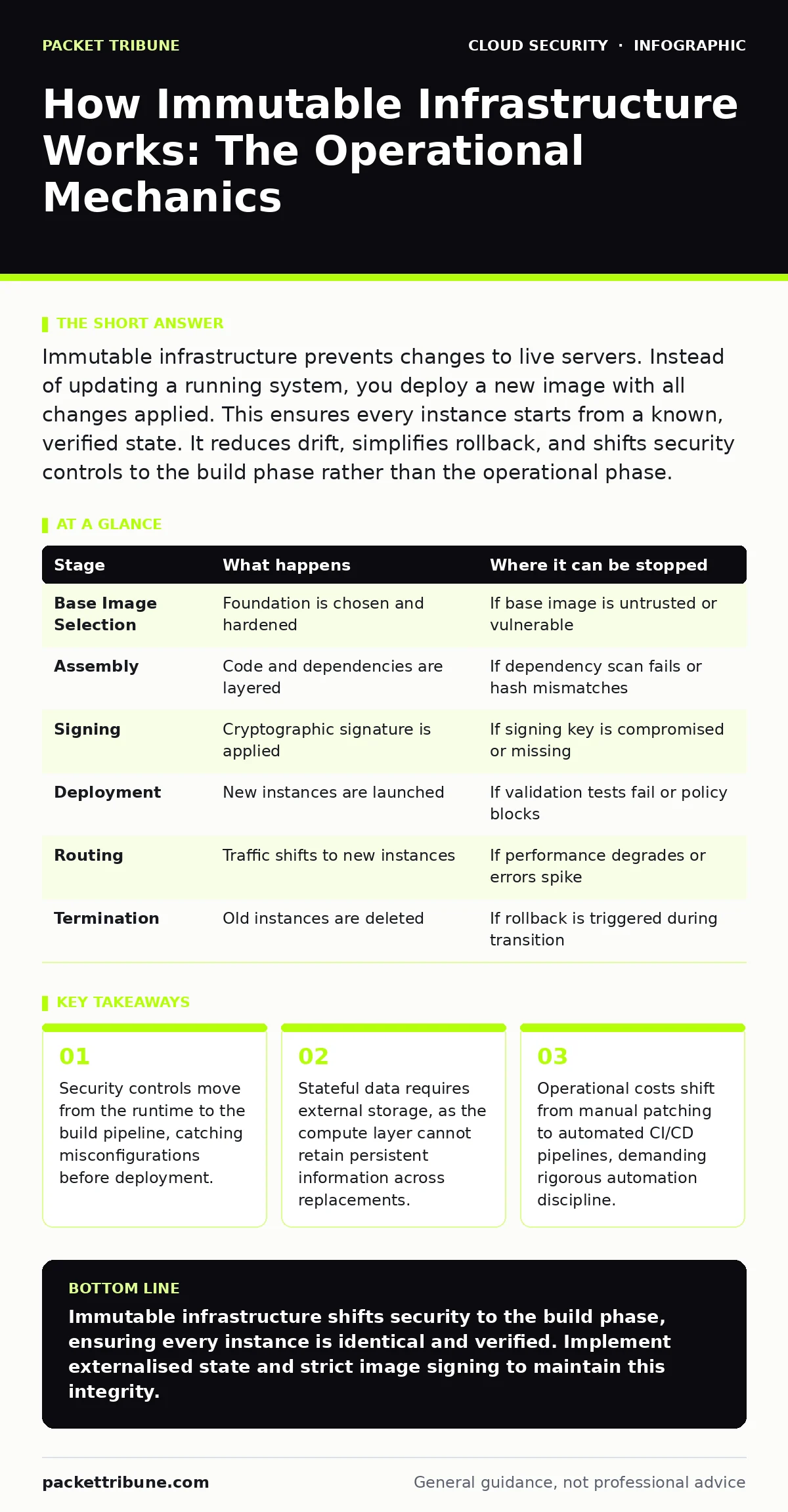
Immutable infrastructure prevents changes to live servers. Instead of updating a running system, you deploy a new image with all changes applied. This ensures every instance starts from a known, verified state. It reduces drift, simplifies rollback, and shifts security controls to the build phase rather than the operational phase.
The Principle of Replacement Over Modification
Traditional infrastructure treats servers as pets. You patch them, tune them, and troubleshoot them over years. Immutable infrastructure treats servers as cattle. You do not modify a running instance. Instead, you build a new image, deploy it, and discard the old one.
This approach eliminates configuration drift. Configuration drift occurs when live systems diverge from their intended state due to manual edits or automated updates. By never changing a live system, you guarantee that every instance matches the tested image.
This method shifts the security boundary. You no longer secure the runtime environment against ad-hoc changes. You secure the build process that creates the image. If the build is secure, the runtime is secure by definition.
Stage 1: Base Image Selection and Hardening
The process begins with a base image. This is a minimal operating system or container image that serves as the foundation. You must choose an image from a trusted source, such as an official distribution registry.
You then harden this base image. This involves removing unnecessary packages, disabling unused services, and applying security patches. The goal is to reduce the attack surface before any application code is added.
Stage 2: Application and Dependency Assembly
You add your application code and its dependencies to the base image. This happens in a build pipeline, not on the server. You use tools like Docker or Ansible to layer files onto the image.
Every dependency is pinned to a specific version. This prevents "dependency confusion" attacks where an attacker registers a malicious package with the same name as a legitimate one. You verify the integrity of each layer using cryptographic hashes.
This stage is where most security controls should reside. If you scan for vulnerabilities here, you catch issues before they reach production. Scanning live systems is reactive; scanning images is proactive.
Stage 3: Image Signing and Verification
Before the image is used, you must sign it. Signing creates a cryptographic proof that the image originated from your build pipeline and has not been tampered with. You use public-key infrastructure to manage these signatures.
You configure your deployment tool to verify these signatures. If an image lacks a valid signature, the deployment fails. This prevents malicious actors from injecting compromised images into your repository.
This step closes the gap between build and deploy. It ensures that the image you tested is the exact image that runs in production. It removes trust from the registry and places it in the cryptographic chain.
Stage 4: Automated Deployment and Validation
You deploy the new image to your infrastructure. This is done through an automated pipeline. The pipeline pulls the signed image and launches new instances.
You must validate the new instances. This involves running smoke tests to ensure the application functions correctly. You check that the new instances can communicate with necessary services and that security policies are enforced.
If validation fails, the pipeline stops. The new instances are terminated. The old instances continue running. This ensures that a broken image never reaches users.
See also: Prevent Public File Share Exposure With This Technical Checklist · DevSecOps vs SecDevOps: Why the Syntax Defines Your Security Posture
Stage 5: Traffic Routing and Old Instance Termination
Once validation passes, you route traffic to the new instances. This is often done using a load balancer. You gradually shift traffic from the old instances to the new ones.
You monitor the new instances for errors. If issues arise, you route traffic back to the old instances. This is a rollback. Because the old instances are unchanged, they remain stable.
After a successful period, you terminate the old instances. They are deleted permanently. There is no need to patch or update them. They are disposable.
| Stage | What happens | Where it can be stopped |
|---|---|---|
| Base Image Selection | Foundation is chosen and hardened | If base image is untrusted or vulnerable |
| Assembly | Code and dependencies are layered | If dependency scan fails or hash mismatches |
| Signing | Cryptographic signature is applied | If signing key is compromised or missing |
| Deployment | New instances are launched | If validation tests fail or policy blocks |
| Routing | Traffic shifts to new instances | If performance degrades or errors spike |
| Termination | Old instances are deleted | If rollback is triggered during transition |
The Hidden Cost: State Management
Immutable compute layers cannot hold persistent state. Any data written to the local disk of an instance is lost when the instance is terminated. You must externalise state.
This means using databases, object storage, or message queues for all persistent data. This separation simplifies scaling but adds complexity. You must manage the lifecycle and security of these stateful components separately.
If you attempt to store secrets or logs on the instance, they will disappear. You must use external services for these needs. This forces a cleaner architecture but requires careful design.
Integrating with Cloud Security Controls
Immutable infrastructure works best when combined with other security measures. You should use secrets managers to inject credentials at runtime, rather than baking them into images. This prevents accidental exposure in image layers.
You must enforce least privilege in the cloud for the service accounts that run these instances. Even if the image is secure, the runtime permissions might allow an attacker to move laterally.
Consider using cloud-native application protection platforms (CNAPP) to monitor the lifecycle of these images. These tools can scan for vulnerabilities and misconfigurations across the entire pipeline.
If you are using containers, Kubernetes admission controllers can enforce policies that prevent unsigned images from running. This adds a layer of enforcement at the cluster level.
Be aware of Kubernetes misconfigurations that might bypass these controls. Even with immutable images, a misconfigured cluster can allow unauthorised access or privilege escalation.
Operational Discipline and Feedback Loops
Immutable infrastructure requires strict automation. You cannot manually edit instances. Any change must go through the build pipeline. This eliminates "snowflake" servers that are unique and difficult to replace.
You must monitor the build pipeline itself. If the pipeline is compromised, every instance becomes compromised. Secure the pipeline with the same rigor as the production environment.
Feedback from production must feed back into the build. If a vulnerability is found in a running instance, you fix it in the image and redeploy. You do not patch the running instance. This creates a cycle of continuous improvement.
Common Pitfalls in Implementation
A common mistake is baking sensitive data into images. This includes API keys, database passwords, or private keys. These secrets become part of the image history and are difficult to remove.
Another pitfall is ignoring the size of images. Large images take longer to build, push, and deploy. This slows down your response to incidents. Keep images minimal.
Finally, do not ignore the cost of storage. Every version of an image consumes storage. You need a retention policy to delete old images. Without this, your registry will fill up with unused versions.
Key takeaways
- Security controls move from the runtime to the build pipeline, catching misconfigurations before deployment.
- Stateful data requires external storage, as the compute layer cannot retain persistent information across replacements.
- Operational costs shift from manual patching to automated CI/CD pipelines, demanding rigorous automation discipline.
Immutable infrastructure shifts security to the build phase, ensuring every instance is identical and verified. Implement externalised state and strict image signing to maintain this integrity.
Frequently asked questions
Does immutable infrastructure mean I never update my servers?
You update them by replacing them. You create a new image with the updates and deploy it, then discard the old version.
How do I handle database migrations in an immutable model?
Database migrations are stateful and should be run separately from the compute deployment. Use a dedicated migration service or step in your pipeline.
Is immutable infrastructure suitable for all workloads?
It is best for stateless services. Stateful workloads like databases require careful handling of externalised state and are often harder to make fully immutable.
How this guide was produced: written by the Packet Tribune editorial team with AI assistance, checked against the public references listed below, and reviewed when the facts change. See our editorial policy or report an error.