How Misconfigured IAM Roles Work: The Step-by-Step Attack Path
Misconfigured IAM roles allow attackers to move laterally across cloud accounts by exploiting implicit trust relationships and overly permissive policy statements that grant administrative access without explicit authentication.
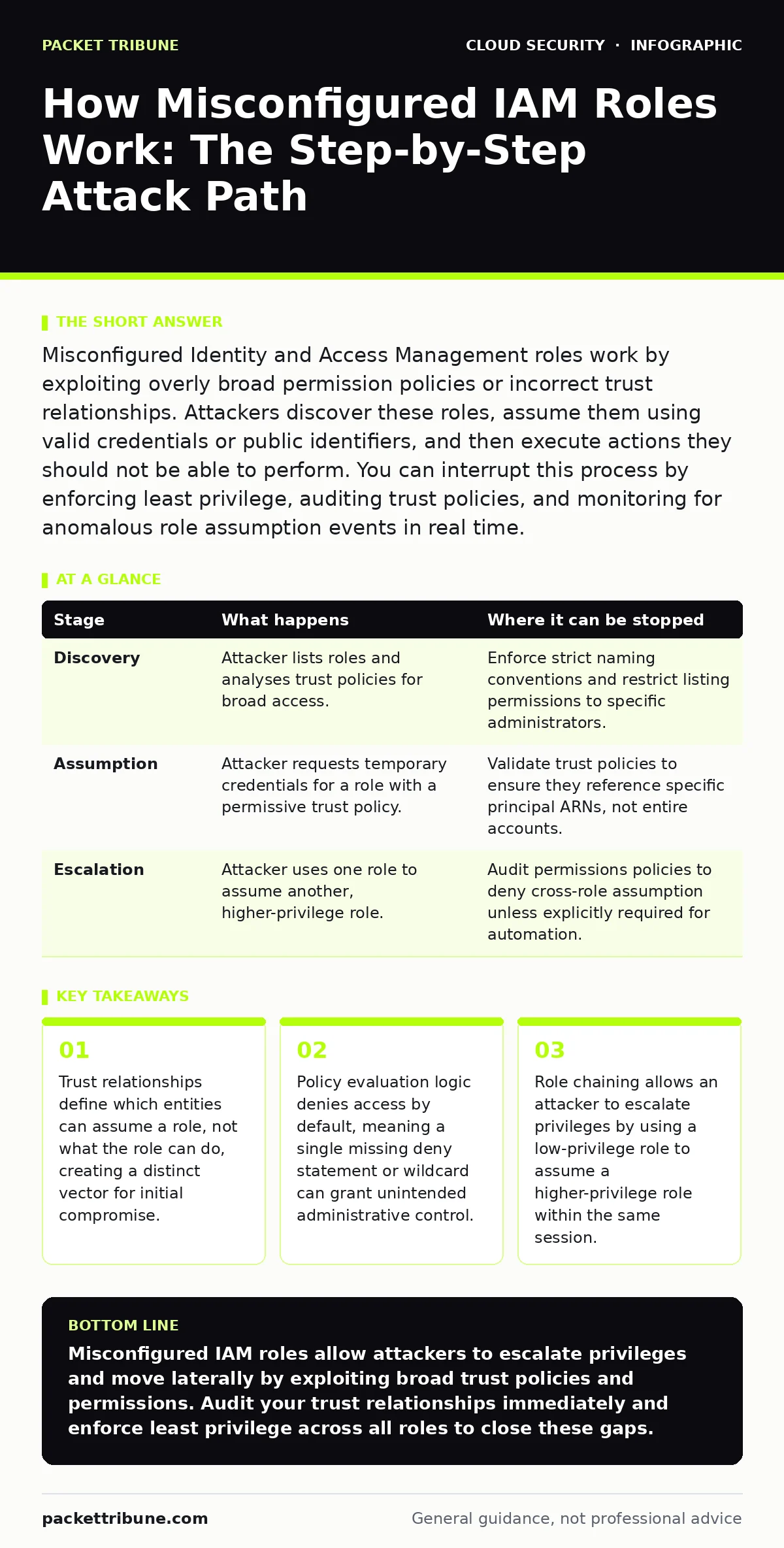
Misconfigured Identity and Access Management roles work by exploiting overly broad permission policies or incorrect trust relationships. Attackers discover these roles, assume them using valid credentials or public identifiers, and then execute actions they should not be able to perform. You can interrupt this process by enforcing least privilege, auditing trust policies, and monitoring for anomalous role assumption events in real time.
Understanding the IAM Trust Mechanism
Identity and Access Management (IAM) roles are temporary credentials that grant specific permissions to users or services. Unlike long-term access keys, roles expire and are assumed through a secure request. The core mechanism relies on two distinct policy documents. The trust policy determines who can assume the role. The permissions policy determines what the role can do once assumed. Security failures often occur because administrators focus on permissions while neglecting the trust policy.
A role with minimal permissions is dangerous if the trust policy allows any authenticated user in the account to assume it. This separation of concerns means that even a service account with read-only access can become a pivot point if it can assume a role with write access. The architecture assumes that trust is explicit and narrowly defined. When this assumption fails, the entire perimeter collapses from the inside.
Stage 1: Discovery and Reconnaissance
The attacker begins by identifying roles that exist within the target environment. This does not require breaking encryption or guessing passwords. It relies on public information or low-level access. Attackers often start with a compromised user account or a leaked access key. They use standard API calls to list available roles. The goal is to find roles with broad trust policies.
A common mistake is leaving roles that trust the entire organisation instead of specific service accounts. Imagine a developer who has read access to the cloud console. They can list all roles and their attached trust policies. If a role trusts the entire account, the developer can attempt to assume it. This stage is silent. No alerts trigger because listing roles is a standard administrative action. The attacker builds a map of potential privilege escalation paths.
Stage 2: Initial Role Assumption
Once a vulnerable role is identified, the attacker attempts to assume it. The cloud provider verifies the request against the trust policy. If the policy allows the requesting entity to assume the role, the provider issues temporary security credentials. These credentials include an access key, a secret key, and a session token. The session token is critical. It expires after a set duration, typically a few hours.
The attacker now possesses valid credentials for the role. They do not need to crack passwords. They simply present the token with API requests. The system treats these requests as coming from the role, not the original user. This decoupling makes attribution difficult. The attacker’s identity is masked by the role’s identity. If the role has administrative permissions, the attacker now has full control.
Stage 3: Privilege Escalation via Policy Chaining
Not all initially assumed roles have high privileges. Attackers often start with low-privilege roles to gain a foothold. They then look for roles that the current role can assume. This is known as role chaining. The permissions policy of the first role must include the action to assume other roles. If it does, the attacker can request credentials for a second, more powerful role. This second role might have administrative access.
The attacker repeats this process, hopping from role to role, escalating privileges at each step. This technique exploits the transitive nature of trust. Role A trusts User X. Role B trusts Role A. Therefore, User X can effectively assume Role B. This indirect path is often invisible to simple access controls. The attacker moves laterally across the infrastructure, gaining access to sensitive resources they were never meant to touch.
| Stage | What happens | Where it can be stopped |
|---|---|---|
| Discovery | Attacker lists roles and analyses trust policies for broad access. | Enforce strict naming conventions and restrict listing permissions to specific administrators. |
| Assumption | Attacker requests temporary credentials for a role with a permissive trust policy. | Validate trust policies to ensure they reference specific principal ARNs, not entire accounts. |
| Escalation | Attacker uses one role to assume another, higher-privilege role. | Audit permissions policies to deny cross-role assumption unless explicitly required for automation. |
Stage 4: Lateral Movement and Data Access
With elevated privileges, the attacker moves to the objective. This often involves accessing storage buckets, databases, or compute instances. The role’s permissions policy dictates what resources are accessible. If the policy uses wildcards, the attacker can access any resource of that type. They might download sensitive data, modify configurations, or inject malicious code. The attacker operates within the legitimate boundaries of the role.
Firewalls and network security groups are less effective here because the traffic is authorised API requests. The attacker can also create new roles or users to maintain persistence. They might add their own public key to a bastion host. This stage exploits the principle of least privilege failures. Broad permissions mean broad damage potential. The attacker does not need to bypass network controls. They simply use the keys they already have.
See also: DevSecOps vs SecDevOps: Why the Syntax Defines Your Security Posture · Cloud migration security strategy: secure data in transit and at rest
Stage 5: Persistence and Exfiltration
The final stage involves maintaining access and stealing data. The attacker creates backdoors or modifies logging configurations to hide their activity. They might disable CloudTrail logging or delete log groups. This prevents detection of their actions. They then exfiltrate data to external storage. This can happen in small chunks to avoid triggering volume-based alerts.
The attacker relies on the fact that many organisations do not monitor for changes to IAM policies. Modifying a policy is a high-risk action, but if it is done through a privileged role, it may go unnoticed. The attacker ensures they have a path back in case their initial access is revoked. This persistence layer makes remediation difficult. Simply revoking the initial access key does not stop the attacker if they have created new credentials or modified trust policies.
Interrupting the Attack Chain
Interrupting this chain requires defence in depth. You must secure the trust policies as rigorously as the permissions policies. Use conditions in trust policies to restrict assumption to specific IP ranges or MFA requirements. This adds a layer of verification. Monitor for role assumption events. Alert on unusual patterns, such as a role being assumed from an unexpected region or by an unexpected user.
Implement infrastructure-as-code scanning to detect misconfigurations before deployment. This catches errors in policy definitions early. Regular audits of IAM policies are necessary. Look for wildcards in permissions and broad trust relationships. Remove unnecessary permissions. The goal is to reduce the attack surface. Every unnecessary permission is a potential foothold.
The Hidden Cost of Convenience
Administrators often configure broad permissions for convenience. It is easier to grant full access than to define precise boundaries. This convenience comes at a high security cost. The complexity of IAM policies grows exponentially with the number of roles and services. It becomes difficult to track which role has access to which resource. This opacity leads to shadow IT and unmanaged access.
Attackers exploit this complexity. They find the gaps in the matrix of trust and permissions. The solution is not just technical. It requires a cultural shift towards rigorous policy management. Automation helps, but human oversight is still required. You must understand the business context of each role. If a role does not need a permission, remove it. This discipline reduces risk and simplifies auditing.
Conclusion of the Attack Path
Misconfigured IAM roles provide a direct path from initial access to full compromise. The attack relies on the misconfiguration of trust and permissions. It exploits the temporary nature of credentials to mask the attacker’s identity. Each stage of the attack can be interrupted with the right controls. Discovery is hindered by restricting listing permissions.
Assumption is blocked by strict trust policies. Escalation is prevented by denying cross-role assumption. Lateral movement is limited by least privilege. Persistence is detected by monitoring policy changes. The key is to treat IAM as a critical security boundary. It is not just an administrative tool. It is the gatekeeper of your cloud environment. Secure it with the same rigor as your network perimeter.
Key takeaways
- Trust relationships define which entities can assume a role, not what the role can do, creating a distinct vector for initial compromise.
- Policy evaluation logic denies access by default, meaning a single missing deny statement or wildcard can grant unintended administrative control.
- Role chaining allows an attacker to escalate privileges by using a low-privilege role to assume a higher-privilege role within the same session.
Misconfigured IAM roles allow attackers to escalate privileges and move laterally by exploiting broad trust policies and permissions. Audit your trust relationships immediately and enforce least privilege across all roles to close these gaps.
Frequently asked questions
How do I know if my IAM roles are misconfigured?
Review your trust policies for broad principals like entire accounts or wildcard services. Check permissions for wildcard actions on sensitive resources. Use automated tools to scan for common misconfigurations.
Can MFA prevent IAM role exploitation?
MFA adds a layer of security but does not fix broken trust policies. If a role trusts an entity that has compromised credentials, MFA on the initial login might be bypassed if the attacker assumes the role directly via API. Enforce MFA in the trust policy itself.
What is the difference between a user and a role?
A user has long-term credentials and is typically a human or application. A role has temporary credentials and is assumed by users or services. Roles are more secure because credentials expire and can be audited for assumption events.
How often should I audit IAM policies?
Audit IAM policies continuously. Integrate scanning into your deployment pipeline. Perform manual reviews quarterly to ensure policies align with current business needs and security standards.
How this guide was produced: written by the Packet Tribune editorial team with AI assistance, checked against the public references listed below, and reviewed when the facts change. See our editorial policy or report an error.