Identity Sprawl Response: Containment and Recovery Steps
Automated identity creation often outpaces detection, meaning your first action must be verifying the source of truth before revoking credentials.

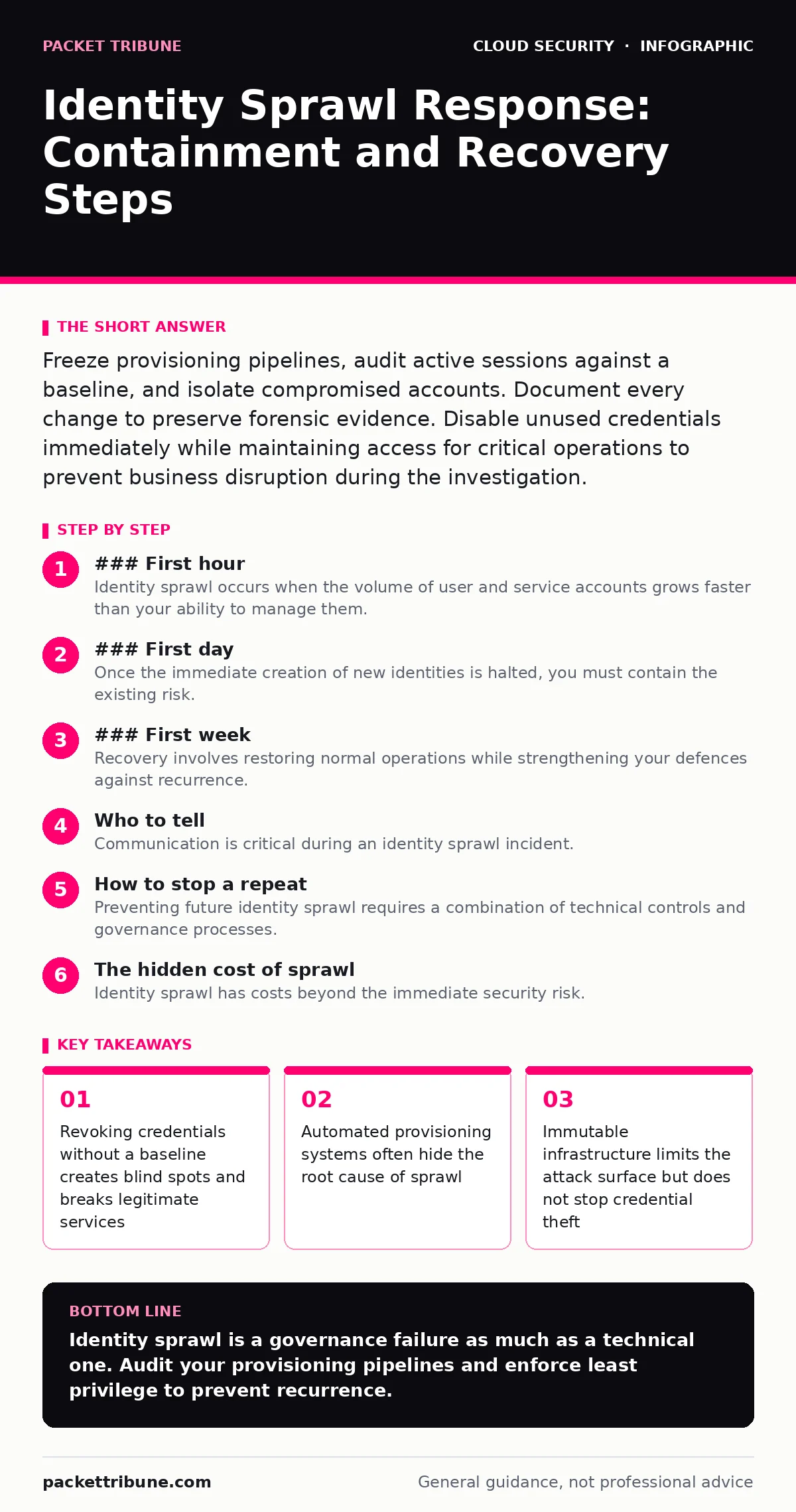
Freeze provisioning pipelines, audit active sessions against a baseline, and isolate compromised accounts. Document every change to preserve forensic evidence. Disable unused credentials immediately while maintaining access for critical operations to prevent business disruption during the investigation.
### First hour
Identity sprawl occurs when the volume of user and service accounts grows faster than your ability to manage them. This creates hidden entry points that attackers exploit to move laterally. Your immediate goal is to stop the bleeding without causing a wider outage.
- Identify the scope of the sprawl by comparing active sessions against your known baseline
- Disable the provisioning pipelines that created the unknown accounts
- Isolate the most sensitive accounts with anomalous login patterns
- Preserve logs from identity providers and cloud consoles before they rotate
- Notify your incident response team and legal counsel
The first action is not technical remediation but verification. You must determine which accounts are legitimate and which are artefacts of misconfiguration or compromise. Check your identity provider logs for bursts of creation events. Look for accounts created by scripts rather than human users. These are often service accounts with excessive permissions.
If you find accounts created by automation, trace the script or pipeline responsible. Disable that pipeline immediately. This stops the creation of new unknown identities. Do not delete the accounts yet. You need them for analysis. Deleting them removes the evidence of how the attacker gained access or how the misconfiguration occurred.
### First day
Once the immediate creation of new identities is halted, you must contain the existing risk. This involves reviewing permissions and active sessions. Identity sprawl often means many accounts have permissions they do not need. Attackers look for these excess privileges to escalate their access.
Review the permission sets attached to the unknown accounts. Compare them to the least privilege principle. If an account has administrative rights but was created for a read-only service, reduce its permissions immediately. Use temporary access tokens for critical operations if you cannot verify the account’s legitimacy fully.
Check active sessions. An account can be disabled, but existing sessions may remain active for hours or days depending on your token expiry settings. Force a session refresh for high-risk accounts. This logs out users and requires re-authentication. Monitor these re-authentication attempts closely. Legitimate users will complain; attackers will fail or exhibit unusual behaviour.
Consider the role of secrets managers in this phase. If the sprawl includes service accounts with stored credentials, verify that these secrets are rotated. Old secrets might still be valid even if the account is disabled. Rotate keys and certificates associated with the affected identities. This ensures that any cached credentials the attacker might have are rendered useless.
### First week
Recovery involves restoring normal operations while strengthening your defences against recurrence. You must rebuild trust in your identity lifecycle. This means auditing every identity creation process and ensuring that every new account is approved and documented.
Start by reviewing your provisioning policies. Identify where the sprawl originated. Was it a misconfigured script? A lack of approval workflows? A shadow IT initiative? Fix the root cause. If the issue was a lack of governance, implement mandatory approval steps for new account creation. If it was technical, fix the code or configuration.
Implement automated monitoring for identity creation. Set alerts for bursts of account creation, unusual permission assignments, and logins from new locations. These alerts allow you to detect sprawl early, before it becomes a security incident. Integrate these alerts into your security operations centre workflow.
Consider the use of Kubernetes admission controllers if your sprawl includes service accounts in containerised environments. These controllers can enforce policies on account creation and permission assignment. They prevent accounts with excessive privileges from being created in the first place. This reduces the attack surface and limits the impact of any future compromises.
Who to tell
Communication is critical during an identity sprawl incident. You must inform the right people at the right time. This includes technical teams, management, and potentially external parties.
Tell your IT and security teams first. They need to know the scope of the incident and the steps being taken to contain it. Provide them with clear instructions on what to monitor and report. Ensure they understand the importance of preserving evidence.
Inform senior management about the potential business impact. Identity sprawl can lead to data breaches, service disruptions, and compliance violations. Be honest about the risks and the steps being taken to mitigate them. Do not downplay the severity of the incident.
If the sprawl resulted from a breach, you may need to notify regulators and affected customers. Check your local laws and regulations to determine your obligations. Be prepared to provide detailed information about the incident, including the number of accounts affected and the type of data accessed.
How to stop a repeat
Preventing future identity sprawl requires a combination of technical controls and governance processes.
Implement regular access reviews. These reviews ensure that users and service accounts have only the permissions they need. Remove excess permissions promptly. Automate these reviews where possible to reduce the administrative burden.
Use cloud-native application protection platforms (CNAPP) to monitor your cloud environments. These platforms can detect misconfigurations and anomalous behaviour. They provide a holistic view of your security posture, including identity and access management.
Adopt immutable infrastructure principles. This means treating servers and containers as disposable. If an identity is compromised, you can replace the entire instance rather than trying to patch it. This reduces the risk of persistent threats and simplifies recovery.
See also: Federated Identity Mistakes: Six Config Errors That Break Security · Principle of Least Privilege: Correcting Common Misinterpretations
The hidden cost of sprawl
Identity sprawl has costs beyond the immediate security risk. It increases administrative overhead and reduces operational efficiency. Managing thousands of accounts is difficult and prone to error.
You spend more time provisioning and deprovisioning accounts. You spend more time investigating access issues. You spend more time responding to incidents caused by excess permissions. This drains your resources and slows down your business.
Sprawl also increases the complexity of your security posture. It is harder to monitor and protect a large number of identities. You are more likely to miss an anomaly or a misconfiguration. This increases your risk of a breach.
Building a resilient identity framework
To prevent sprawl, you need a resilient identity framework. This framework should include clear policies, automated controls, and regular reviews.
Define clear policies for identity creation and management. Ensure that everyone in your organisation understands and follows these policies. Train your staff on the importance of identity hygiene.
Implement automated controls to enforce these policies. Use tools to monitor and audit identity activity. Alert on anomalies and violations. This allows you to detect and respond to issues quickly.
Conduct regular reviews of your identity framework. Ensure that it is up to date and effective. Identify areas for improvement and implement changes promptly. This ensures that your framework evolves with your organisation and its threats.
Key takeaways
- Revoking credentials without a baseline creates blind spots and breaks legitimate services
- Automated provisioning systems often hide the root cause of sprawl
- Immutable infrastructure limits the attack surface but does not stop credential theft
Identity sprawl is a governance failure as much as a technical one. Audit your provisioning pipelines and enforce least privilege to prevent recurrence.
Frequently asked questions
How do I distinguish between shadow IT and malicious sprawl?
Shadow IT accounts often have consistent, low-level activity patterns, while malicious accounts show bursts of creation and excessive permission requests.
Can tenant isolation prevent identity sprawl?
Tenant isolation limits lateral movement but does not stop the creation of excessive accounts within a single tenant.
Does immutable infrastructure solve identity issues?
It reduces persistence risks by allowing rapid replacement of compromised instances, but it does not prevent the initial creation of excessive identities.
How often should I review service account permissions?
Review them quarterly or after any significant change in the service’s function or environment to ensure permissions remain minimal.
How this guide was produced: written by the Packet Tribune editorial team with AI assistance, checked against the public references listed below, and reviewed when the facts change. See our editorial policy or report an error.