Cloud Logging Gaps: How to Catch What Your Stack Misses
Most organisations miss cloud threats because they log infrastructure changes but ignore the silent identity movements that precede them.

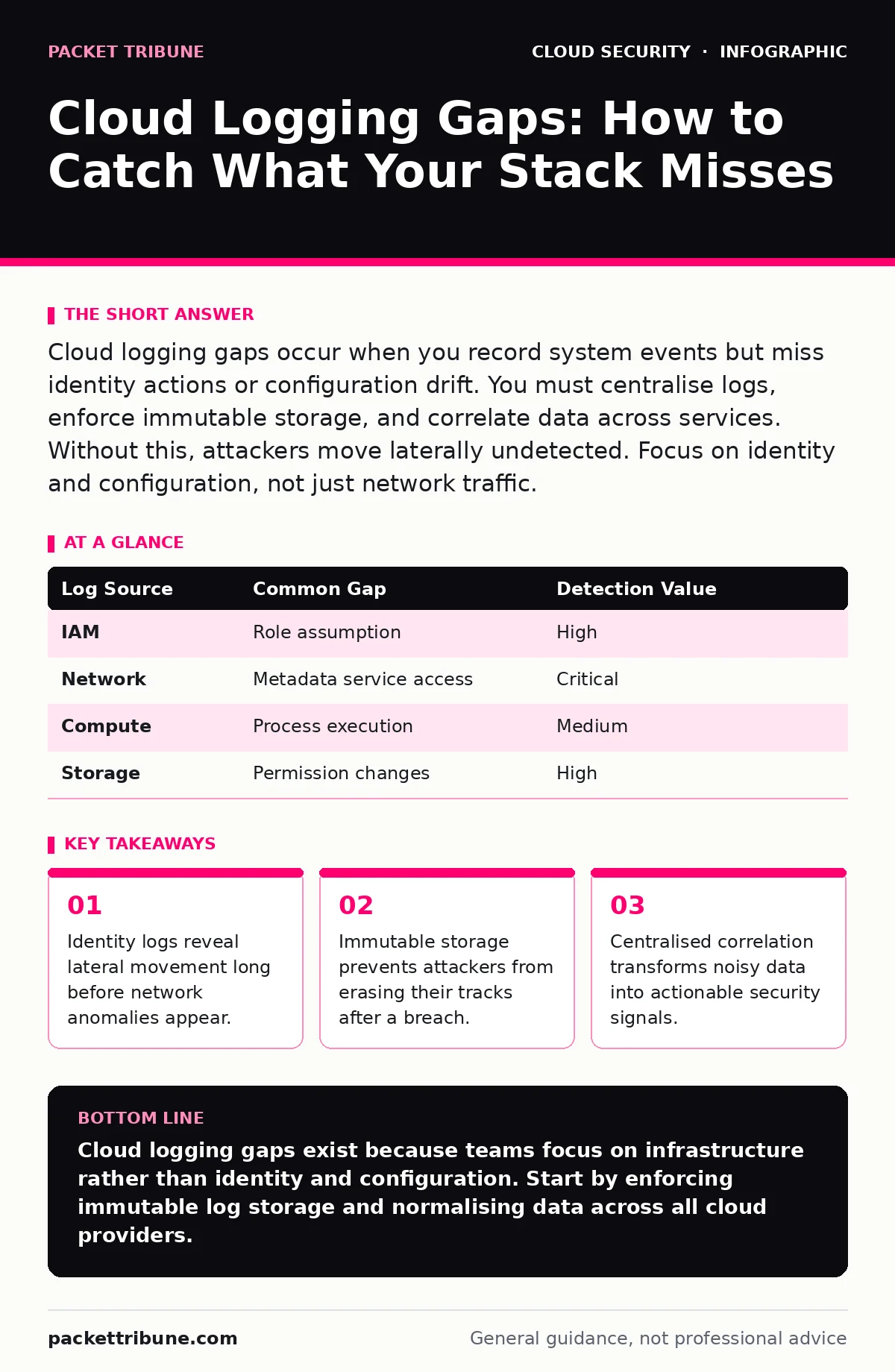
Cloud logging gaps occur when you record system events but miss identity actions or configuration drift. You must centralise logs, enforce immutable storage, and correlate data across services. Without this, attackers move laterally undetected. Focus on identity and configuration, not just network traffic.
Why do my logs show nothing during an attack?
Your logging stack likely records infrastructure events but ignores identity actions. Attackers rarely trigger network alerts immediately; they first manipulate permissions or create new service accounts. If your logs do not capture identity lifecycle events, you are blind to the initial compromise.
Identity sprawl creates noise that hides malicious activity. When hundreds of service accounts exist, a single rogue account blends into the background. You must treat identity changes as high-fidelity signals, not low-priority metadata.
Are cloud provider logs enough for compliance?
Cloud provider logs record API calls but do not interpret their intent. They tell you who made a request, not whether that request violated your security policy. Compliance auditors require proof of control, not just a list of actions.
You need a layer that translates raw logs into policy violations. Without this translation, you cannot prove that you monitored for specific threats. Provider logs are the raw material, not the final product.
How do I stop attackers from deleting logs?
You must store logs in an immutable bucket or storage system. Immutability means data cannot be modified or deleted for a set retention period. This prevents an attacker with administrative privileges from erasing their evidence.
Immutable infrastructure principles apply here. If you treat logs as stateless, append-only data, you remove the risk of tampering. This requires a separate storage destination that the primary cloud environment cannot access.
What is the real cost of centralised logging?
Centralisation creates a single point of failure for visibility. If your central log aggregator goes down, you lose sight of your entire estate. The cost is not just storage; it is the architectural complexity of maintaining uptime.
You pay for bandwidth and parsing rules. High-volume logs from verbose services can exhaust your budget quickly. You must filter at the source, sending only relevant data to the central hub.
Which log sources are most often missed?
Identity and Access Management (IAM) logs are frequently overlooked. Teams focus on compute and storage, ignoring the users and roles that control them. This is a critical blind spot for lateral movement.
Configuration management logs are also under-utilised. Changes to firewall rules or security groups often happen without generating high-priority alerts. You must log configuration drift, not just successful deployments.
| Log Source | Common Gap | Detection Value |
|---|---|---|
| IAM | Role assumption | High |
| Network | Metadata service access | Critical |
| Compute | Process execution | Medium |
| Storage | Permission changes | High |
See also: Prevent Public File Share Exposure With This Technical Checklist · DevSecOps vs SecDevOps: Why the Syntax Defines Your Security Posture
How do I handle log volume without losing data?
You cannot log everything at the highest verbosity level. You must define a data retention policy that balances cost with forensic needs. Keep high-fidelity logs for a short period and aggregate lower-fidelity summaries for longer retention.
Sampling is a valid strategy for non-critical events. If you receive thousands of identical health checks, log one representative sample. This preserves the pattern without consuming storage.
Why does correlation fail in multi-cloud environments?
Different cloud providers use different schema structures for their logs. A login event in one provider looks nothing like a login event in another. This inconsistency breaks automated correlation rules.
You need a normalisation layer. This tool translates disparate log formats into a common schema. Without normalisation, you cannot detect attacks that span multiple cloud platforms.
How do I detect privilege escalation in logs?
Look for sequences, not single events. A user assuming a role is normal; assuming a role they have never used before is suspicious. You must baseline normal behaviour for each identity.
Least privilege in the cloud reduces the attack surface. If users only have the permissions they need, escalation attempts become more obvious. Log all permission changes and audit them regularly.
What is the gap between logging and response?
Logging tells you what happened; it does not stop it. You need automated response mechanisms to act on log data. This is where cloud detection and response platforms integrate.
Without automated response, you face alert fatigue. Security teams cannot manually investigate every anomaly. Automate containment for known threats, such as blocking compromised credentials.
How do I validate my logging coverage?
You must simulate attacks to test your logs. This is known as purple teaming. You generate benign but suspicious activity and check if your logs capture it.
If you cannot see the simulation, you cannot see the real attack. Regularly test your logging pipeline with controlled scenarios. This ensures your investment delivers visibility.
Key takeaways
- Identity logs reveal lateral movement long before network anomalies appear.
- Immutable storage prevents attackers from erasing their tracks after a breach.
- Centralised correlation transforms noisy data into actionable security signals.
Cloud logging gaps exist because teams focus on infrastructure rather than identity and configuration. Start by enforcing immutable log storage and normalising data across all cloud providers.
Frequently asked questions
Do I need to log every API call?
No. Logging every call creates noise and high costs. Focus on high-risk actions like permission changes and credential usage. Filter routine health checks and status queries.
How long should I keep cloud logs?
Keep high-fidelity logs for at least three months for immediate incident response. Store aggregated, lower-fidelity logs for a year or more for compliance and trend analysis. Balance this against storage costs.
Can I use open-source tools for log management?
Yes. Open-source solutions offer flexibility but require more maintenance. You must build your own normalisation and correlation layers. Commercial tools often provide pre-built integrations for major cloud providers.
What is the biggest mistake in cloud logging?
The biggest mistake is assuming provider logs are sufficient. They are raw data, not security intelligence. You must add context, correlation, and immutable storage to make them useful for detection.
How this guide was produced: written by the Packet Tribune editorial team with AI assistance, checked against the public references listed below, and reviewed when the facts change. See our editorial policy or report an error.