NoSQL Injection Warning Signs: Detecting Hidden Database Attacks
NoSQL injection bypasses traditional SQL filters, allowing attackers to extract data through logical operators that standard scanners often miss entirely.

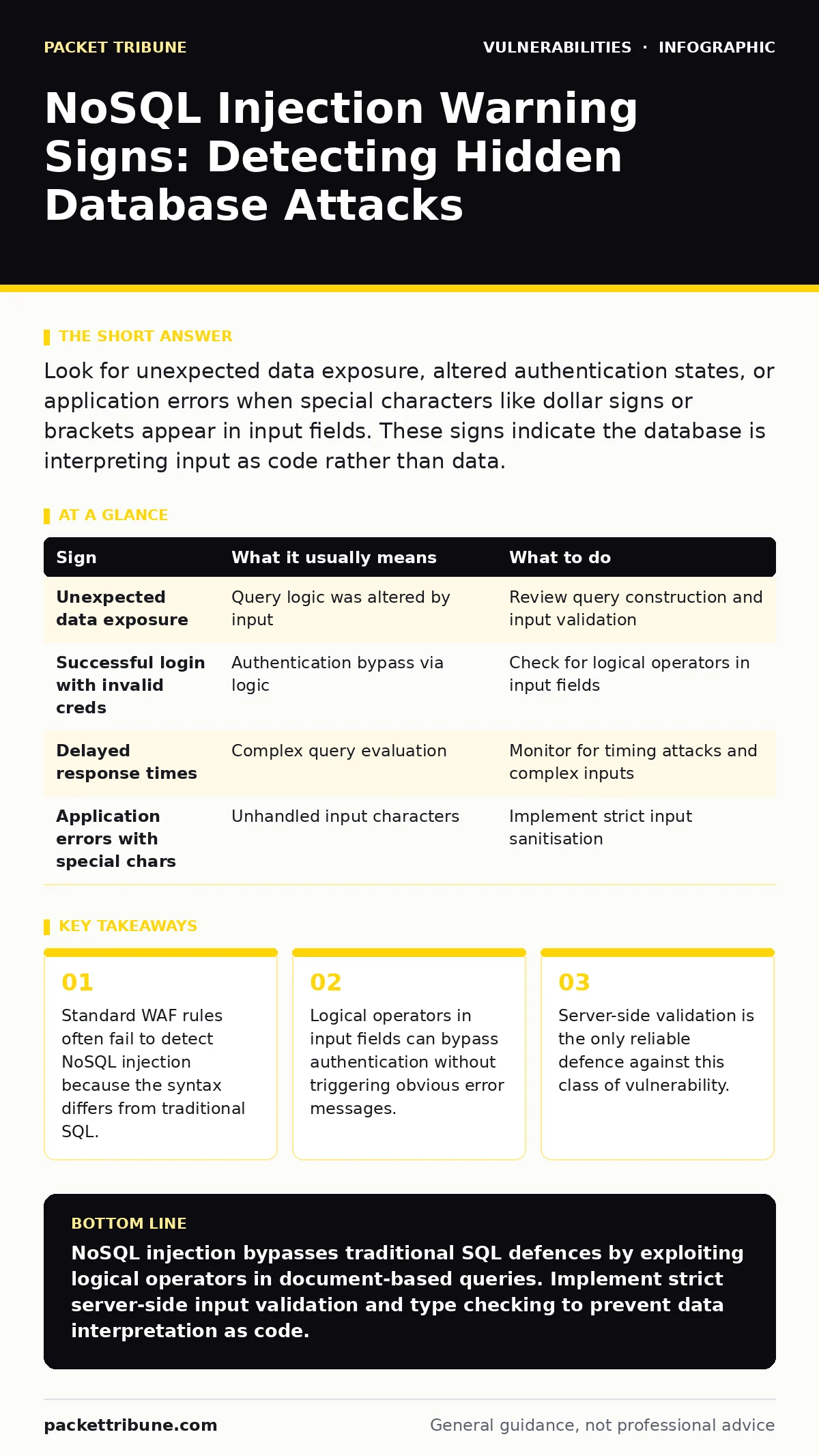
Look for unexpected data exposure, altered authentication states, or application errors when special characters like dollar signs or brackets appear in input fields. These signs indicate the database is interpreting input as code rather than data.
The Illusion of Safety in Document Stores
Many organisations migrate to NoSQL databases believing they escape the historical risks of SQL injection. This assumption is dangerous. NoSQL injection occurs when untrusted data is interpreted as part of a query command by the database engine. Unlike relational databases, which use a structured query language, document stores like MongoDB use object-based queries. The mechanism differs, but the root cause remains the same: failing to distinguish between data and code. You must treat every input field as a potential execution vector, regardless of the underlying storage technology.
Immediate Indicators of Compromise
The first signs of NoSQL injection often appear in application behaviour rather than server logs. Imagine a user enters a username that includes special characters such as dollar signs or curly braces. If the application returns more data than expected, or if it grants access to an unauthorised account, the database has likely executed the input as a command. This happens because the application passes the input directly into the query constructor without sanitisation. You will see this when a login form accepts a crafted payload and returns a true result for authentication, even with an incorrect password.
Subtle Signs That Slip Past Scanners
Standard vulnerability scanners often miss NoSQL injection because they look for SQL-specific keywords like SELECT or UNION. NoSQL queries use different syntax, relying on operators such as $gt (greater than) or $ne (not equal). These operators are valid parts of the database language, making them difficult to flag as malicious. A subtle sign is a change in the application’s response time. When an attacker sends a complex logical query, the database may take longer to process it. This delay is a non-obvious consequence of the database evaluating the injected logic rather than simply retrieving static data.
The Role of Input Validation
You cannot rely on output encoding alone to prevent NoSQL injection. Encoding protects against cross-site scripting, but it does not stop the database from interpreting logical operators. The defence must happen before the data reaches the database layer. Input validation ensures that data matches the expected format, type, and range. For example, if a field expects a numerical ID, the application must reject any string containing letters or symbols. This approach aligns with best practices for mitigations and workarounds where defence-in-depth is required. You must validate on the server side, as client-side checks can be bypassed by a determined attacker.
Detecting Logic-Based Attacks
Attackers often use logic-based injection to bypass authentication mechanisms. Suppose an attacker submits a username with a condition that is always true. The database evaluates this condition and returns a match, granting access. This is easy to miss because the application does not crash or throw an error. Instead, it behaves as if the user provided valid credentials. You should monitor for successful logins from unusual IP addresses or with unexpected user agents. Correlating these events with input patterns helps identify the attack. This is similar to how API vulnerabilities are often detected through anomalous usage patterns rather than direct errors.
Response and Remediation Steps
When you suspect NoSQL injection, immediate action is required. Isolate the affected application to prevent further data exposure. Review the code paths that handle user input, focusing on database query construction. Ensure that all inputs are validated against strict schemas. Use parameterised queries or built-in query builders that separate data from commands.
This prevents the database from interpreting input as executable code. Do not rely on blacklisting specific characters, as attackers can find alternative syntax. Instead, whitelist allowed characters and formats. This strategy complements risk-based vulnerability management by addressing the root cause rather than applying temporary fixes.
| Sign | What it usually means | What to do |
|---|---|---|
| Unexpected data exposure | Query logic was altered by input | Review query construction and input validation |
| Successful login with invalid creds | Authentication bypass via logic | Check for logical operators in input fields |
| Delayed response times | Complex query evaluation | Monitor for timing attacks and complex inputs |
| Application errors with special chars | Unhandled input characters | Implement strict input sanitisation |
Preventing Future Incidents
To prevent NoSQL injection, adopt a zero-trust model for all inputs. Assume that any data entering your system is hostile. Use type checking to ensure that inputs match the expected data type. For instance, if a field expects an integer, reject any string input. This reduces the attack surface significantly. Regularly audit your code for direct query construction. Use static analysis tools that understand NoSQL query syntax. These tools can identify where input is concatenated into queries. This process is part of dependency updates when using third-party libraries that handle database interactions. Ensure these libraries are up to date and secure.
Integration with Security Frameworks
NoSQL injection defence should be integrated into your broader security framework. It is not a standalone issue but part of a larger strategy. Consider how emergency patching procedures apply when a critical vulnerability is discovered. You must have a plan to deploy fixes quickly. Similarly, understand the role of CVE Numbering Authorities in tracking known vulnerabilities in database drivers. This helps you stay informed about new threats. By combining technical controls with process improvements, you create a resilient defence. This approach ensures that you are not just reacting to attacks but preventing them.
Key takeaways
- Standard WAF rules often fail to detect NoSQL injection because the syntax differs from traditional SQL.
- Logical operators in input fields can bypass authentication without triggering obvious error messages.
- Server-side validation is the only reliable defence against this class of vulnerability.
NoSQL injection bypasses traditional SQL defences by exploiting logical operators in document-based queries. Implement strict server-side input validation and type checking to prevent data interpretation as code.
Frequently asked questions
Does using a NoSQL database eliminate the risk of injection attacks?
No, NoSQL databases have their own query syntax that can be exploited if input is not properly validated. The risk shifts from SQL to document-based query injection.
Can a Web Application Firewall detect NoSQL injection?
Standard WAFs often miss NoSQL injection because they are tuned for SQL syntax. You need specific rules or application-level validation to detect these attacks effectively.
What is the difference between SQL and NoSQL injection?
SQL injection exploits structured query language, while NoSQL injection exploits the object-based query syntax of document stores. Both involve interpreting input as code, but the syntax differs.
How do I validate input for NoSQL queries?
Use strict type checking and schema validation on the server side. Ensure that inputs match the expected format and range before they are used in any database query.
How this guide was produced: written by the Packet Tribune editorial team with AI assistance, checked against the public references listed below, and reviewed when the facts change. See our editorial policy or report an error.