Open Source Security: The Hidden Costs of Transparency
Public code offers immediate scrutiny but creates a dependency risk where a single abandoned maintainer can cripple your entire infrastructure without warning.

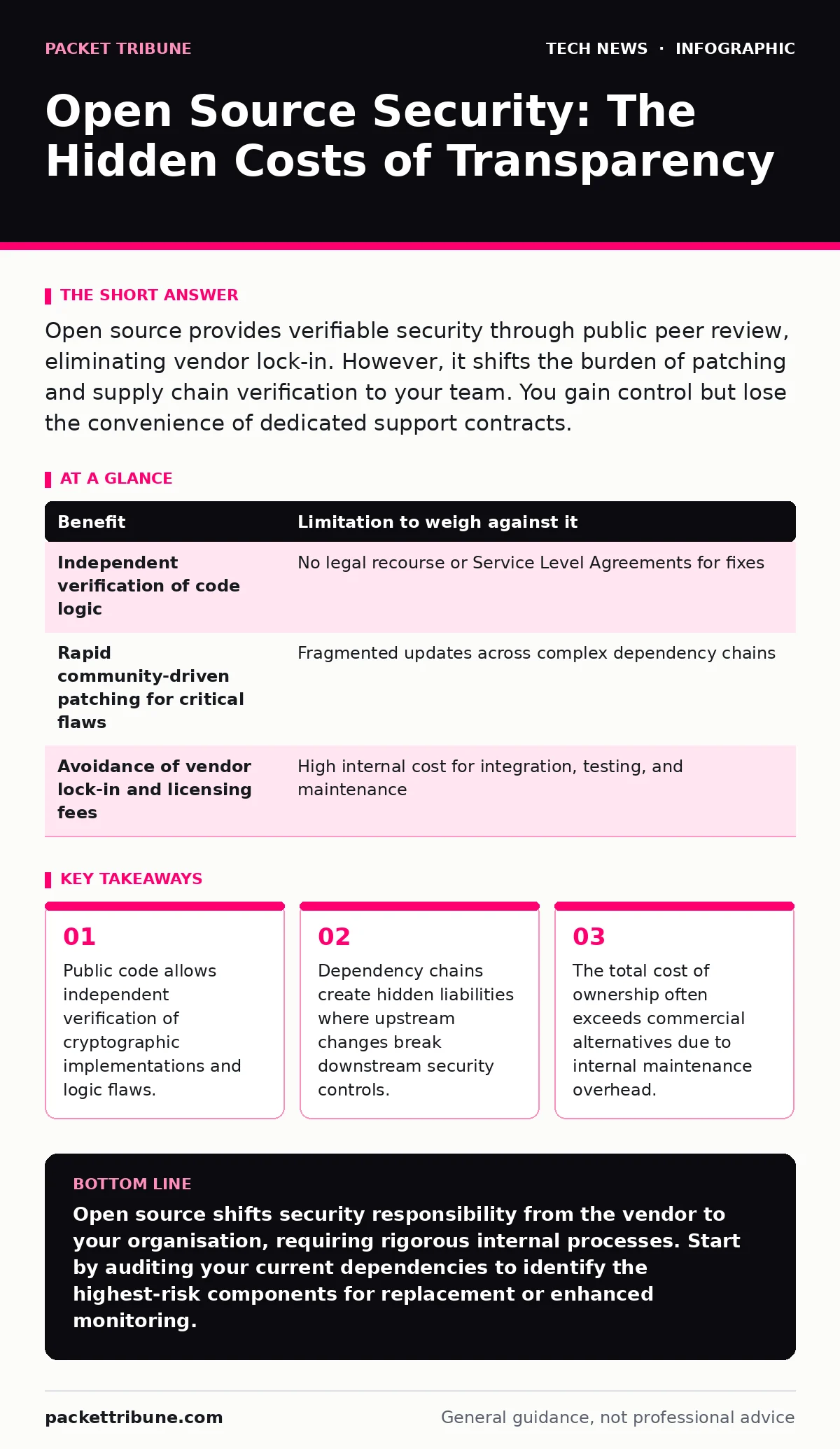
Open source provides verifiable security through public peer review, eliminating vendor lock-in. However, it shifts the burden of patching and supply chain verification to your team. You gain control but lose the convenience of dedicated support contracts.
The Illusion of Free Security
Open-source software is often perceived as inherently secure because the source code is visible to anyone. This transparency allows experts to audit the logic for backdoors or flaws. However, visibility does not guarantee that anyone is actually looking. Most open-source projects have a small number of active maintainers who review code sporadically.
The benefit is that you are not trusting a vendor’s word about what is inside the binary. You can verify the implementation yourself or hire a third party to do so. The limitation is that verification requires significant expertise and time. If you do not have the resources to audit the code, you are trusting the community by default.
Scrutiny Versus Stewardship
The core advantage of open source is the "many eyes" theory. When code is public, developers across the globe can identify vulnerabilities. This often leads to faster discovery of logic errors that might hide in proprietary black boxes. For critical components like TLS certificates or AES encryption, public scrutiny ensures that the mathematical foundations remain sound.
The corresponding limitation is the lack of accountability. In a commercial product, a vendor is liable for security failures. In open source, the maintainer usually provides the software "as is". If a vulnerability is found, there is no guaranteed timeline for a fix. You must monitor the project’s activity levels closely to anticipate when support might dry up.
| Benefit | Limitation to weigh against it |
|---|---|
| Independent verification of code logic | No legal recourse or Service Level Agreements for fixes |
| Rapid community-driven patching for critical flaws | Fragmented updates across complex dependency chains |
| Avoidance of vendor lock-in and licensing fees | High internal cost for integration, testing, and maintenance |
The Dependency Chain Risk
Modern applications rarely use open-source libraries in isolation. They import dozens of modules, each of which may import others. This creates a deep dependency tree. A vulnerability in a low-level library can propagate through multiple layers before reaching your application.
This structure complicates security management. You must track not only the direct libraries you use but also their transitive dependencies. When a critical flaw is discovered in a foundational library, you may need to update multiple components simultaneously. This process is often slower and more error-prone than applying a single patch from a commercial vendor.
Integration and Customisation Control
Open source allows you to modify the software to fit your specific security requirements. You can remove unnecessary features that increase the attack surface. You can also integrate the software tightly with your existing network access control systems or remote work security protocols.
This flexibility is a double-edged sword. Custom modifications create a divergence from the upstream codebase. When the upstream project releases a security patch, you cannot simply apply it. You must merge your changes with the new code, a process that requires skilled developers. Over time, this maintenance burden grows exponentially.
Supply Chain Verification
With proprietary software, you trust the vendor’s build process. With open source, you can verify that the binary matches the source code. This is critical for preventing supply chain attacks where malicious code is injected during compilation. You can implement reproducible builds to ensure integrity.
However, verifying the entire build pipeline is resource-intensive. It requires setting up isolated environments and checking every step of the compilation process. Most organisations lack the infrastructure to perform these checks for every library they use. Consequently, many teams skip this step, leaving a gap in their security posture.
See also: Wifi router security: Stop hidden admin access from leaking data · Email Security Protocols: Mechanics, Gaps and Mitigation
When It Is Worth It
Open source is worth the effort when you need full control over the security configuration. If you are building a system that handles sensitive data, the ability to audit the code is invaluable. It is also worth it when the open-source solution is the industry standard, ensuring a large community of contributors and users.
Consider open source when the functionality is mature and stable. Projects with a long history of regular updates and a large contributor base are less likely to abandon you. The trade-off is manageable if you have a dedicated team to handle updates and integrations.
When It Is Not
Open source is not worth it when you lack the internal expertise to maintain it. If your team is small or focused on other priorities, the overhead of managing open-source components will distract from your core business. In these cases, the hidden costs of maintenance outweigh the licensing savings.
Avoid open source for critical infrastructure where downtime is unacceptable. If a vulnerability is found and the maintainer does not respond quickly, you may be forced to patch it yourself or switch vendors. This risk is too high for systems that require guaranteed availability and support.
Managing the Trade-offs
You can mitigate the limitations of open source by implementing strict governance. Define clear policies for which versions of libraries are allowed. Automate the scanning of dependencies for known vulnerabilities. Integrate these checks into your software updates pipeline to ensure that no new vulnerabilities are introduced.
Regularly review your dependency tree to identify unused or outdated libraries. Removing unnecessary dependencies reduces your attack surface. Engage with the open-source community to contribute fixes or improvements. This helps ensure the long-term viability of the tools you rely on.
Key takeaways
- Public code allows independent verification of cryptographic implementations and logic flaws.
- Dependency chains create hidden liabilities where upstream changes break downstream security controls.
- The total cost of ownership often exceeds commercial alternatives due to internal maintenance overhead.
Open source shifts security responsibility from the vendor to your organisation, requiring rigorous internal processes. Start by auditing your current dependencies to identify the highest-risk components for replacement or enhanced monitoring.
Frequently asked questions
Is open-source software safer than proprietary software?
Safety depends on the specific project and your ability to maintain it. Open source allows verification, but proprietary software often has dedicated security teams.
How do I track vulnerabilities in open-source libraries?
Use automated tools that scan your dependencies against public vulnerability databases. Integrate these scans into your development pipeline.
What is the total cost of ownership for open source?
It includes licensing savings but adds costs for integration, testing, maintenance, and potential custom development. These internal costs often exceed commercial licensing fees.
Can I get support for open-source software?
You can hire third-party companies that offer commercial support for specific open-source projects. This provides a safety net similar to vendor support.
How this guide was produced: written by the Packet Tribune editorial team with AI assistance, checked against the public references listed below, and reviewed when the facts change. See our editorial policy or report an error.