What is security debt: the hidden costs of delayed fixes
Unresolved security shortcuts compound over time, creating a technical burden that eventually outweighs the initial speed gained by deferring proper controls.

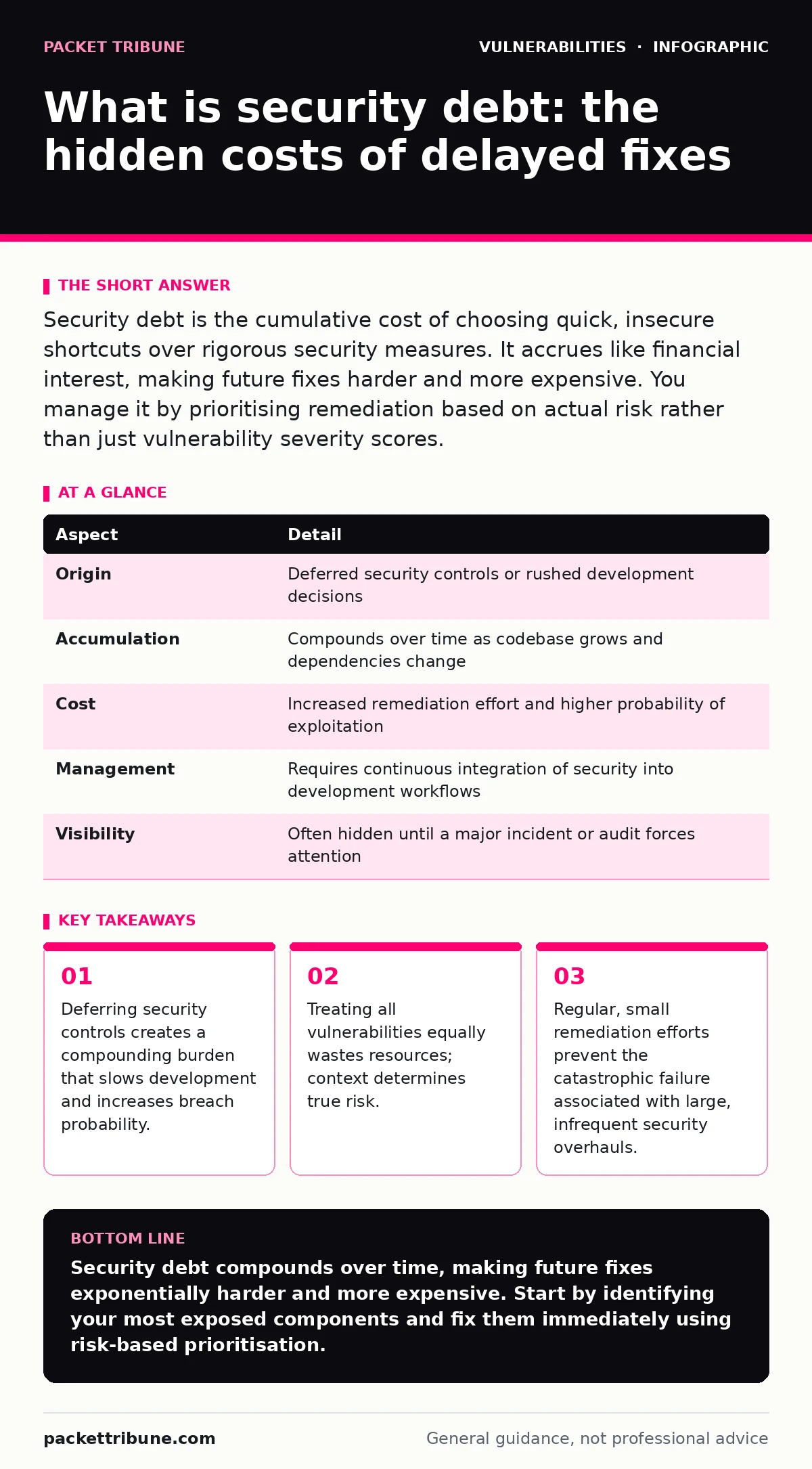
Security debt is the cumulative cost of choosing quick, insecure shortcuts over rigorous security measures. It accrues like financial interest, making future fixes harder and more expensive. You manage it by prioritising remediation based on actual risk rather than just vulnerability severity scores.
An everyday analogy for security debt
Imagine you borrow money to finish a project quickly. You pay no interest initially, but the debt grows. Eventually, the interest payments exceed your income. Security debt works similarly. You skip a security control to meet a deadline. The code ships faster, but the underlying weakness remains. Over time, fixing that weakness requires rewriting large sections of code. The initial time saving disappears. The technical burden becomes unmanageable. This analogy helps explain why small shortcuts create large problems.
What is security debt
Security debt is the technical burden created by choosing fast, insecure solutions over slower, secure ones. It is not a single bug or a missing patch. It is the aggregate result of deferred security responsibilities. When you bypass authentication checks to launch a feature early, you create debt. When you ignore dependency updates because they might break the build, you create debt. This debt accumulates silently. It does not cause immediate failure. It increases the complexity of the system. It raises the likelihood of a successful attack. The definition matters because it shifts focus from individual flaws to systemic risk.
| Aspect | Detail |
|---|---|
| Origin | Deferred security controls or rushed development decisions |
| Accumulation | Compounds over time as codebase grows and dependencies change |
| Cost | Increased remediation effort and higher probability of exploitation |
| Management | Requires continuous integration of security into development workflows |
| Visibility | Often hidden until a major incident or audit forces attention |
How security debt works in practice
Security debt operates through compounding complexity. A single insecure function might be easy to fix in isolation. However, other parts of the system depend on that function. When you finally attempt to fix it, you must update every dependent module. The scope of the fix expands. The risk of introducing new bugs rises. This is the core mechanism of security debt. It is not just about the original flaw.
It is about the architectural entanglement that makes fixing the flaw difficult. The longer you wait, the more entangled the code becomes. The debt grows not linearly, but exponentially. This dynamic explains why large, infrequent security audits often fail. They reveal too much debt to fix at once. The organisation chooses to ignore the worst parts. The debt continues to grow.
Who security debt affects most
Security debt affects organisations that prioritise speed over security. Startups often incur this debt to reach market quickly. Large enterprises incur it when legacy systems prevent modern security practices. The impact is not limited to small teams. Any organisation that treats security as an afterthought suffers. The CISO faces pressure to reduce risk. The development team faces pressure to ship features.
These conflicting goals create the conditions for debt. The technical team bears the burden of fixing complex, entangled code. The business bears the burden of potential reputational damage. The users bear the burden of compromised data. Everyone loses when debt is ignored. The distribution of pain varies, but the root cause is the same. The organisation chose short-term gain over long-term stability.
What people usually get wrong
Many teams believe that fixing vulnerabilities in order of severity solves the problem. This approach fails because it ignores context. A critical vulnerability in an isolated, unused module is less risky than a low-severity issue in a public-facing login screen. Severity scores are generic. They do not account for your specific architecture. Another common mistake is treating security as a phase.
Teams build features, then scan for issues, then fix them. This linear process creates bottlenecks. Security becomes a gate, not a practice. The debt accumulates between phases. A third error is assuming that automated tools eliminate debt. Tools find flaws, but they do not prioritise them. Human judgment is required to decide what to fix first. Without judgment, teams chase low-value fixes. The real debt remains untouched.
See also: How to Run Tabletop Exercises: A Practical Implementation Framework
Managing security debt effectively
You manage security debt by integrating security into the development lifecycle. This is not about adding more steps. It is about making security decisions earlier. When designing a feature, consider the security implications. Choose libraries with active maintenance. Write code that is easy to audit. This reduces the initial debt. You also need a strategy for existing debt. Identify the most exposed components. Fix those first.
Use risk-based vulnerability management to prioritise work. This approach focuses on what matters most to your business. It avoids the trap of fixing everything equally. Small, regular fixes are better than large, rare overhauls. This keeps the debt manageable. It prevents the compounding effect from becoming catastrophic. The goal is not zero debt. That is impossible. The goal is sustainable debt.
The role of dependencies and updates
Third-party libraries are a major source of security debt. You do not write this code, but you are responsible for it. When a library contains a flaw, your application inherits it. Ignoring dependency updates is a common way to incur debt. Teams fear that updating will break functionality. This fear is valid, but ignoring the risk is worse. You must have a process for testing updates.
Automated testing pipelines help here. They catch breaking changes before they reach production. You also need to monitor for known vulnerabilities in your dependencies. Tools can alert you when a library you use has a flaw. You must act on these alerts. Delaying updates increases the window of exposure. The debt grows with every day you wait. Managing dependencies is a continuous process. It requires discipline and automation.
Balancing speed and security
The tension between speed and security is real. You cannot eliminate it. You can only manage it. The key is to make security decisions explicit. When you choose to skip a control, document why. Assign a due date for fixing it. Treat it like a task, not an afterthought. This creates visibility. It allows leadership to understand the risk. It also allows developers to plan the fix. Without this visibility, debt hides.
It surprises you later. You must also educate your team. Developers need to understand the cost of debt. They need to see how shortcuts create future work. Training and mentorship help here. Share examples of how debt slowed down projects. Show the connection between early decisions and later pain. This cultural shift reduces the rate of debt accumulation. It makes security a shared responsibility.
Implementing a sustainable approach
Sustainable security requires a shift in mindset. You must view security as a feature, not a constraint. This means designing security into the architecture. It means choosing technologies that support security goals. It means hiring people who value security. The technical measures are only part of the solution. The cultural measures are equally important. You need leadership support. Leaders must accept that security takes time.
They must resist the pressure to ship insecure code. They must allocate resources for remediation. Without this support, technical efforts fail. The debt will grow regardless of your tools. You also need metrics. Track the amount of debt. Track the time to fix. Use these metrics to improve your process. This data helps you justify the need for security investments. It shows the value of reducing debt.
Conclusion on security debt
Security debt is a real and measurable risk. It affects every organisation that develops software. The cost of ignoring it is high. The cost of managing it is lower. You do not need to eliminate all debt. You need to keep it manageable. This requires discipline, automation, and cultural change. It requires integrating security into every step of the process. It requires making explicit decisions about risk.
The alternative is a system that is too complex to secure. The path forward is clear. Start small. Fix the most exposed issues. Build better habits. Over time, the debt becomes manageable. The system becomes more resilient. The organisation becomes more secure. This is not a one-time project. It is a continuous practice. The benefits compound over time, just like the debt.
Key takeaways
- Deferring security controls creates a compounding burden that slows development and increases breach probability.
- Treating all vulnerabilities equally wastes resources; context determines true risk.
- Regular, small remediation efforts prevent the catastrophic failure associated with large, infrequent security overhauls.
Security debt compounds over time, making future fixes exponentially harder and more expensive. Start by identifying your most exposed components and fix them immediately using risk-based prioritisation.
Frequently asked questions
How do I measure security debt?
Measure debt by tracking the number of unresolved vulnerabilities, the age of known issues, and the complexity of the codebase. Focus on metrics that reflect actual risk, not just raw counts.
Can automation eliminate security debt?
No. Automation finds flaws and helps fix them, but it cannot make prioritisation decisions. Human judgment is required to determine which fixes provide the most risk reduction.
Is it better to fix all vulnerabilities at once?
No. Large, infrequent fixes are risky and disruptive. Small, regular fixes are more sustainable and less likely to introduce new bugs. Prioritise based on risk exposure.
How does security debt affect development speed?
Initially, skipping security controls speeds up development. Over time, the debt slows development as engineers spend more time fixing complex, entangled issues.
How this guide was produced: written by the Packet Tribune editorial team with AI assistance, checked against the public references listed below, and reviewed when the facts change. See our editorial policy or report an error.