Should I Disable Virtualisation Based Security on Endpoints
Turning off hardware-enforced hypervisor isolation exposes kernel secrets to preserve negligible computing overhead on modern enterprise fleets.

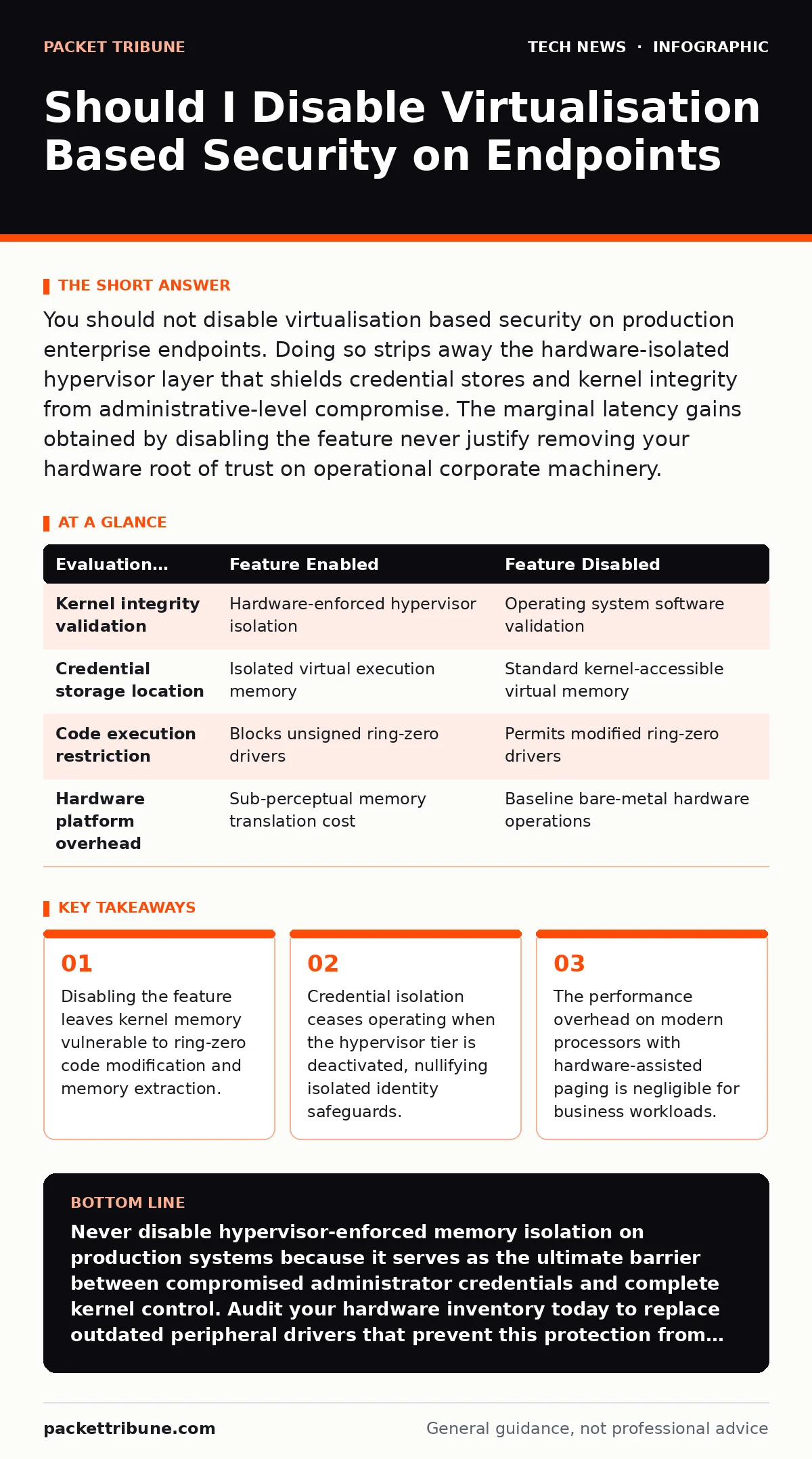
You should not disable virtualisation based security on production enterprise endpoints. Doing so strips away the hardware-isolated hypervisor layer that shields credential stores and kernel integrity from administrative-level compromise. The marginal latency gains obtained by disabling the feature never justify removing your hardware root of trust on operational corporate machinery.
Should I disable virtualisation based security on enterprise devices?
You should not disable virtualisation based security on enterprise devices unless you are diagnosing a verified hardware incompatibility in specialized laboratory equipment. Virtualisation based security uses hardware virtualisation extensions to create an isolated region of operational memory that sits entirely outside the standard operating system. Disabling this defence exposes operating system secrets directly to administrative privileges, rendering endpoint telemetry suspect whenever a device suffers an intrusion during everyday operations.
What happens inside the operating system when the feature runs?
The operating system delegates critical validation routines to a bare-metal hypervisor rather than executing them inside the primary kernel space. The CPU operates using distinct Virtual Trust Levels, dividing memory access so that the highest level can view the lower tier, but the lower tier cannot access the higher tier. If malicious code achieves unrestricted kernel access inside the standard workspace, the hypervisor prohibits that code from writing executable pages or reading credentials housed inside protected hardware memory.
How does hypervisor isolation safeguard enterprise credentials?
The hypervisor isolates the authentication subsystem from ordinary system memory, preventing dump utilities from scraping hashed credentials directly out of volatile storage. When attackers compromise an endpoint, their initial objective involves extracting password artefacts from user session spaces to expand lateral movement across corporate infrastructure. Deploying solid remote work security strategies hinges on this hardware segregation, ensuring that compromised local administrator privileges do not translate into enterprise-wide domain credential compromises.
Does disabling the feature actually restore system performance?
Disabling the feature produces negligible performance benefits on modern microprocessors equipped with hardware-enforced nested page tables and dedicated translation lookaside buffers. Workloads involving continuous instruction-level translation, such as high-frequency nested virtualization testing, might observe nominal execution variances, but ordinary corporate operations execute identically. Routine administrative tasks, heavy browser usage, compiled application execution, and background security monitoring manifest no measurable throughput differences on modern platforms.
| Evaluation Metric | Feature Enabled | Feature Disabled |
|---|---|---|
| Kernel integrity validation | Hardware-enforced hypervisor isolation | Operating system software validation |
| Credential storage location | Isolated virtual execution memory | Standard kernel-accessible virtual memory |
| Code execution restriction | Blocks unsigned ring-zero drivers | Permits modified ring-zero drivers |
| Hardware platform overhead | Sub-perceptual memory translation cost | Baseline bare-metal hardware operations |
What edge cases justify turning off the protection layer?
Disabling the protection layer is acceptable only when managing legacy laboratory machinery, debugging hypervisors, or deploying systems reliant on hardware that lacks secondary address translation. Testing suites that rely on third-party nested virtualisation platforms sometimes fail when the host operating system claims exclusive ownership of hardware virtualisation extensions. Maintaining disciplined IT asset management records ensures these non-standard machines remain cordoned off in designated testing subnets rather than joining general operations where identity protections remain mandatory.
See also: Remote work security policy rules that survive real usage · Should I enable firmware TPM and what breaks when you do
How does memory integrity protection interact with local drivers?
Memory integrity protection inspects every kernel-mode driver against established trust policies before allowing execution, preventing unverified or modified binary code from launching. Attackers routinely weaponise legitimate, signed, yet vulnerable third-party drivers to write arbitrary instructions directly into kernel memory spaces. Hypervisor-enforced code integrity intercepts these execution attempts by enforcing digital signatures before pages map into memory, neutralizing attempts to subvert running endpoint configurations.
What security boundaries fail when the feature is turned off?
Three distinct security mechanisms collapse simultaneously the moment you deactivate hardware hypervisor enforcement on an endpoint:
- Kernel-level code integrity checks cease enforcement at the hypervisor level, falling back to vulnerable operating system-level routines.
- Isolated identity services revert to shared system memory, leaving cached session tokens accessible to debugging utilities.
- System hardware roots of trust disconnect from operational memory validation, permitting modified boot sequences to load unmonitored.
What steps should you take instead of turning off the feature?
Update outdated device drivers and platform firmware systematically instead of switching off hypervisor isolation across your endpoint fleet. When an operating system flags an incompatible driver, the resolution involves replacing the obsolete binary with an updated module validated by contemporary security baselines. Retaining hardware-enforced boundaries preserves foundational defences, ensuring endpoints withstand persistent intrusion attempts without degrading routine operational performance.
Key takeaways
- Disabling the feature leaves kernel memory vulnerable to ring-zero code modification and memory extraction.
- Credential isolation ceases operating when the hypervisor tier is deactivated, nullifying isolated identity safeguards.
- The performance overhead on modern processors with hardware-assisted paging is negligible for business workloads.
- Nested virtualisation environments and legacy industrial peripherals represent the only valid engineering exceptions.
Never disable hypervisor-enforced memory isolation on production systems because it serves as the ultimate barrier between compromised administrator credentials and complete kernel control. Audit your hardware inventory today to replace outdated peripheral drivers that prevent this protection from remaining active by default.
Frequently asked questions
Does turning off hypervisor isolation improve gaming or graphics rendering speeds?
Frame rendering latency drops slightly on older hardware architectures lacking nested paging support, but modern systems show virtually no perceptible performance variation. Competitive testing environments may record marginal differences, but standard visual workloads run unhindered with protections active.
Can malware disable hardware-isolated virtual security controls on its own?
Malware cannot disable these protections from within the operating system if your administrative policies enforce device integrity flags via immutable platform firmware settings. Disabling the framework requires administrative execution privileges alongside a machine restart, rendering silent exploitation unviable.
Will enabling the protection mechanism break developer tools like local software containers?
Modern container systems and local virtual machine platforms integrate directly with hypervisor management services without requiring you to lower host protections. Legacy third-party hypervisors may conflict with native services, necessitating updates to modern frameworks that support shared virtualisation architectures.
How can I verify whether hypervisor protection is running on an active machine?
Operating system system summary utilities display hypervisor isolation status alongside active memory integrity validation flags directly within the device security interface. You can inspect local diagnostic consoles to ensure the virtualization-based integrity services reflect an operational status.
How this guide was produced: written by the Packet Tribune editorial team with AI assistance, checked against the public references listed below, and reviewed when the facts change. See our editorial policy or report an error.