Should I enable firmware TPM and what breaks when you do
Enabling a firmware-based trusted platform module shifts cryptographic keys from external silicon to shared memory, creating a hidden performance tax.
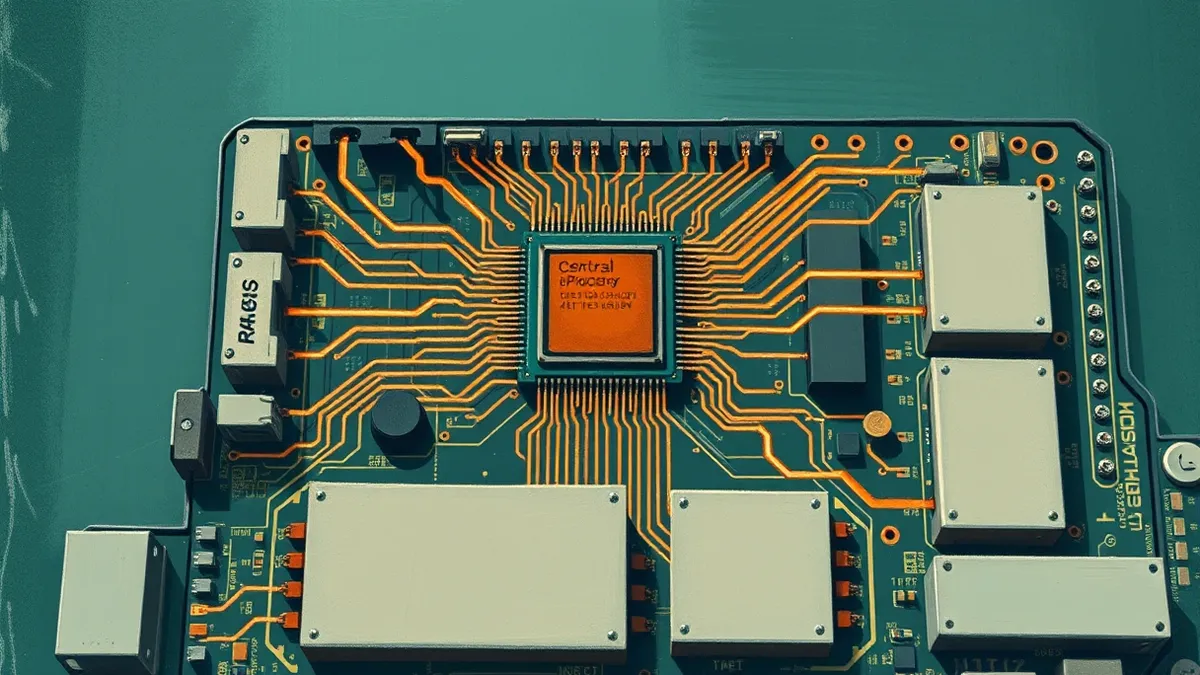
You should enable firmware TPM if your hardware supports it and your operating system requires measured boot sequences. This setting activates a secure cryptographic processor embedded within your main system chipset rather than requiring an external microchip soldered to the motherboard.
What does a firmware TPM actually do inside your computer?
A firmware TPM, or trusted platform module, provides a hardware-isolated environment for generating and storing cryptographic keys and platform measurements. Mainboard manufacturers implement this capability directly inside the primary processor's secure execution mode rather than supplying a discrete silicon microchip. This design stores endorsement keys and platform configuration registers inside non-volatile memory regions managed by system firmware.
Cryptographic isolation prevents unprivileged software from reading raw private keys even if the main operating system suffers complete compromise. Platform integrity measurements occur during boot, where each loaded component hashes the next layer before execution transfers control. Operating systems read these hash values to confirm that boot files remain unmodified by unauthorized agents or rootkits.
Should I enable firmware TPM on existing infrastructure?
You should enable firmware TPM whenever modern operating system features demand measured boot verification or hardware-backed disk encryption. Legacy operating systems running specialized line-of-business applications often experience zero functional benefit from this setting. Performance trade-offs emerge because cryptographic operations contend with regular system tasks for execution slots inside the main processor.
| Deployment State | Performance Impact | Security Benefit | Failure Risk |
|---|---|---|---|
| Disabled | None | None | Low |
| Enabled | Low | Moderate | Moderate |
| Dedicated Chip | Negligible | High | Low |
Management overhead increases when upgrading infrastructure because keys tied to a specific firmware implementation cannot always migrate smoothly. IT asset management teams must track which machines possess discrete hardware versus firmware implementations to streamline future motherboard replacements.
How does firmware TPM differ from discrete hardware modules?
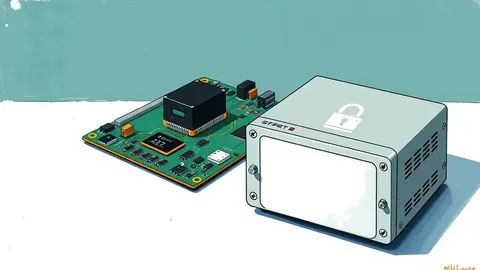
Discrete hardware modules reside on separate physical microchips soldered directly onto the motherboard and communicate over a dedicated low-pin-count bus. Firmware alternatives execute inside the main central processing unit using a specialized privilege level protected by system microcode. Cost reduction drives the adoption of firmware solutions across consumer and enterprise hardware fleets.
| Feature | Firmware TPM | Discrete TPM |
|---|---|---|
| Physical Location | Inside main CPU | Separate chip |
| Bus Traffic | Internal CPU bus | External LPC/SPI bus |
| Tamper Resistance | Relies on CPU isolation | Dedicated physical shielding |
| Supply Chain Cost | Zero additional parts | Requires physical component |
Physical attack vectors differ significantly between these two implementation models. Dedicated microchips resist sophisticated probing attacks against external data buses because cryptographic operations happen off-die. Firmware variants remain vulnerable to side-channel analysis targeting shared cache lines and memory controllers on the primary processor package.
What performance penalties accompany firmware TPM activation?
System latency increases marginally during heavy disk input-output operations and frequent certificate validation routines because cryptographic instructions share execution pipelines. Main memory bandwidth diminishes slightly when the processor context-switches into secure execution modes to process requests.
Virtualization environments experience unique scheduling overhead when multiple guest operating systems request cryptographic services simultaneously from the underlying firmware layer. Hardware resource contention forces hypervisors to serialize requests, introducing unpredictable latency spikes into time-sensitive enterprise applications.
Why do firmware TPM keys vanish during motherboard maintenance?
Firmware TPM keys disappear because the underlying key hierarchy derives from hardware secrets bound to specific physical components and microcode versions. Replacing a mainboard or updating system firmware improperly alters the measured boot path, rendering previously encrypted storage volumes inaccessible without a backup recovery passphrase.
Enterprises relying on automated disk encryption workflows must integrate proper key escrow procedures to prevent permanent data loss during routine hardware repairs. Secure software development pipelines often overlook these recovery dependencies, assuming that underlying platform security functions never fail.
See also: Should i use post quantum encryption to secure data today · Encryption at Rest: The Hidden Costs and Real Protection Limits
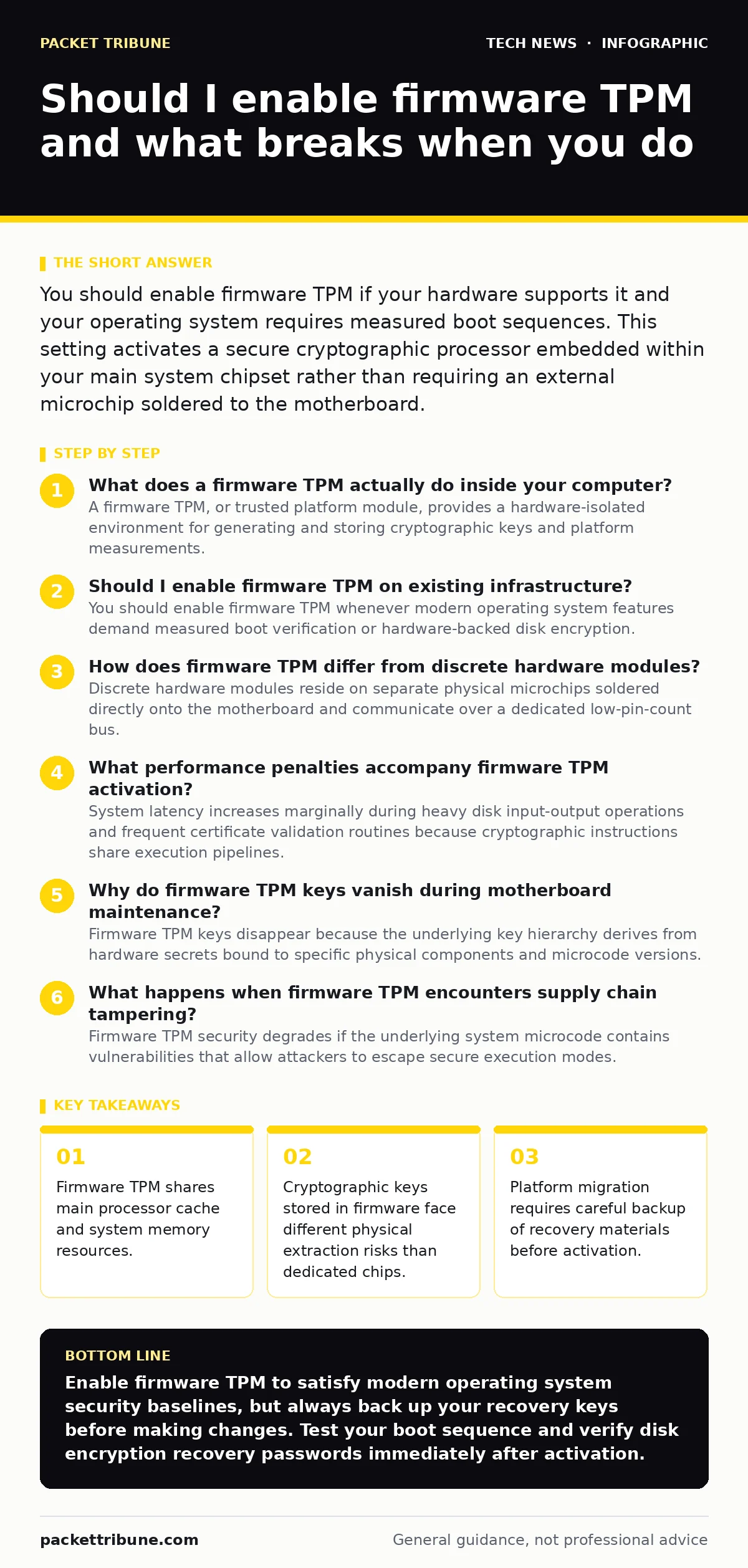
What happens when firmware TPM encounters supply chain tampering?
Firmware TPM security degrades if the underlying system microcode contains vulnerabilities that allow attackers to escape secure execution modes. Because the cryptographic logic lives in flash memory shared with system BIOS, flawed update mechanisms can compromise the root of trust entirely.
Edge computing security strategies often mitigate this risk by preferring discrete hardware roots of trust that resist remote firmware modification attempts. Regular auditing of flash write protections prevents unauthorized modification of the storage regions holding cryptographic measurement logs.
Key takeaways
- Firmware TPM shares main processor cache and system memory resources.
- Cryptographic keys stored in firmware face different physical extraction risks than dedicated chips.
- Platform migration requires careful backup of recovery materials before activation.
Enable firmware TPM to satisfy modern operating system security baselines, but always back up your recovery keys before making changes. Test your boot sequence and verify disk encryption recovery passwords immediately after activation.
Frequently asked questions
Can I convert a firmware TPM into a discrete hardware module later?
No, you cannot convert a firmware implementation into a physical chip without replacing the motherboard or adding an external module header if available.
Does enabling firmware TPM slow down network traffic processing?
Network throughput remains largely unaffected unless your applications perform constant cryptographic handshakes that saturate the CPU's secure execution pipelines.
Will firmware TPM prevent malware from infecting my operating system?
Firmware TPM detects unauthorized modifications during boot but does not stop runtime malware infections or credential theft.
How do I verify if my firmware TPM is currently active?
You can check the system security management console within your operating system or review the cryptographic device status in your firmware configuration menus.
How this guide was produced: written by the Packet Tribune editorial team with AI assistance, checked against the public references listed below, and reviewed when the facts change. See our editorial policy or report an error.