Hardware security module vs tpm for your architecture
A hardware security module guards enterprise keys in network appliances while a trusted platform module anchors system boot integrity directly on the motherboard.
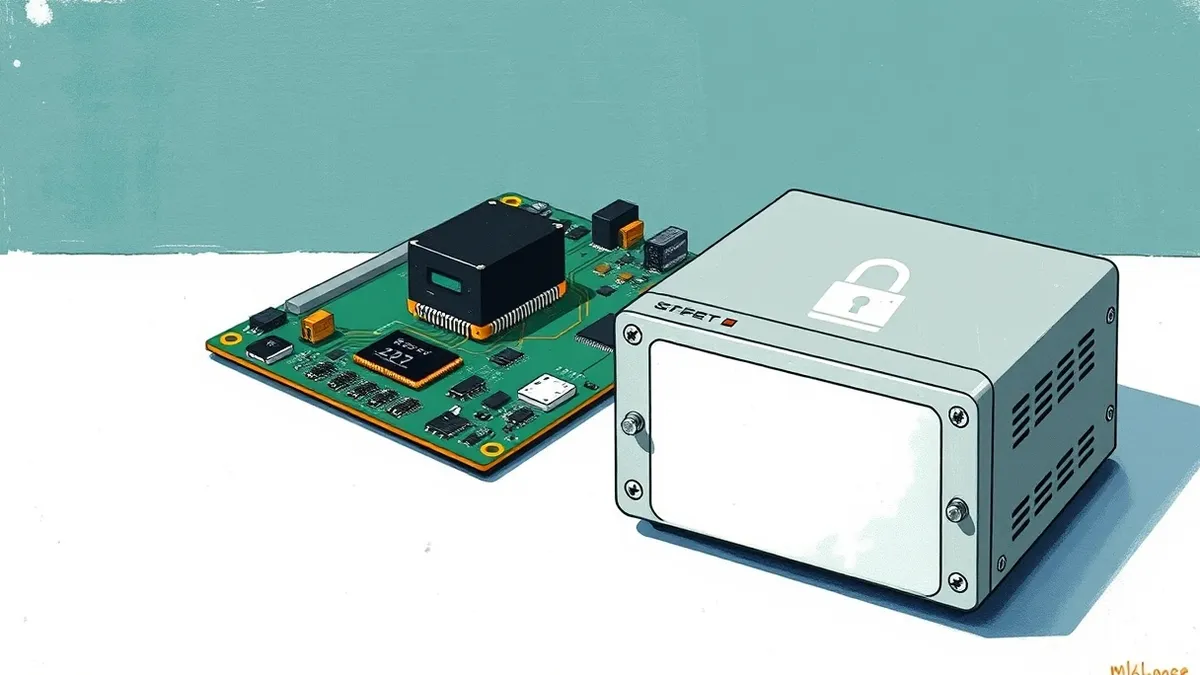
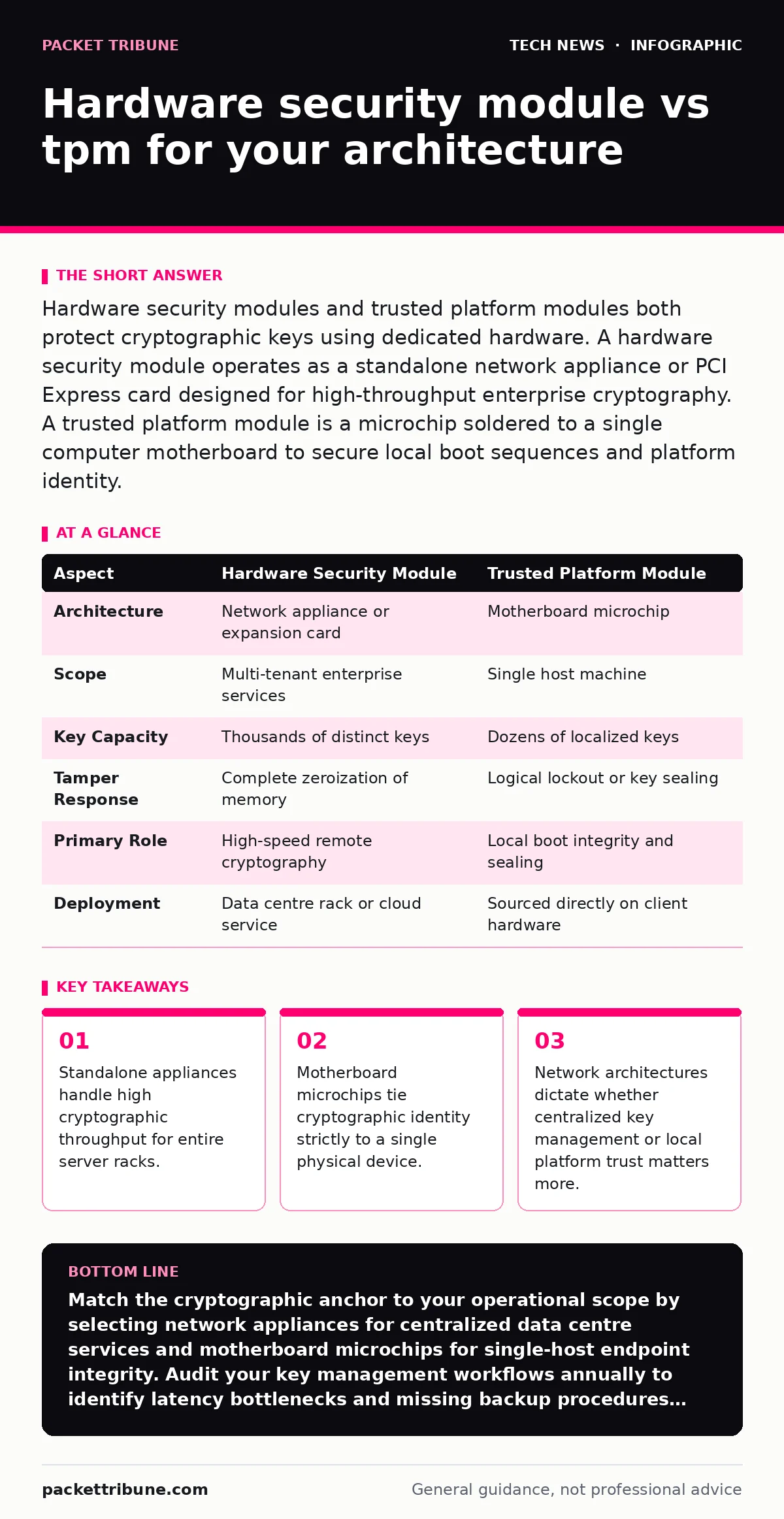
Hardware security modules and trusted platform modules both protect cryptographic keys using dedicated hardware. A hardware security module operates as a standalone network appliance or PCI Express card designed for high-throughput enterprise cryptography. A trusted platform module is a microchip soldered to a single computer motherboard to secure local boot sequences and platform identity.
What is a hardware security module
Dedicated cryptographic processors housed within tamper-resistant physical enclosures form a hardware security module, abbreviated as an HSM. These devices generate, store, and protect sensitive cryptographic keys away from the main operating system memory. Organizations deploy network-attached units to offload heavy mathematical operations from standard web servers and database clusters.
Physical sensors inside the enclosure detect drilling, extreme temperature shifts, or voltage anomalies. Such events trigger an immediate zeroization protocol that wipes all stored material instantly. Imagine a financial institution processing millions of transactions daily where private keys must never touch standard disk storage.
Centralised key management brings operational complexity alongside security gains. Network latency increases when applications must request remote signatures across the local area network for every transaction.
What is a trusted platform module
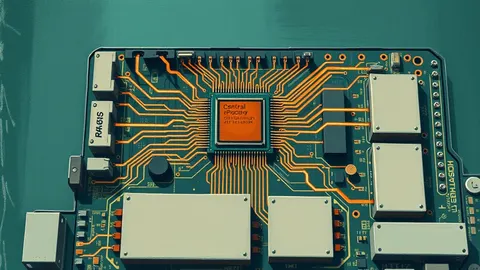
Cryptographic microchips permanently attached to computer motherboards act as a trusted platform module, abbreviated as a TPM. This dedicated crypto processor measures system boot components to verify that firmware and bootloaders remain unaltered before handing control to the operating system. Secure software development relies heavily on such underlying hardware roots of trust to ensure build pipelines compile verified code.
Internal non-volatile memory stores platform configuration registers that record cryptographic hashes of each boot stage sequentially. An unexpected modification in the bootloader alters the final hash value, preventing the system from releasing encrypted drive keys.
Local device binding creates a distinct limitation for disaster recovery procedures. Moving encrypted storage drives to replacement hardware fails unless you escrow the recovery secrets securely outside the original microchip.
Hardware security module vs tpm core differences
Evaluating hardware security module vs tpm requires examining physical placement, primary functions, and cryptographic capacities. Network appliances serve multiple hosts across an entire data centre infrastructure simultaneously. Motherboard cryptoprocessors serve strictly one host machine and cannot share their internal key material with network peers easily.
| Aspect | Hardware Security Module | Trusted Platform Module |
|---|---|---|
| Architecture | Network appliance or expansion card | Motherboard microchip |
| Scope | Multi-tenant enterprise services | Single host machine |
| Key Capacity | Thousands of distinct keys | Dozens of localized keys |
| Tamper Response | Complete zeroization of memory | Logical lockout or key sealing |
| Primary Role | High-speed remote cryptography | Local boot integrity and sealing |
| Deployment | Data centre rack or cloud service | Sourced directly on client hardware |
Throughput differences dictate operational choices for identity management systems. Network appliances handle heavy asymmetric key operations efficiently using specialized internal math accelerators. Motherboard chips process operations slowly because they contain minimal processing power designed solely for basic integrity checks.
When to choose a hardware security module
Centralised key management requirements dictate deployments requiring cryptographic operations across hundreds of distinct application servers simultaneously. Financial services, certificate authorities, and large-scale database encryption projects demand the high transaction rates that dedicated network appliances provide.
High availability configurations require redundant network units paired together to maintain operations if a single hardware unit fails. Network access control systems often integrate with these central cryptographic stores to validate device certificates rapidly without overloading local host processors.
Scale brings hidden operational costs including complex network routing, specialized administrative credentials, and strict physical maintenance requirements. Remote administration demands multi-factor authentication tokens distributed among several trusted administrators to authorize administrative actions securely.
When to choose a trusted platform module
Single-machine threat models require motherboard microchips to protect local operating systems and user authentication tokens. Endpoint fleets benefit from cryptographic boot verification that prevents persistent rootkits from surviving reboots unnoticed.
Disk encryption solutions use the microchip to seal recovery keys until the system passes all pre-boot integrity checks successfully. Mobile workers rely on this local binding to protect sensitive corporate data stored on portable laptops against offline extraction attacks.
Hardware replacement cycles introduce management friction when aging endpoints require decommissioning. Technicians must clear all internal states securely to prevent cryptographic remnants from leaking onto the secondhand market.
See also: Should i use post quantum encryption to secure data today · Why do we need public key cryptography and how it secures data
Where both systems overlap in practice
Cryptographic key generation and secure random number generation occur inside both device architectures. Both technologies prevent private keys from ever existing in plain text within volatile system memory where memory scraping malware might capture them.
OAuth token validation workflows utilize both approaches depending on architectural scale. A high-volume identity provider relies on network appliances, while a local enterprise desktop verifies single sign-on tokens using motherboard cryptoprocessors.
Edge computing security scenarios blur these boundaries further as remote gateways adopt features traditionally reserved for enterprise data centre appliances. Miniature cryptographic processors now appear in smart meters and industrial controllers, merging local boot trust with remote key management capabilities.
Hidden costs and architectural trade offs
Cryptographic architecture choices carry severe maintenance penalties that rarely appear on initial procurement spreadsheets. Firmware updates for motherboard microchips require physical presence or complex out-of-band management controllers when remote flashing fails.
Network appliances introduce single points of failure if engineers misconfigure high-availability clustering and failover parameters. Latency spikes can cascade through dependent microservice architectures when the central cryptographic device reaches maximum transaction capacity.
Disaster recovery planning becomes exponentially harder when hardware failure destroys the underlying root of trust. Backing up master keys requires coordinated offline ceremonies involving multiple trusted personnel and physical secure tokens.
Key takeaways
- Standalone appliances handle high cryptographic throughput for entire server racks.
- Motherboard microchips tie cryptographic identity strictly to a single physical device.
- Network architectures dictate whether centralized key management or local platform trust matters more.
Match the cryptographic anchor to your operational scope by selecting network appliances for centralized data centre services and motherboard microchips for single-host endpoint integrity. Audit your key management workflows annually to identify latency bottlenecks and missing backup procedures before a hardware failure occurs.
Frequently asked questions
Can a trusted platform module replace a network hardware security module?
No, motherboard microchips lack the network interfaces, multi-tenant key capacity, and processing speed required for enterprise-scale cryptographic operations.
What happens if a hardware security module loses power?
Non-volatile memory retains all stored keys safely during power outages, while volatile temporary registers clear instantly.
How do applications communicate with a remote hardware security module?
Applications use standardized programming interfaces like PKCS eleven to send cryptographic requests across the network securely.
Can you backup keys stored inside a trusted platform module?
You cannot extract primary endorsement keys, but you can backup application-specific wrapped keys using secure storage mechanisms.
How this guide was produced: written by the Packet Tribune editorial team with AI assistance, checked against the public references listed below, and reviewed when the facts change. See our editorial policy or report an error.