Edge Computing Security: Defending the Perimeter That Is Everywhere
Moving workloads to the edge fragments your defensible perimeter, forcing you to manage thousands of unattended devices with physical access risks.

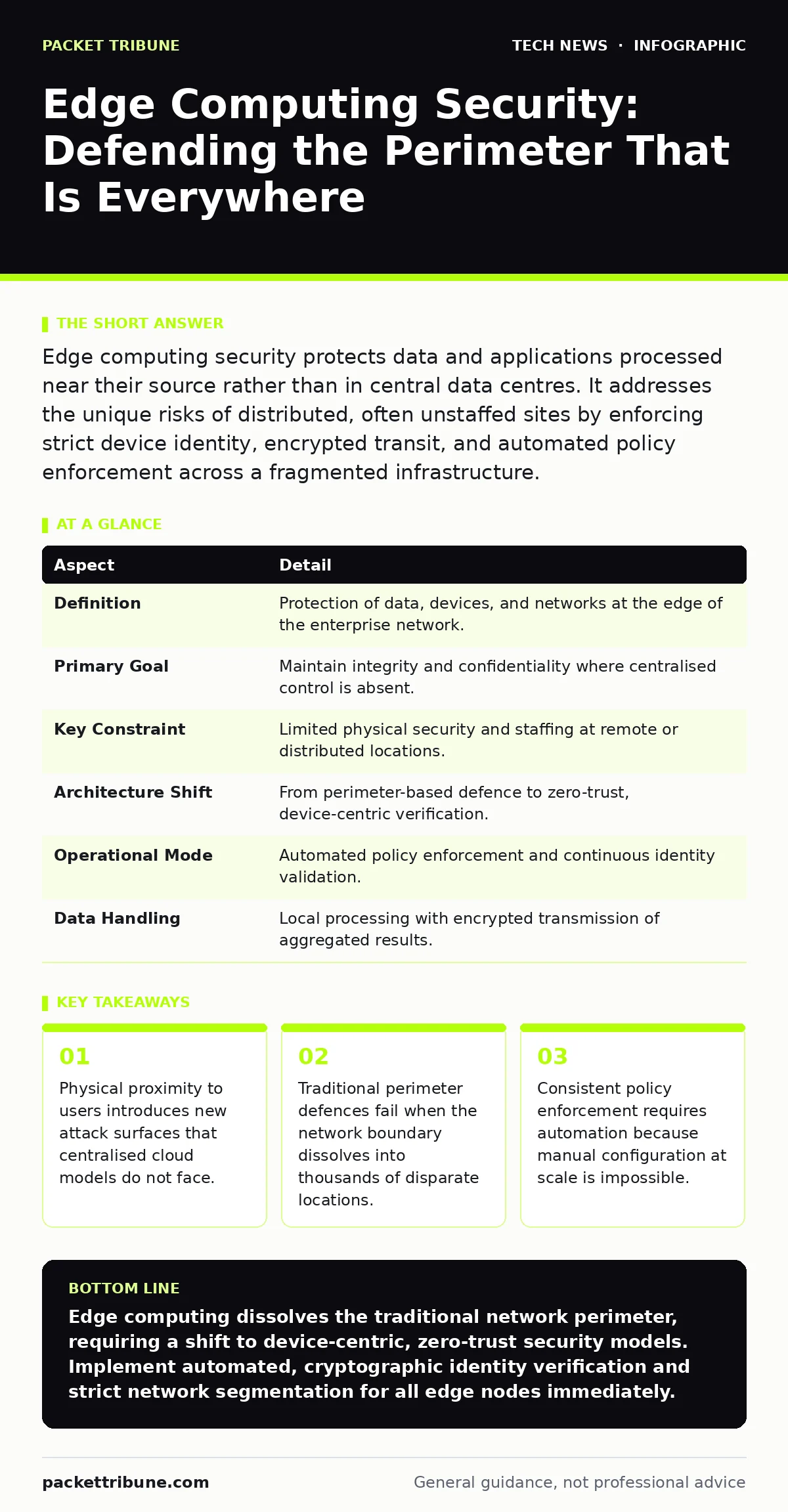
Edge computing security protects data and applications processed near their source rather than in central data centres. It addresses the unique risks of distributed, often unstaffed sites by enforcing strict device identity, encrypted transit, and automated policy enforcement across a fragmented infrastructure.
The Shifting Boundary of Trust
Imagine a factory floor where every sensor sends data to a central server miles away. Now imagine those sensors make decisions locally, only sending summaries to the centre. This shift moves computation from a fortified castle to a scattered village. You gain speed and bandwidth efficiency, but you lose the protective walls of the data centre. The perimeter is no longer a line you can draw on a map. It is a porous membrane that exists wherever your hardware sits.
Security at this scale is not about building higher walls. It is about verifying every entry point individually. When processing happens at the edge, the assumption that the network is hostile becomes the default operating state. You must design systems that function correctly even if an attacker has physical access to the device. This requires a fundamental change in how you architect trust.
| Aspect | Detail |
|---|---|
| Definition | Protection of data, devices, and networks at the edge of the enterprise network. |
| Primary Goal | Maintain integrity and confidentiality where centralised control is absent. |
| Key Constraint | Limited physical security and staffing at remote or distributed locations. |
| Architecture Shift | From perimeter-based defence to zero-trust, device-centric verification. |
| Operational Mode | Automated policy enforcement and continuous identity validation. |
| Data Handling | Local processing with encrypted transmission of aggregated results. |
Why Centralised Models Fail Here
Centralised security relies on the premise that you can control the environment. In a data centre, you control the power, the cooling, and the physical access. At the edge, you often do not. A router in a retail store or a sensor in a warehouse is accessible to anyone who can walk in. Traditional firewalls assume traffic enters through known choke points. Edge computing disperses those choke points into thousands of locations.
This dispersion creates a hidden cost: the complexity of management. You cannot patch a device manually if it is in a remote location. You cannot reset a compromised server if you do not have local staff. The usual advice to "keep software updated" becomes a logistical nightmare when you have devices with intermittent connectivity. You must rely on over-the-air updates that are cryptographically signed and verified. Without this, you are deploying software that could have been tampered with during transit.
The Three Pillars of Edge Defence
Effective edge security rests on three interconnected mechanisms. First, device identity ensures that every device is who it claims to be. This goes beyond simple passwords. It requires cryptographic certificates or hardware-bound keys that cannot be cloned. If a device is lost or stolen, its identity must be revocable instantly.
Second, data encryption protects information both at rest and in transit. Even if an attacker gains physical access, they should not be able to read the data stored on the device. Third, network segmentation limits the blast radius. If one edge node is compromised, the attacker should not be able to move laterally to other nodes or the core network.
These pillars must work together. A strong device identity is useless if the data it sends is unencrypted. Encryption is futile if the network allows unrestricted lateral movement. You must treat the edge as a hostile environment where no single point of failure is acceptable. This approach aligns with the principles of zero trust, where every request is verified regardless of its origin.
Integration with Existing Defences
Edge security does not replace your existing defences; it extends them. You still need strong API key security for the connections between edge devices and the cloud. If an edge device sends data via an API, that key must be rotated regularly and scoped to the minimum necessary permissions. You also rely on TLS certificates to secure the communication channel. These certificates must be managed centrally to prevent certificate pinning issues that can break connectivity during renewal.
Furthermore, edge devices often act as endpoints for remote workers or IoT systems. This means remote work security policies must extend to these devices. If an edge node allows user interaction, the same authentication and monitoring standards apply. The edge is not a separate domain; it is an extension of your network that requires consistent policy application. You must ensure that your post-quantum cryptography readiness plans include edge devices, as their long lifecycle means they may still be in use when quantum computing threats become reality.
What People Usually Get Wrong
Many organisations assume that edge devices are too small to be valuable targets. This is a dangerous misconception. Attackers do not always target the crown jewels directly. They target the edge to create a foothold. A compromised sensor can be used to pivot into the wider network. This is known as lateral movement. By focusing only on the central data centre, you leave the doors at the edge wide open.
Another common error is assuming that physical security is sufficient. Locking a device in a cabinet does not prevent remote exploitation. If the device has a network connection, it can be attacked from anywhere. You must assume that physical security will fail and design your software to resist tampering. This includes using Trusted Platform Modules to measure the boot process. If the device detects that its firmware has been altered, it should refuse to start.
See also: Wifi router security: Stop hidden admin access from leaking data · Email Security Protocols: Mechanics, Gaps and Mitigation
The Operational Reality
Managing edge security requires automation. You cannot manually configure thousands of devices. You need a central management platform that pushes policies and updates automatically. This platform must be able to handle devices that come and go, or that have intermittent connectivity. It must store state locally and sync when possible. This is where secure software development practices become critical. The code running on the edge must be written to handle failures gracefully and securely.
You must also consider the lifecycle of these devices. Edge hardware often has a longer lifespan than typical IT equipment. A sensor might run for five years without intervention. This means you need a plan for long-term support and security patching. If a vulnerability is discovered in the underlying operating system, you must be able to patch it remotely. Without this capability, your devices become liabilities as they age.
Building a Resilient Edge
Resilience at the edge means designing for failure. Devices will be disconnected, tampered with, or lost. Your architecture must allow for these scenarios. Data should be stored locally in an encrypted format. When the device reconnects, it should sync with the central system, verifying the integrity of the data. This ensures that you do not lose critical information during an outage.
You must also monitor for anomalies. Since you cannot watch every device physically, you rely on behavioural analysis. If a sensor starts sending data at an unusual rate or from an unusual location, it should be flagged. This requires sophisticated analytics that can distinguish between normal operational variance and a security breach. By integrating these practices, you create a defence that is adaptive and resilient.
Key takeaways
- Physical proximity to users introduces new attack surfaces that centralised cloud models do not face.
- Traditional perimeter defences fail when the network boundary dissolves into thousands of disparate locations.
- Consistent policy enforcement requires automation because manual configuration at scale is impossible.
Edge computing dissolves the traditional network perimeter, requiring a shift to device-centric, zero-trust security models. Implement automated, cryptographic identity verification and strict network segmentation for all edge nodes immediately.
Frequently asked questions
How does edge security differ from cloud security?
Edge security focuses on protecting distributed, often physically accessible devices with limited management oversight, whereas cloud security relies on the provider’s infrastructure and centralised controls.
Is encryption enough for edge devices?
No, encryption protects data but does not prevent unauthorized access or tampering with the device itself. You also need strong device identity, secure boot processes, and network segmentation.
Can edge devices be patched remotely?
Yes, but this requires robust over-the-air update mechanisms and cryptographic verification to ensure the firmware has not been tampered with during transmission.
What is the biggest risk for edge computing?
The primary risk is the lack of physical security combined with the difficulty of managing thousands of dispersed devices, creating numerous potential entry points for attackers.
How this guide was produced: written by the Packet Tribune editorial team with AI assistance, checked against the public references listed below, and reviewed when the facts change. See our editorial policy or report an error.