Remote work security policy rules that survive real usage
Written rules often fail because they treat home networks like corporate branch offices rather than shared family spaces.

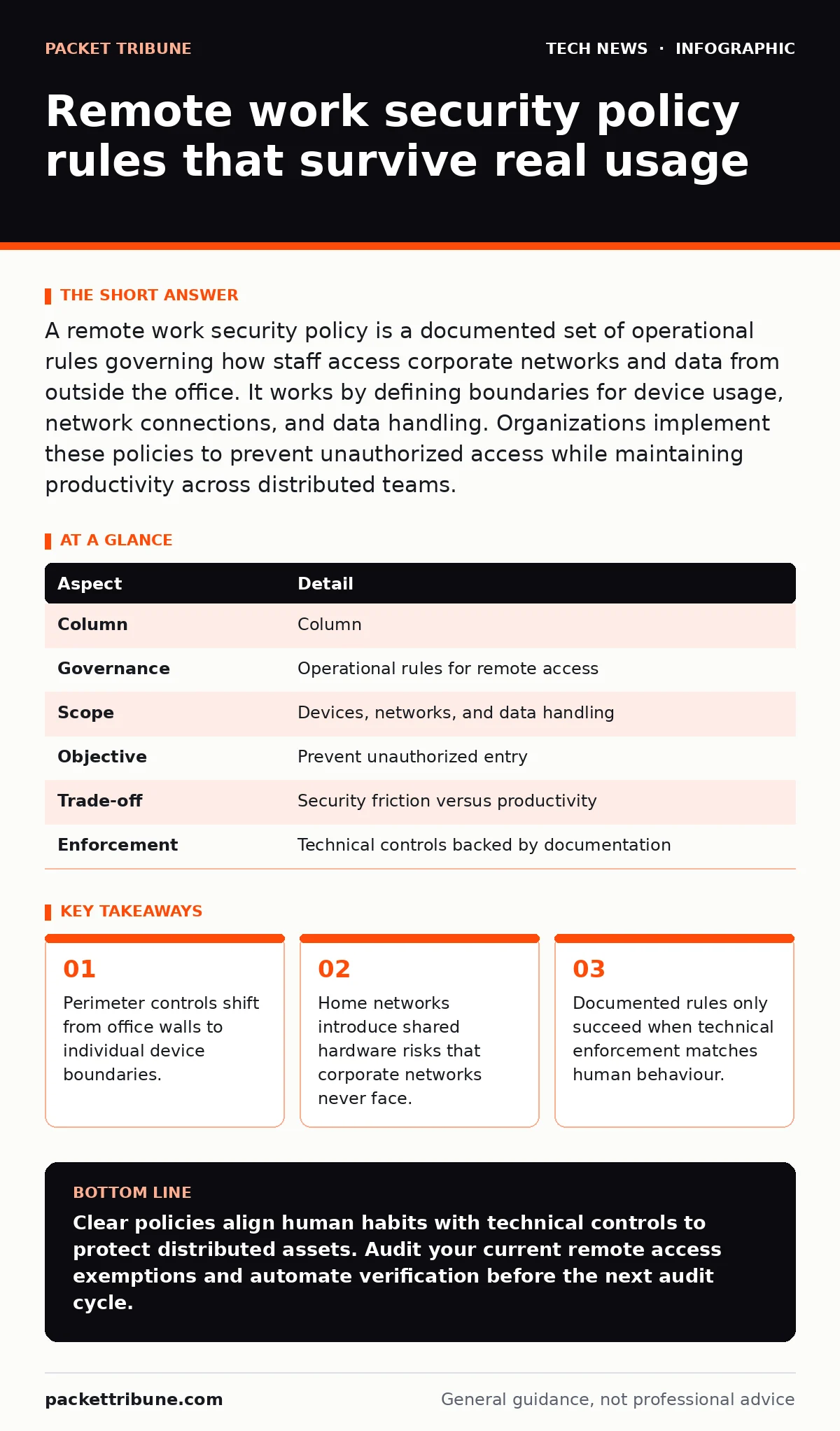
A remote work security policy is a documented set of operational rules governing how staff access corporate networks and data from outside the office. It works by defining boundaries for device usage, network connections, and data handling. Organizations implement these policies to prevent unauthorized access while maintaining productivity across distributed teams.
Understanding remote work security policy
A remote work security policy is a formal governance framework that dictates how employees interact with corporate infrastructure beyond the physical office. Imagine an organization handing out master keys to every employee, yet expecting those keys to only open specific doors inside designated houses. Clear boundaries prevent unauthorized entry without locking legitimate users out of their daily work.
Establishing this framework requires balancing strict access control with operational flexibility. Rigid mandates often encourage staff to bypass security controls entirely in pursuit of efficiency. Technical measures must therefore align with practical workflows to ensure compliance remains higher than friction.
| Aspect | Detail |
|---|---|
| Column | Column |
| Governance | Operational rules for remote access |
| Scope | Devices, networks, and data handling |
| Objective | Prevent unauthorized entry |
| Trade-off | Security friction versus productivity |
| Enforcement | Technical controls backed by documentation |
How distributed boundary enforcement works
Network boundaries dissolve when corporate assets leave physical premises and connect through consumer-grade infrastructure. Traditional firewalls cannot inspect traffic originating from a kitchen table or a public coffee shop. Security architectures must instead rely on cryptographic verification and identity-based access models that treat every connection as untrusted by default.
Traffic protection relies heavily on protocols established during a secure TLS handshake, which negotiates encryption parameters before any data crosses the public internet. Endpoints authenticate themselves using cryptographic certificates rather than simple passwords, ensuring that intercepted communications remain unreadable.
Who the rules affect across the organisation
Remote security policies impact every individual handling corporate data, from software engineers to administrative personnel. Each role requires tailored access privileges based on the principle of least privilege, granting only the permissions necessary to complete specific tasks.
IT administrators face the heaviest burden of maintaining visibility across unmanaged environments without violating personal privacy. Employees bear the responsibility of maintaining physical security for hardware and ensuring household members do not access corporate applications. Leadership teams must approve the operational trade-offs and fund the required technical tooling.
What usually goes wrong with written mandates
Organizations frequently draft rules assuming ideal behaviour, ignoring the messy reality of domestic life and shared hardware. When a policy demands hardware that is physically impossible to secure in a shared apartment, people find workarounds.
Another hidden cost involves performance degradation caused by unnecessary routing of local traffic through corporate gateways. Users respond by disabling security clients entirely, leaving endpoints completely exposed. Effective governance accounts for human error and builds resilient defaults rather than punishing mistakes after the fact.
Implementing technical controls for remote teams
Enforcing policy manually through checklists fails because human memory cannot match the speed of automated threats. Technical controls must automate compliance wherever possible, checking device health before granting access to sensitive repositories.
Hardware-level verification often involves checking the state of Trusted Platform Modules, dedicated cryptoprocessors embedded in motherboards that store cryptographic keys securely. If the hardware state indicates tampering or missing updates, network access is automatically revoked until the device is remediated.
Operating systems manage these processes through operating system kernels, the core software components that control hardware access and isolate running applications from malicious interference. Keeping these components patched prevents local privilege escalation when remote workers visit compromised websites.
See also: Implement Database Security: A Step-by-Step Technical Guide · Prevent Public File Share Exposure With This Technical Checklist
Managing authentication and external access points
Identity verification forms the bedrock of modern remote operations, replacing traditional network perimeters with user-centric validation. When external applications require authentication, systems frequently use OAuth, an open standard for token-based authorization that allows third-party services to access data without exposing user passwords.
Session tokens must expire rapidly and require re-authentication when network characteristics change significantly. Relying solely on static credentials leaves systems vulnerable to interception and replay attacks across untrusted local networks.
Key takeaways
- Perimeter controls shift from office walls to individual device boundaries.
- Home networks introduce shared hardware risks that corporate networks never face.
- Documented rules only succeed when technical enforcement matches human behaviour.
Clear policies align human habits with technical controls to protect distributed assets. Audit your current remote access exemptions and automate verification before the next audit cycle.
Frequently asked questions
What is the primary purpose of a remote work security policy?
It defines acceptable behaviours and technical requirements for accessing corporate assets outside the office.
How do you enforce security rules on personal devices?
Organizations use containerization and device management software to separate personal data from corporate applications without inspecting personal files.
Why do traditional perimeter defences fail for remote workers?
Corporate firewalls cannot protect devices operating on unmanaged home networks and public Wi-Fi connections.
What is the biggest mistake organisations make with remote policies?
They write rules that rely on perfect human compliance rather than building automated technical enforcement.
How this guide was produced: written by the Packet Tribune editorial team with AI assistance, checked against the public references listed below, and reviewed when the facts change. See our editorial policy or report an error.